Indiana’s Unthinkable Triumph: How Mendoza and Cignetti Authored College Football’s Greatest Story
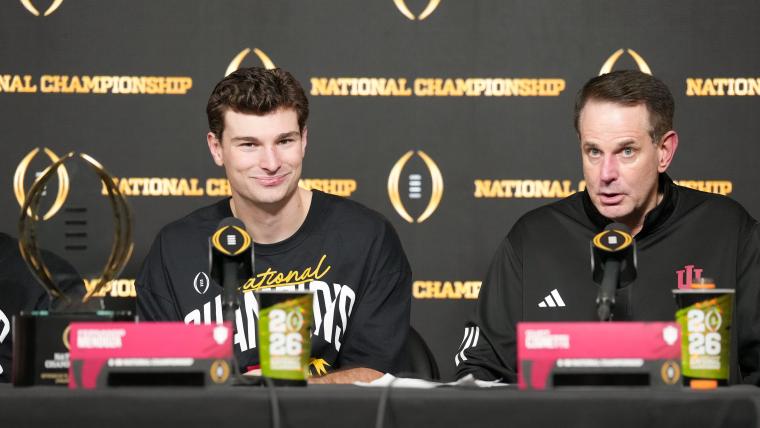
The confetti cannons fired, not in Tuscaloosa, Athens, or Columbus, but in the heart of South Florida. A sea of crimson and cream, a fraction of the size of the orange and green masses that had long since fallen silent, swarmed the Hard Rock Stadium field. In the center of it all, a quarterback from Miami and a coach from the coaching carousel’s periphery embraced, having just completed a journey so improbable it redefines the very concept of an underdog. This is not just the story of the Indiana Hoosiers winning the national championship. This is the story of Fernando Mendoza, Curt Cignetti, and the single greatest narrative college football has ever witnessed.
The Audacity of a Timeout: A Program’s Moment of Truth
Greatness is often born not in the spotlight, but in the shadow of a decision. With 9:27 left in the fourth quarter of the national championship game, leading the mighty No. 10 Miami Hurricanes by a precarious 17-14 margin, Indiana faced a fourth-and-4. The field goal unit trotted onto the field. A make would extend the lead to six, a one-score game. A miss would give Miami prime field position. It was the safe, expected, and logical call for a program of Indiana’s historic stature.
Then, Curt Cignetti called timeout.
In that huddle, history pivoted. As recounted by receiver Charlie Becker, quarterback Fernando Mendoza did not question the play. He declared a new reality. “We need a touchdown and we’re going to score a touchdown,” he stated. Cignetti, the architect, sent his offense back out. The gamble was seismic. It communicated one thing to his team, and to the watching world: Indiana was not there to hope for a win. They were there to take it.
The Run That Shattered Destiny
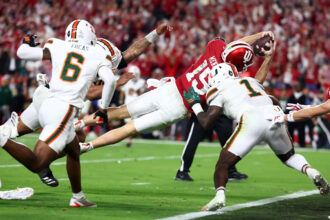
The play call was a designed rollout, a chance for Mendoza to find a receiver or throw it away. Miami’s ferocious pass rush, led by future NFL first-rounder Rueben Bain Jr., closed in. The primary reads were covered. In that heartbeat, Mendoza’s calculus shifted from passer to predator. He let Bain and Akheem Mesidor fly past him, a patient, terrifying hesitation. Then, he turned upfield.
What followed was a 12-yard symphony of chaos and will:
- Elusion: Slipping the initial wave of elite edge rushers.
- Confrontation: A violent, pad-lowering collision with Miami linebacker Wesley Bissainthe at the sticks that should have ended the play.
- Extraction: Twisting, driving, and carrying Bissainthe for three more crucial yards.
First down. The drive lived. But more importantly, a legend was born. That run was not just a conversion; it was the physical manifestation of an entire team’s identity—resourceful, tough, and utterly fearless. It broke Miami’s spirit and set up the game-sealing touchdown that would follow minutes later.
Architect and Assassin: The Symbiosis of Cignetti and Mendoza
This championship was not a fluke; it was the culmination of a perfect, volatile alchemy between coach and quarterback. Curt Cignetti, the son of a coaching legend, had built winners at every stop, from IUP to James Madison, by installing a culture of relentless confidence. He didn’t just believe in his process; he evangelized it. Upon arriving in Bloomington, he didn’t talk about rebuilding. He spoke of championships. The media scoffed. The college football world dismissed it as coachspeak.
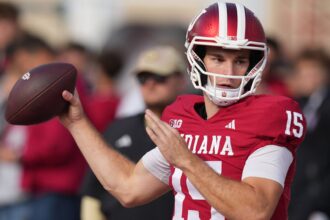
He found his on-field avatar in Fernando Mendoza, a former three-star recruit and Miami native who began the season as a backup. Cerebral, physically rugged, and possessing an intangible moxie, Mendoza was not a Heisman-level talent on paper. But he was the perfect embodiment of Cignetti’s philosophy: unshakable belief, prepared aggression, and a refusal to be defined by history.
Their partnership unlocked a revolutionary truth for Indiana:
- Identity Over Stars: They built a system where the whole was exponentially greater than the sum of its parts.
- Psychological Edge: Cignetti’s bravado freed the players to believe the impossible, and Mendoza’s clutch gene executed it.
- Tactical Fearlessness: The fourth-down timeout was the season in microcosm—a willingness to risk embarrassment for the chance at immortality.
Legacy and the New Blueprint: What This Means for College Football
The seismic ripples of Indiana’s title will be felt far beyond the Hoosier State. It is a paradigm-shifting event for the sport. In an era of super-conferences, NIL collectives, and transfer portal frenzies, Indiana won with a coach who believed in development, a quarterback who was developed, and a culture that was weaponized.
Expert analysis suggests this victory provides a new blueprint for programs outside the traditional aristocracy. It proves that while resources are critical, the most powerful resource is a unified, identity-driven culture led by a visionary coach and empowered by a quarterback who reflects that vision. The transfer portal can now be seen not just as a tool for talent acquisition, but for finding the perfect psychological fit.
Looking ahead, the predictions for Indiana and the college football landscape are fascinating:
- Indiana will immediately become a destination for transfers seeking a proven, culture-first program, accelerating their ability to sustain success.
- Cignetti’s coaching tree will suddenly bear immense fruit, and his methods will be studied and emulated at every level.
- The “Cinderella” concept in major college football is dead. Any Power Four program with the right alignment can now realistically point to Indiana and say, “Why not us?”
An Eternal Echo in Bloomington
They will tell the story for generations in Bloomington. They will talk about the coach who said he would win a national championship and then did it in Year One. They will replay the run—the hesitation, the collision, the extra yards—on a loop at every pre-game hype video forever. The 2024 Indiana Hoosiers did more than win a trophy; they liberated a program and inspired every overlooked team in America.
The greatest stories are those that defy every established plot point. This was a story written by a quarterback who waited for his moment and a coach who seized his. It was written in a timeout huddle and etched into history on a grass field in Miami Gardens. Fernando Mendoza and Curt Cignetti didn’t just complete the greatest college football story ever told. They proved that the next great story can begin anywhere, with anyone brave enough to call the play that changes everything.
Source: Based on news from Yahoo Sports.