Infantino’s ‘Infantile’ Russia Gambit: A Betrayal of Sport or a Pragmatic Play?
The beautiful game is once again mired in the ugly realities of geopolitics. In comments that have ignited a firestorm of condemnation, FIFA President Gianni Infantino has signaled a willingness to lift the ban on Russian national and club teams from international football, a suspension enacted in the wake of the country’s full-scale invasion of Ukraine in February 2022. The reaction from Kyiv was swift and scathing, with Ukraine’s Sports Minister, Vadym Guttsait, branding Infantino’s stance as “irresponsible” and, more damningly, “infantile.” This clash exposes a deep fissure in world sport: between the uncompromising moral stance that sport cannot be neutral in the face of aggression, and a pragmatic, some would say cynical, desire to “keep politics out of football.” Infantino’s reasoning, however, risks not only legitimizing a brutal war but also undermining the very integrity he is sworn to protect.
The Heart of the Controversy: Infantino’s “Frustration and Hatred” Thesis
Speaking at the Council of Europe, Infantino presented a rationale that framed the ban as a failed experiment. “This ban has not achieved anything,” he asserted, arguing it has “just created more frustration and hatred.” He pivoted to an emotional appeal, suggesting that “having girls and boys from Russia being able to play football games in other parts of Europe would help.” On the surface, it’s a plea for unity and the healing power of sport. But this analysis is dangerously simplistic and ignores the foundational context.
The ban was never a tool designed to single-handedly end a war. It was a consequence—a direct response to an act of violent aggression that violates the fundamental principles of international law and the Olympic Charter, which FIFA claims to uphold. It was a statement that Russia’s actions had made its peaceful participation in the global sporting community impossible. To claim it “achieved nothing” is to misunderstand its purpose: it was an act of solidarity and a refusal to provide the Putin regime with a platform for sportswashing. Reversing it while cities like Kharkiv are still being bombed would be a catastrophic moral surrender, telling Ukraine and the world that football’s commercial and competitive interests ultimately trump basic principles of sovereignty and human rights.
The Shadow of the Order of Friendship: A Credibility Crisis
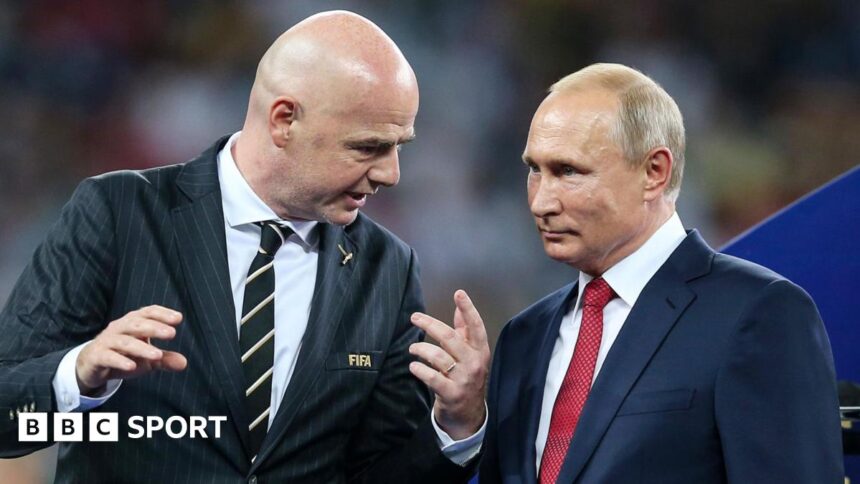
Any analysis of Infantino’s position is incomplete without acknowledging his deeply entangled relationship with the Kremlin. In 2019, following Russia’s hosting of the 2018 World Cup, President Vladimir Putin awarded Gianni Infantino the Russian Order of Friendship medal. This was not a trivial souvenir; it is a state honor bestowed for “special merits in strengthening peace, friendship, cooperation, and mutual understanding between nations.”
This fact hangs over the current controversy like a specter. It creates a glaring perception problem:
- Conflict of Interest: Can a recipient of one of the Russian state’s highest honors be seen as an impartial arbiter on its readmission to world sport?
- Leverage and Loyalty: The award symbolizes a relationship of mutual benefit—a successful World Cup for Infantino’s FIFA and global prestige for Putin’s Russia. Is there an unspoken debt?
- Erosion of Trust: For Ukrainian athletes and millions worldwide, this connection fatally undermines Infantino’s moral authority on the issue. It lends credence to the view that his “pragmatism” is, in fact, a favor to an old patron.
This backdrop transforms his “frustration and hatred” argument from a naive miscalculation into a move viewed with profound suspicion.
Expert Analysis: The Faulty Logic and Dangerous Precedent
Sports governance experts and ethicists are largely united in their criticism of Infantino’s framing. The idea that reintroducing Russian teams would dampen “frustration and hatred” is not only unproven but likely backwards. Matches involving Russian teams would become instant flashpoints, politicized arenas for protest, and potential security nightmares. The “boys and girls” narrative is equally flawed; Russian youth footballers are not banned from all football—they are banned from representing a nation that is currently waging war. The two are inextricably linked under current FIFA statutes.
Furthermore, lifting the ban would:
- Invalidate the Stance of UEFA and Other Federations: UEFA has maintained its ban consistently. A FIFA reversal would create a schism at the heart of European football.
- Punish Ukrainian Athletes: It would force Ukrainian teams and athletes to compete against representatives of a nation actively trying to destroy their homeland, an unimaginable psychological burden.
- Establish a Catastrophic Precedent: It would signal to authoritarian regimes globally that even prolonged, unprovoked aggression incurs only temporary sporting consequences, effectively neutering sport’s most powerful tool of ethical sanction.
Predictions: The Rocky Road Ahead and Potential Outcomes
Infantino’s comments are a trial balloon, but it is already leaking air rapidly. The backlash has been severe and will shape what happens next.
Scenario 1: The Full Retreat (Most Likely). Faced with unified condemnation from Ukraine, likely boycotts from numerous European federations, and sponsor unease, FIFA will quietly let the idea die. The ban will remain until there is a fundamental change in the geopolitical situation, likely a certified and lasting peace. Infantino will claim his words were “misinterpreted” or part of a broader, hypothetical discussion on reconciliation.
Scenario 2: The Phased, Face-Saving Return (Possible, but Explosive). FIFA might attempt a compromise, such as allowing Russian teams back under a neutral flag and anthem, and only in youth or women’s categories initially. This would be marketed as a “humanitarian” gesture. However, this would still be met with fierce resistance and boycotts, making it a logistical and reputational minefield.
Scenario 3: The Defiant Push (Least Likely). Infantino could use his executive power to force a vote or enact a return. This would be an act of immense hubris, risking the fragmentation of FIFA itself, major legal challenges, and a sponsor exodus. The “infantile” label would stick permanently.
Conclusion: Sport’s Soul in the Balance
Gianni Infantino’s flirtation with rehabilitating Russian football is more than a diplomatic misstep; it is a profound misreading of the moment. By dismissing a principled stand as mere “frustration,” and by prioritizing a vague concept of inclusion over concrete justice, he threatens to empty sport of its moral compass. The suspension of Russian teams was a rare moment of clarity for sports governance—a recognition that some actions are so egregious they place a nation beyond the pale of civilized international competition.
To lift the ban now would not be an act of peacemaking; it would be an act of appeasement. It would tell Ukraine that its suffering is an inconvenience to FIFA’s calendar. It would tell Putin that his war crimes can be waited out. And it would tell the world that the Russian Order of Friendship medal around Infantino’s neck weighs heavier than the solidarity owed to a nation fighting for its existence. The beautiful game has often been a refuge from the world’s conflicts. But sometimes, it must have the courage to take a stand. This is one of those times. The ban must stay. To do otherwise would indeed be the height of infantilism.
Source: Based on news from BBC Sport.