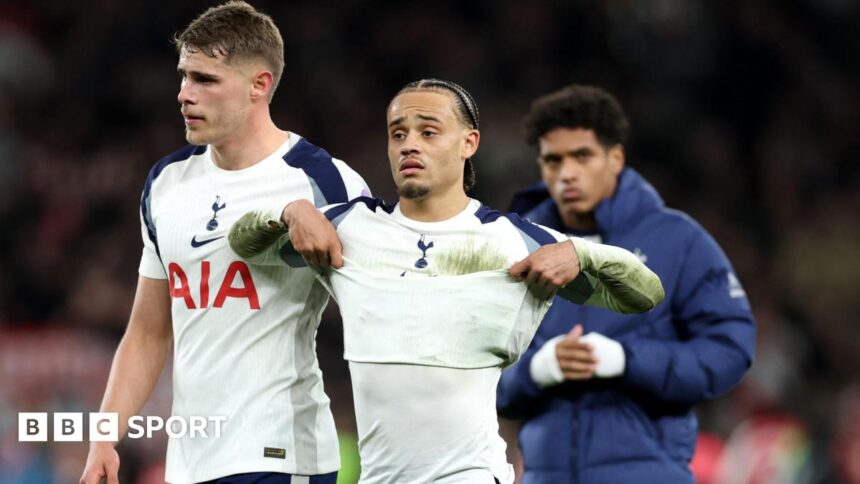
It Would Be Catastrophic: Are Tottenham Hotspur Too Big to Go Down?
The final whistle at the Tottenham Hotspur Stadium on Sunday didn’t just signal another Arsenal victory. It felt like a piercing alarm, a stark, undeniable confirmation of a crisis that has been simmering for months. A 4-1 home demolition in the North London derby didn’t just hurt pride; it placed Spurs in a position unthinkable at the season’s start: perilously perched just four points above the Premier League relegation zone. The question, once a hyperbolic fan’s nightmare, is now being asked in serious, hushed tones across the football world: Are Tottenham Hotspur too big to go down?
A Descent From Grace: The Unraveling of a Giant
Tottenham’s current predicament is not a sudden collapse but a slow, agonizing unraveling. The statistics paint a picture of a club in freefall. They have not won a domestic league game in 2026, a drought stretching over two months. Their last victory came on 26 October 2025. Since that distant point, they have managed a mere two league wins. This form is not just bad; it is relegation-grade. Only bottom-club Wolverhampton Wanderers have a worse recent record than 16th-placed Spurs.
The issues are systemic, a perfect storm of failing components:
- A Fractured Defensive Unit: Once a relative strength, the Spurs backline is now a source of constant panic. A lack of leadership, individual errors, and a disorganized structure have seen them concede cheap, demoralizing goals.
- Midfield Imbalance: The engine room lacks both steel and creativity. They are easily bypassed and offer little protection or progression, leaving a gaping chasm between defense and attack.
- Managerial Instability: Igor Tudor arrived with a reputation for intensity, but his methods appear to have confused rather than galvanized. The team looks devoid of identity or clear tactical plan, a group of individuals rather than a cohesive unit.
- A Crisis of Confidence: You can see it in the players’ body language. Every mistake is compounded, every setback feels inevitable. The belief that once fueled comebacks has evaporated.
The “Too Big to Fail” Fallacy in Football
The notion that a club’s size, history, or revenue inoculates it from relegation is a dangerous myth. Football history is littered with cautionary tales. Newcastle United, a club with a massive, passionate support and global brand, were relegated in 2009 and again in 2016. Aston Villa, European Cup winners, went down in 2016. In Germany, Hamburg SV’s historic status didn’t prevent their first-ever relegation. No club is immune.
For Spurs, the “catastrophe” extends far beyond the sporting shame. The financial ramifications of dropping out of the Premier League’s riches would be seismic.
- Broadcasting Revenue Collapse: The loss of Premier League TV money, estimated to be over £100m per season, would create an immediate and enormous financial black hole.
- Stadium Debt Strain: The magnificent 62,850-seater stadium, the crown jewel of the club’s modern era, was built on the financial model of consistent Champions League or, at minimum, Premier League football. Servicing that debt in the Championship is a terrifying prospect.
- Commercial Exodus: Major sponsors pay for Premier League exposure. Relegation clauses would trigger, and renewals would be at a fraction of the cost.
- Player Exodus & Wage Bill: A fire sale of top talent would be inevitable, yet the club could be left saddled with high-earning players unwilling or unable to move, creating a suffocating wage-to-revenue ratio.
The sporting project would be set back a decade. The gap to the elite they once chased would become a chasm.
The Run-In: Navigating a Minefield
Survival is still in Spurs’ hands, but their fixture list offers little comfort. The lack of winning momentum is their biggest enemy. Every match becomes a high-pressure event, a cup final against teams fighting for their lives or with points to prove.
The psychological burden on the players will be immense. Can a squad that folded against Arsenal show the fight required in a relegation six-pointer? The leadership vacuum is glaring. Who in this team drags them through a gritty, ugly 1-0 win? These are questions not asked of Tottenham Hotspur for a generation.
Manager Igor Tudor faces the ultimate test of his career. He must simplify his message, organize his defense, and find a way to scrape points. It is no longer about style; it is about survival, about grinding out results with a resilience this team has not shown all season.
Verdict: A Catastrophe Averted or Realized?
So, are they too big to go down? The answer is a resounding no. Their size doesn’t grant them extra points. What it does provide is resources and, theoretically, a quality of player that should be more than enough to secure safety. But that theory is currently being shredded by a harsh reality.
The prediction here is that Spurs will, by the barest of margins, avoid the unthinkable. Their squad, on paper, should find just enough moments of quality to pick up crucial points. The sheer financial catastrophe of relegation might finally spark a reaction from the board and the playing staff that has been absent all season.
But this is no longer a guarantee. It is a desperate, week-to-week struggle. The Tottenham Hotspur of 2026 is not too big to go down; it is a club in a full-blown identity crisis, flirting with a disaster that would redefine its future. The warning signs have been ignored for too long. The derby defeat was not the cause of the crisis; it was the loudest and clearest symptom yet. The work to avoid a catastrophic relegation starts now, not with grand plans for Europe, but with the basic, gritty fundamentals of football. The clock is ticking, and history shows it waits for no one, not even the giants.
Source: Based on news from BBC Sport.