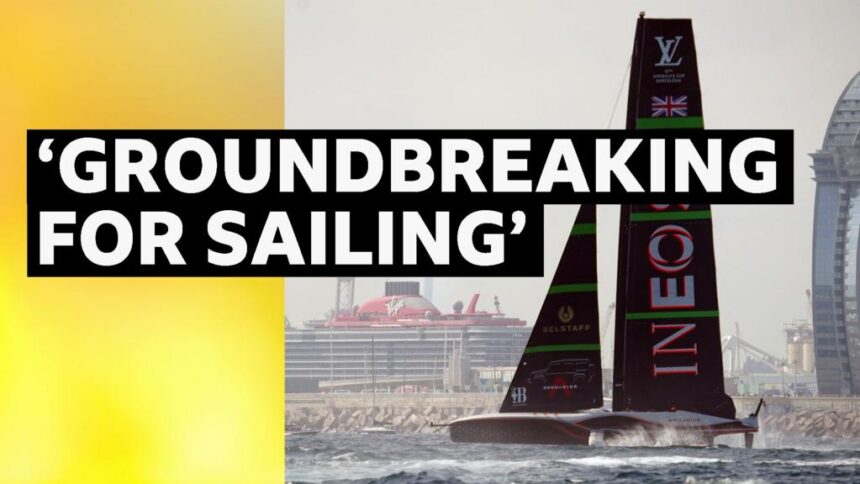
‘It’s a Fascinating Time’: Inside Ben Ainslie’s Vision for the America’s Cup Alliance
The America’s Cup, sailing’s oldest and most prestigious trophy, has long been a theatre of technological one-upmanship and fiercely guarded secrecy. Historically, the period between cycles is marked by a deafening silence from syndicates, each retreating to their design bunkers to plot in isolation. That era, according to Sir Ben Ainslie, is decisively over. In a groundbreaking move, the five founding teams of the next America’s Cup have formed an unprecedented alliance, a strategic partnership that the British sailing legend believes will fundamentally “revamp and commercialise” the event for a new generation.
Breaking the Mold: From Solo Silos to a Strategic Consortium
For over 170 years, the America’s Cup has been defined by its cutthroat, winner-takes-all ethos. The new alliance, comprising INEOS Britannia (Athena Racing), Emirates Team New Zealand, Luna Rossa Prada Pirelli, Alinghi Red Bull Racing, and Orient Express Racing Team, represents a seismic philosophical shift. This is not a sporting merger, but a commercial and operational coalition aimed at securing the event’s long-term viability and broadening its appeal.
Sir Ben Ainslie, the driving force behind Britain’s INEOS Britannia challenge, frames this collaboration as a necessary evolution. “It’s a fascinating time,” he states, highlighting the collective recognition that for the Cup to thrive, it must evolve beyond its traditional, insular model. The alliance will focus on key shared objectives:
- Commercial Growth: Unifying to attract major global sponsors and broadcasters by presenting a more stable, cohesive product.
- Cost Management: Collaborating on aspects of boat design and logistics to curb the astronomical, escalating costs of competition.
- Fan Engagement: Actively working to make the racing more accessible and understandable for a global television and live audience.
- Event Stability: Creating a consistent framework and calendar beyond the whim of a single defender, ensuring long-term planning for teams and partners.
Commercialising the “F1 of the Seas” Without Losing Its Soul
The comparison to Formula 1 is inevitable and intentional. Like F1, the America’s Cup is a pinnacle of engineering and athleticism, but its commercial reach has been fragmented. Each team historically negotiated its own broadcast and sponsorship deals, leading to a disjointed fan experience. The new alliance seeks to change that by potentially centralising certain commercial rights and creating a unified narrative.
This commercial focus is not about diluting the competition, Ainslie insists, but about fueling it. The financial arms race has threatened to shrink the field to only the wealthiest billionaires and corporations. By creating a more sustainable economic model, the alliance aims to make the Cup more attractive to a wider pool of competitive teams, thereby strengthening the racing itself. The success of SailGP—where Ainslie’s team recently clinched the Season 4 title in Abu Dhabi—has demonstrated the appetite for fast-paced, simplified fleet racing with a clear commercial structure. The America’s Cup alliance appears to be learning from that playbook, aiming to marry the Cup’s historic grandeur with modern sports marketing savvy.
The Spectator’s Cup: Ainslie’s Promise of a Better Show
Beyond the boardroom, Ainslie is emphatic that this partnership will directly benefit the supporter. “Making the competition a better event for supporters to watch” is a central pillar. For the average fan, the complexities of the AC75 foiling monohulls and the nuances of match-racing tactics can be barriers to entry.
The alliance teams are now incentivised to work together on presentation. We can anticipate significant advancements in:
- Broadcast Technology: Shared investment in augmented reality graphics, on-board audio, and data visualisation to explain strategy and speed in real-time.
- Racing Format: Collaborative development of pre-Cup events and a race schedule designed for maximum drama and viewer convenience.
- Digital Access: A potential centralised digital platform for content, behind-the-scenes footage, and athlete storytelling, building narratives beyond just the on-water action.
The goal is to amplify the human and sporting drama that has always been present, but often obscured by technical mystery. By collectively lifting the veil—just enough—the alliance can transform casual viewers into invested fans.
Predictions and Perils: Navigating Uncharted Waters
This bold experiment is not without its risks. The core tension lies in balancing cooperation with competition. How much design and developmental information can truly be shared before it undermines the competitive imperative to be faster and smarter than your rival? The alliance will likely focus collaboration on “non-performance” areas like logistics, safety protocols, and broadcast hardware, while the race for aerodynamic and hydrodynamic supremacy remains fiercely private.
Furthermore, the inclusion of the defender, Emirates Team New Zealand, in this group is particularly noteworthy. It signals a move away from the traditional, often adversarial defender-challenger dynamic towards a more league-style governance. The long-term prediction is a more stable, predictable America’s Cup cycle, with teams locked in earlier and a clearer roadmap for commercial partners.
The most immediate impact will be seen in the lead-up to the 37th Cup in Barcelona. We can expect a series of unified pre-regattas with enhanced production values, acting as a powerful marketing engine to build momentum. The success of this model, however, will ultimately be judged on two metrics: whether it attracts a new, lasting wave of global sponsorship and whether the on-water racing in Barcelona is the most intensely watched and widely celebrated in the event’s history.
Conclusion: A Historic Tack for a Historic Trophy
Sir Ben Ainslie’s vision, shared by his fellow founding teams, is nothing short of a cultural reset for the America’s Cup. This alliance is a pragmatic acknowledgment that for the sport to survive in the modern age, it must adapt. It seeks to protect the Cup’s essence—the innovation, the national rivalry, the sheer human endeavor—by building a stronger commercial and promotional foundation around it.
The journey from a secretive, scattergun approach to a unified, fan-centric enterprise is complex. Yet, if successful, this alliance could ensure that the America’s Cup is not just a relic of maritime history, but a dynamic, thriving spectacle for the 21st century. As Ainslie suggests, it is indeed a fascinating time. The most fascinating chapter, where this unprecedented alliance is tested against the timeless hunger to win, is still to be written on the waters off Barcelona.
Source: Based on news from BBC Sport.