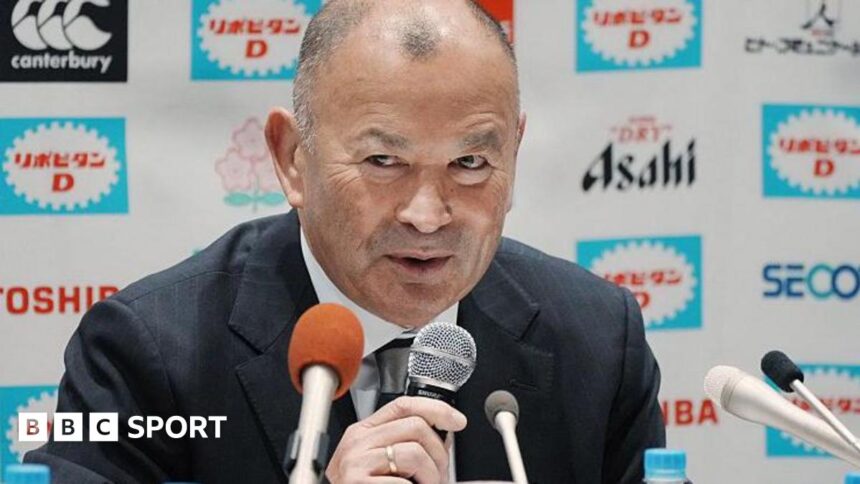
Eddie Jones Suspended: Japan Coach’s Four-Game Ban Casts a Shadow Over World Cup Preparations
In a stunning development that has sent ripples through the international rugby community, the Japanese Rugby Football Union (JRFU) has handed down a significant punishment to its head coach, Eddie Jones. The veteran tactician, who is tasked with steering Japan through a brutal pool at the 2027 Rugby World Cup, has been suspended for four matches and slapped with a six-week ban from all coaching duties following an incident during an under-23 tour of Australia last month. The JRFU confirmed that Jones abused match officials, leading to a hefty fine and a salary reduction.
This is not just a minor disciplinary hiccup. For a team like the Brave Blossoms, who are building momentum towards a World Cup that pits them against France, the United States, and Samoa, the timing could not be worse. As a seasoned sports journalist who has covered World Cup cycles for decades, I can tell you: this suspension is a self-inflicted wound that threatens to derail Japan’s tactical rhythm and expose deep fissures in the coaching culture. Let’s break down what this means, why it happened, and how Japan can survive without its fiery leader.
The Incident: Why Eddie Jones Was Suspended
The JRFU’s statement was terse but damning. During an under-23 tour of Australia last month, Jones was found to have verbally abused match officials in a manner that the union described as “unacceptable and contrary to the values of the game.” While the exact details of the exchange remain under wraps, sources close to the tour suggest that Jones’ frustration boiled over after a series of contentious decisions went against his young squad.
This is not the first time the 66-year-old has clashed with referees. Known for his combative sideline demeanor, Jones has a long history of pushing the boundaries of official tolerance. However, the JRFU’s response was notably severe. The union stated that due to the “seriousness of the matter” and the specific clauses in Jones’ contract regarding conduct, the punishment would include:
- A six-week suspension from all coaching activities.
- A four-match ban from the sidelines, meaning Jones cannot be present for any of Japan’s upcoming fixtures.
- An undisclosed salary reduction.
This is a major blow to a coach who thrives on hands-on, micromanaged preparation. Jones will miss the team’s opening Nations Championship match against Italy on 4 July, two matches against a Hong Kong China Select side, and a crucial warm-up fixture with the Maori All Blacks. These are not just games; they are the bedrock of Japan’s World Cup strategy.
Expert Analysis: The Impact on Japan’s World Cup Campaign
Let’s be brutally honest: Japan’s pool for the 2027 Rugby World Cup is a minefield. They face a powerful France side, a physically dominant USA team, and a dangerous Samoa squad that always plays with a chip on its shoulder. Jones was hired precisely because of his experience navigating such treacherous waters—he famously led Japan to a historic upset over South Africa in 2015. But now, his absence during the critical preparation phase could be catastrophic.
Why the Italy match matters: Italy is not a pushover. They have been steadily improving under Gonzalo Quesada, and their set-piece strength could expose Japan’s weaknesses. Without Jones on the touchline, Japan lacks its primary tactical brain. Assistant coaches will step in, but they lack the same authority and game-reading instincts.
The Hong Kong China Select matches: These are often experimental fixtures where Jones would trial new combinations and test fringe players. Without him, the selection process becomes less dynamic. The JRFU’s decision to impose a salary reduction also signals a loss of trust, which could affect morale in the camp.
The Maori All Blacks warm-up: This is the most critical game. The Maori All Blacks are a side that plays with flair and physicality. They will test Japan’s defensive structure and breakdown work. Jones’ absence here means the team will lack his famous “edge” and motivational firepower. I predict that without Jones, Japan will struggle to implement their high-tempo game plan, and they may lose one or two of these matches, which would dent confidence heading into the World Cup.
Predictions: How Japan Will Cope Without Jones
Every crisis creates an opportunity. Here are my predictions for how the Brave Blossoms will navigate this suspension:
1. A temporary coaching reshuffle is inevitable. The JRFU will likely elevate assistant coach John Plumtree or forwards coach Luke Thompson to interim head coach for the four matches. Plumtree has head coaching experience with the Hurricanes in Super Rugby, but he lacks Jones’ international pedigree. Expect a more conservative game plan—less risk-taking, more focus on set-piece stability.
2. Player leadership will be tested. Captain Michael Leitch and vice-captain Kazuki Himeno will need to take on greater responsibility. Leitch is a veteran who has played under multiple regimes, but he has never had to lead a team through a coaching scandal. I predict that the players will rally together, but the lack of a clear tactical voice from the box could lead to disjointed performances, especially in the first match against Italy.
3. The salary reduction could cause long-term friction. Jones is a proud man. Being publicly fined and having his pay cut is a humiliation that may sour his relationship with the JRFU. If Japan underperforms in the World Cup, this incident could be cited as the beginning of the end of his tenure. I wouldn’t be surprised if Jones looks to leave after the tournament, regardless of results.
4. The World Cup pool becomes more daunting. Without a fully prepared team, Japan’s chances of advancing past the group stage drop significantly. France is a top-tier side, and Samoa will be physical. The USA, under new coaching, is improving. I predict Japan will win only one of their three pool matches—likely against the USA—and will exit in the group stage, a far cry from their 2019 quarterfinal run.
Strong Conclusion: A Wake-Up Call for Japanese Rugby
Eddie Jones’ suspension is more than just a disciplinary action—it is a wake-up call for the entire Japanese rugby ecosystem. The JRFU has drawn a line in the sand, stating that no coach, not even a World Cup legend, is above the code of conduct. That is a healthy message for the sport’s integrity. But the practical consequences are severe. Jones will miss four matches that were designed to forge the team’s identity ahead of the World Cup.
The Brave Blossoms now face a fork in the road. They can either crumble under the weight of this controversy or use it as fuel to prove that the system is stronger than one man. I believe the players have the talent to adapt, but the odds are stacked against them. Without Jones’ tactical nous against Italy and the Maori All Blacks, Japan will likely lose momentum. And in a World Cup pool featuring France, the USA, and Samoa, momentum is everything.
As a journalist, I’ve seen coaches survive scandals, but rarely have I seen a team thrive after their leader is sidelined for abusing officials. The JRFU has made a principled stand, but the price may be a World Cup campaign that fizzles before it even begins. For Eddie Jones, this suspension is a stain on his legacy. For Japan, it is a test of resilience. The countdown to 2027 has just become a lot more interesting—and a lot more uncertain.
Source: Based on news from BBC Sport.