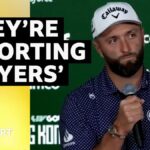
Jon Rahm Accuses DP World Tour of ‘Extorting Players’ in Fiery LIV Golf Fallout
The simmering tension between golf’s established tours and the lucrative LIV Golf circuit erupted into a fresh public feud this week, with former world No. 1 Jon Rahm launching a blistering verbal assault on the DP World Tour. In a candid explanation for his absence from a list of LIV players seeking reinstatement, Rahm didn’t mince words, accusing the European-based tour of extorting players through punitive financial and competitive demands. This explosive accusation lays bare the deepening rift and complex power struggle fracturing the professional game.
The Waiver List and Rahm’s Conspicuous Absence
On Tuesday, it was revealed that eight LIV Golf players—Laurie Canter, Thomas Detry, Tyrrell Hatton, Tom McKibbin, Adrian Meronk, Victor Perez, David Puig, and Elvis Smylie—had signed waivers to regain eligibility for DP World Tour events. This agreement came with significant strings attached: dropping all pending legal appeals, paying any outstanding fines levied for playing in LIV events without permission, and committing to a minimum tournament requirement on the DP World Tour schedule.
Jon Rahm, the Masters champion and the most high-profile European to defect to LIV, was notably absent from that list. When pressed, the Spaniard delivered a fiery rationale, framing the tour’s conditions not as reconciliation but as coercion. “It just seems like in a way they’re using us to capitalize on our impact in tournaments and fining us and trying to benefit both ways from what we have to offer,” Rahm stated. “And it’s just in a way they’re extorting players like myself and young players that have nothing to do with the politics of the game.”
Breaking Down the “Extortion”: Fines and Forced Appearances
Rahm’s accusation hinges on two specific demands from the DP World Tour, which he views as punitive and exploitative.
- Substantial Financial Penalties: Rahm confirmed he faces a fine reportedly between $2 million and $3 million for his move to LIV Golf. From the tour’s perspective, this is a pre-contracted penalty for violating its membership regulations. For Rahm, it’s a cash grab, a fee to be paid before any discussion of returning can begin.
- The Six-Event Mandate: More grating to the competitive spirit of a top player is the mandated playing requirement. Rahm revealed the tour would require him to enter six of its events, with the tour itself selecting two of those tournaments. “They are forcing me to play in certain events,” he argued, suggesting this was a cynical ploy to leverage his star power to boost the profile and commercial success of specific events, regardless of his own schedule or preparation needs.
This combination—a multi-million dollar buy-in plus a dictated schedule—is what Rahm labels as extortion. He perceives it as the tour seeking to profit from his departure (via the fine) while also capitalizing on his return (via mandatory appearances), all while he remains contractually committed to LIV Golf’s own 14-event schedule.
Expert Analysis: A Battle for Leverage and Legitimacy
This standoff is more than a simple contract dispute; it’s a strategic battle for leverage. The DP World Tour, sanctioned as the main pathway to the PGA Tour and major championships outside North America, is walking a tightrope. It must enforce its rules to maintain its operational integrity and its strategic alliance with the PGA Tour, or risk appearing weak and losing more players. The fines and reinstatement conditions are its tools for maintaining order.
However, from Rahm’s viewpoint, the dynamics have fundamentally shifted. LIV Golf players, particularly stars of his caliber, no longer see the DP World Tour as an essential competitive or financial lifeline. Their lucrative, guaranteed contracts with LIV have changed the calculus. The tour’s sanctions, therefore, feel less like a governing body upholding rules and more like a rival entity trying to tax and control a competitor’s assets—the players themselves.
The mandated appearances are particularly telling. They reveal the tour’s acute awareness of its diminished fields and need for star power. By compelling Rahm to play two events of its choosing, the tour is essentially leveraging Rahm’s market value to satisfy its own sponsors and broadcast partners. This commercial reality underpins Rahm’s feeling of being used as a pawn.
Predictions: Escalation, Isolation, or an Unlikely Truce?
Where does this bitter war of words lead? Several paths are possible, each with significant implications for the future of the European game.
- Deepened Rift and Player Solidarity: Rahm’s powerful language may embolden other top LIV players, both European and international, to reject similar terms. This could create a permanent class of golfing exiles from the DP World Tour, further diluting its product and pushing it further into the role of a feeder tour.
- The Major Championship Wildcard: The looming question is how this affects major championships. The Masters, PGA Championship, and The Open have all granted exemptions to LIV players based on past victories. However, if the rift with the DP World Tour deepens, it could influence future qualification criteria, potentially squeezing non-exempt LIV players. Rahm, as a Masters champion for life, is insulated, but others are not.
- Pressure for a “World Tour” Compromise: The unsustainable nature of the current split may eventually force a truce. Rahm’s outburst highlights the absurdity of the situation for players caught in the middle. The most logical, yet most complex, solution remains a negotiated framework between the PGA Tour, DP World Tour, and LIV’s financiers to allow top-tier global golf to resume with all the best players. Rahm’s comments are a symptom of the disease; a real cure requires leadership currently in short supply.
Conclusion: The Human Cost of Golf’s Civil War
Jon Rahm’s accusation of extortion is a watershed moment. It moves the golf “war” from boardrooms and courtrooms into the raw, emotional territory of personal grievance and perceived injustice. It is no longer just about antitrust lawsuits or strategic alliances; it’s about a premier athlete feeling strong-armed and exploited by an institution he once represented.
Regardless of where sympathies lie, Rahm’s fiery comments expose the central, painful contradiction of this era: players are treated as independent contractors until they seek independence, at which point the machinery of fines, bans, and mandates engages. The DP World Tour is fighting for its survival, but its tactics, as described by one of its greatest modern champions, risk alienating the very talent it needs to survive. The fallout from this week confirms that in golf’s bitter civil war, the players are not just combatants—they are the terrain over which the battle is being fought, and they are growing weary of the crossfire.
Source: Based on news from Deadspin.
Image: CC licensed via commons.wikimedia.org