Jose Mourinho Sparks Outrage by Suggesting Vinicius Jr ‘Incited’ Racism Row
The beautiful game was once again marred by an ugly specter in Lisbon this week, but the post-match narrative took a shocking and controversial turn. Following Real Madrid’s tense Champions League victory over Benfica, a familiar figure found himself at the center of a firestorm not for his tactics, but for his words. Jose Mourinho, the iconic and often incendiary manager, faces severe backlash after appearing to suggest that Vinicius Jr’s goal celebration provoked the racist abuse that halted the match, drawing immediate condemnation from legends like Clarence Seedorf and reigniting a critical debate about victim-blaming in football.
The Incident: Celebration, Allegation, and an 11-Minute Pause
The flashpoint occurred in the second half at the Estadio da Luz. Vinicius Jr, Real Madrid’s brilliant Brazilian winger, broke the deadlock with a moment of sublime skill, curling a stunning strike into the net. His subsequent celebration—a joyful dance by the corner flag in front of the home supporters—was pure, unadulterated Vini Jr. It was also deemed an “excessive celebration” by the referee, who promptly showed him a yellow card.
However, the situation escalated far beyond a simple booking. As players regrouped for the restart, Vinicius was seen in a heated exchange with Benfica’s young Argentine winger, Gianluca Prestianni. Vinicius immediately reported an alleged racist remark to the referee. What followed was a stark reminder of football’s ongoing battle:
- The match official activated FIFA’s three-step protocol for racist abuse, leading to a stadium announcement condemning the behavior.
- Play was suspended for 11 minutes as tensions simmered on the pitch and in the stands.
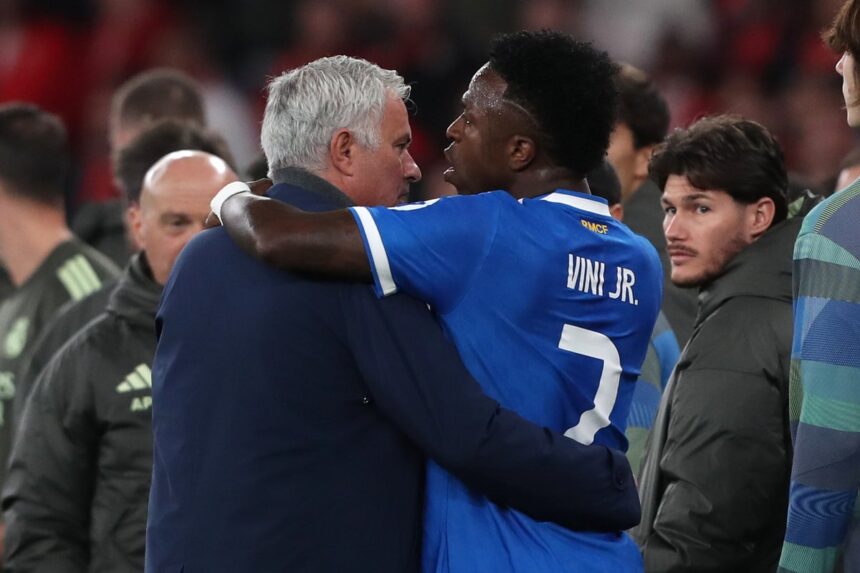
- Mourinho, working as a pundit, was captured on camera pitchside, in intense discussions with Madrid players including Vinicius and Kylian Mbappe.
In the aftermath, Prestianni denied the accusation on Instagram, stating Vinicius had “regrettably misunderstood.” But the damage was done, and the scene was set for a commentary controversy that would overshadow the result.
Mourinho’s Controversial Take and the Swift Backlash
In his post-match analysis, Mourinho dissected the incident with a perspective that many found deeply troubling. While condemning racism, he framed Vinicius’s celebration as a catalyst. “The celebration… it’s not the first time he’s done it,” Mourinho stated. “It’s a celebration that can provoke a reaction. We cannot justify the reaction, but we have to be honest and say that the player sometimes incites it.”
The implication was clear: the player’s behavior shares blame for the abuse he receives. This argument, often used to police the expression of Black players, was swiftly and powerfully dismantled.
Clarence Seedorf, the former Dutch and Real Madrid midfielder, was unequivocal in his rebuttal. “We cannot, in any way, justify or find excuses for racism,” Seedorf stated. “To suggest a player incites racism with his joy, with his culture, is to completely miss the point and shift blame to the victim. The problem lies solely with the perpetrators and a society that allows it.” Seedorf’s condemnation echoed the sentiment of fans, anti-racism organizations, and fellow pundits who saw Mourinho’s comments as a dangerous normalization of abuse.
The core issue here is the normalization of victim-blaming. By focusing on Vinicius’s “provocative” dance, the narrative dangerously drifts from the criminal act of racism to a debate about the victim’s etiquette. It suggests there is a “correct” way for a Black player to behave to avoid abuse—a notion that is fundamentally racist itself.
Expert Analysis: A Pattern of Provocation and a Flawed Narrative
Mourinho’s history is punctuated by psychological warfare and mind games, often using the media as a weapon. Analysts see this latest incident as a potential extension of that tactic, perhaps aimed at unsettling a key opponent or simply generating the headlines he so often thrives upon. However, in the context of racism, this strategy is not just controversial; it’s corrosive.
Football sociologists point to a persistent double standard. Celebrations are routinely scrutinized differently when performed by Black players, especially those of a cultural or dance-oriented nature. What is described as “passionate” or “charismatic” for some is labeled “provocative” or “disrespectful” for others. Vinicius Jr, who has been subjected to vile racist abuse repeatedly in Spain, is a prime example of this bias.
The flawed logic in Mourinho’s argument is stark:
- It implies racism is a reaction, not a pre-existing prejudice.
- It places the onus on the target to modify their behavior to avoid abuse, rather than on institutions to eradicate the abusers.
- It diverts attention from systemic failure to police and punish racism effectively.
The 11-minute pause in the game, a direct result of FIFA’s protocol, proves the severity of the allegation. Mourinho’s comments, intentionally or not, served to undermine that very process.
Predictions and Repercussions: What Happens Next?
The fallout from this incident will ripple through the sport. Firstly, UEFA will likely investigate the alleged racist remark against Prestianni, regardless of his denial. The evidence, including the referee’s report and player testimony, will be crucial.
For Mourinho, the repercussions are reputational. While no formal sanction may come for punditry comments, his standing as a figure of authority is damaged among those fighting for equality in the game. He may find himself increasingly isolated from a modern generation of players and executives for whom this issue is non-negotiable.
Most importantly, this controversy reinforces several urgent needs for football’s governing bodies:
- Strengthening and standardizing punitive measures for racist incidents, including automatic forfeits.
- Mandatory, impactful education for all players, coaches, and officials on the history and impact of racism, moving beyond superficial campaigns.
- Protecting players’ right to cultural expression without fear of reprisal or blame.
The incident also sets a tense stage for any potential future clash involving Mourinho and a team with Vinicius Jr. The psychological battlefield has been drawn along the most sensitive of lines.
Conclusion: The Only Provocation is Racism Itself
The events at the Estadio da Luz and the commentary that followed present football with a mirror. In one reflection, we see a talented young man expressing his joy through dance, a celebration rooted in his identity. In the other, we see the old, tired, and toxic tendency to blame the victim for the hatred he endures. Jose Mourinho’s comments, regardless of his intent, gave oxygen to the latter.
Vinicius Jr did not incite racism. Racism was incited by prejudice, ignorance, and hate. The only provocation that occurred was the alleged racist slur itself. To suggest otherwise is to fail to understand the very nature of the disease killing the sport’s soul. The beautiful game must move beyond debating a player’s dance moves and focus relentlessly on eradicating the bigotry that tries to silence them. The responsibility for change lies with the abusers, the clubs that harbor them, and the authorities who fail to act—not with the players who simply want to play and celebrate in freedom.
Source: Based on news from Yahoo Sports.