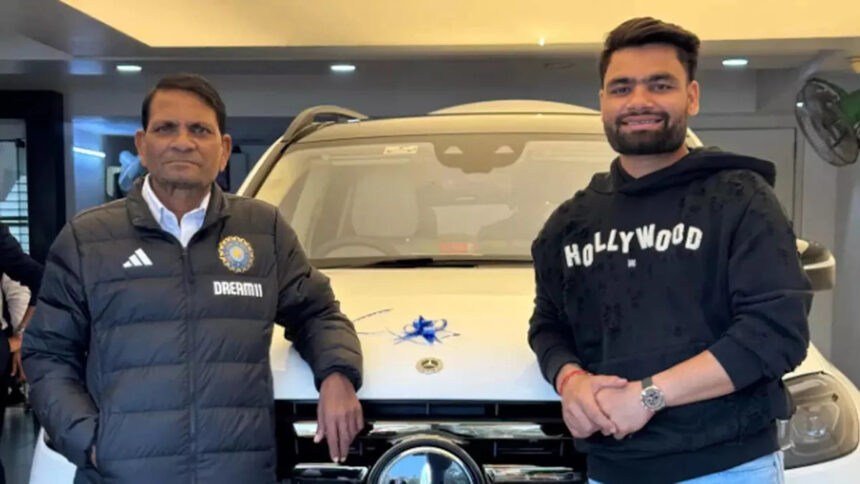
Kash Aap Mere Paas Hote: Rinku Singh’s World Cup Triumph Shadowed by a Father’s Absence
In the cacophony of celebration that followed India’s T20 World Cup 2024 victory—the fireworks over Kensington Oval, the champagne showers in the dressing room, the rapturous welcome in Mumbai—there existed a silence so profound it could break a heart. For Rinku Singh, the moment of ultimate sporting glory was inextricably woven with personal tragedy. The left-handed finisher, whose journey from a small room in Aligarh to the world stage is the stuff of cricketing folklore, had just lost his bedrock. His father, Khanchand Singh, his first coach and fiercest believer, had passed away during the tournament. The trophy, a nation’s dream fulfilled, was also a promise kept to a man who was no longer there to see it.
A Son’s Promise: Duty Before Everything
In a raw, emotional Instagram post written in Hindi after the triumph, Rinku Singh laid bare the chasm between his professional zenith and personal grief. “Aapse baat kiye bina itne din kabhi nahi nikale (I have never spent so many days without talking to you),” he wrote, addressing his father directly. The post was not just a tribute; it was a conversation with a ghost, an attempt to bridge the unbearable distance between a world champion and the man who made him.
He recalled his father’s cardinal lesson: “Aapne sikhaya tha ki farz sabse aage hai… (You taught me that duty comes before everything else).” This single principle became Rinku’s anchor in the storm. While his world was crumbling with the news of his father’s deteriorating health, and later, his passing, Rinku’s duty was to the Indian crest on his chest. He transformed his profound grief into fuel, stepping onto the field with a heavy heart but a clear mission: to fulfill his father’s dream.
“Toh field par bas aapka sapna poora karne ki koshish kar raha tha. Ab aapka sapna pura ho gaya hai… toh bas yahi lagta hai ki kash aap mere paas hote (So on the field, I was just trying to fulfill your dream. Now your dream is fulfilled… I just wish you were here with me).” These closing lines of his tribute encapsulate the bittersweet essence of his World Cup campaign—a mission accomplished for an audience of one, who watched, perhaps, from somewhere beyond the boundary.
The Agonizing Journey: Between Aligarh and the World Cup
Rinku Singh’s World Cup was a masterclass in compartmentalization, a shuttling between the private agony of a son and the public pressure of an athlete. The timeline of his ordeal highlights his immense fortitude:
- Super 8 Stage: After India’s first Super 8 match against South Africa, Rinku rushed back home as his father’s health, battling stage-four cancer, took a critical turn.
- A Father’s Final Farewell: Khanchand Singh passed away at a hospital in Greater Noida. The funeral in Aligarh saw a grieving Rinku, shoulders bearing the weight of his father’s mortal remains, surrounded by a community in mourning.
- The Return to Duty: Displaying staggering resilience, Rinku rejoined the Indian squad ahead of their final Super 8 clash against Zimbabwe. He did not speak of his pain; he simply returned to work, to his ‘farz’.
On paper, his tournament statistics were modest—24 runs in five innings, often coming in during the frantic death overs with little time to settle. But to measure his contribution in runs alone is to miss the point entirely. His presence in the squad, his ability to even put on his pads and face a bowler, was a monumental act of will. Every single he scampered, every dot ball he defended, was a stanza in an ode to his father.
Expert Analysis: The Unseen Impact of Personal Battles
From a sporting lens, Rinku Singh’s saga offers a poignant look at the invisible battles athletes fight. Sports psychologists often speak of the “clutch performer,” but rarely do we factor in the emotional tsunami a player might be navigating just beneath the surface.
Rinku’s role as a finisher is one of cricket’s most high-pressure jobs, requiring a clear mind and ice-cool nerves. That he could even perform this role, however limited his opportunities were in a stacked batting lineup, while his heart was shattered, speaks volumes about his mental toughness. It wasn’t about the runs he scored; it was about being present for his team during the most important campaign of their lives. His journey underscores a critical, often overlooked, aspect of team sports: the emotional scaffolding teammates and support staff provide, allowing a player to grieve yet function.
Furthermore, his story reframes our definition of a “successful World Cup.” For a player like Rinku, success wasn’t about a batting average. It was about honoring a promise. When he held the trophy aloft, he was lifting it for two. In that moment, he wasn’t just a world champion; he was a devoted son who had seen his duty through to the very end.
The Road Ahead: Carrying the Legacy Forward
What does the future hold for Rinku Singh? The path is now dual-tracked. On one hand, he is a vital part of India’s future in white-ball cricket, a proven match-winner in the IPL whose composure is priceless. Predictions for his career suggest he will be a central figure in the next T20 World Cup cycle and a strong contender for ODI cricket.
But his personal road will be one of navigation. As he poignantly wrote, “Har chhoti badi khushi mein aapki kami khalegi. (In every small and big happiness, I will feel your absence).” Every century, every award, every future triumph for India will be touched by this absence. Yet, within that void also lies his greatest source of strength. Khanchand Singh’s teachings, his sacrifices—selling milk, driving an auto-rickshaw to fund his son’s cricket—are now the bedrock of Rinku’s identity. We can expect to see a player driven not just by personal ambition, but by a legacy. His batting, already fearless, may now carry an even deeper layer of purpose.
The Indian cricket fraternity, and fans worldwide, have now seen the man behind the sixes. The respect for him has transcended cricketing skill. He is a symbol of resilience, a reminder that our heroes carry weights we cannot see. The management’s role will be crucial in providing continued support, ensuring this profound experience fuels rather than hinders his extraordinary talent.
Conclusion: A Triumph Etched in Love and Loss
Rinku Singh’s story from the 2024 T20 World Cup is not one you will find in the record books. It won’t be listed under “most runs” or “highest strike rates.” It will be found in the quiet corners of human experience, where love, loss, and duty collide. His emotional tribute, centered on those haunting words, “Kash aap mere paas hote,” echoes far beyond cricket.
It is a universal sentiment felt by anyone who has ever achieved a dream and turned around to share it, only to find a space empty. In fulfilling his father’s dream, Rinku Singh gave us all a lesson in character. He taught us that the truest victories are often those wrestled from the jaws of personal despair, that duty can be the most powerful salve for grief, and that a father’s belief can be so powerful it guides a son to a world title, even from beyond. The trophy is India’s. But the journey, the pain, and the promise—that will forever belong to Rinku and Khanchand Singh.
Source: Based on news from Yahoo Sports.