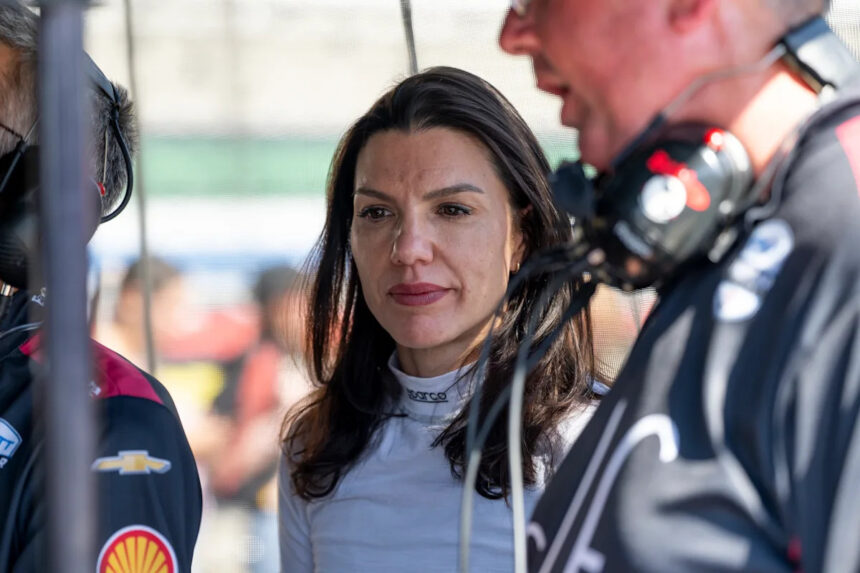
Katherine Legge Aims to Make History: The First Woman to Conquer ‘The Double’
On Memorial Day weekend, the motorsports world will witness a potential seismic shift in its history books. Katherine Legge, a 45-year-old British racing veteran, is not just aiming for the checkered flag; she is aiming for immortality. Already confirmed for the Indianapolis 500, Legge has officially added her name to the entry list for the Coca-Cola 600 in Charlotte, setting the stage for an audacious attempt at “The Double.” If successful, she will become the first woman ever to compete in both crown-jewel events on the same day.
This is not a publicity stunt. This is a high-stakes, high-speed logistical nightmare that has broken the spirits of some of the best drivers in history. Legge, however, sees it as the ultimate challenge. “Why not?” seems to be her mantra. But the question remains: can she pull off what only five men have attempted since 1994?
The Brutal Logistics of ‘The Double’
To the casual fan, racing two events in one day might sound like a simple double-header. But the Coca-Cola 600 and the Indianapolis 500 are not in the same city, nor are they in the same type of race car. The term “The Double” is a misnomer for what is actually a triathlon of speed, endurance, and aviation.
The schedule is a razor-thin margin for error. This year’s Indy 500 is scheduled to start at 12:45 p.m. ET. The race typically runs about three hours, putting the finish window around 4:00 p.m. ET. From the moment the checkered flag falls at Indianapolis Motor Speedway, Legge will have approximately 70 to 90 minutes to:
- Exit the car and undergo a mandatory medical check.
- Shower and change into fireproof NASCAR gear.
- Get to the airport via helicopter or police escort.
- Fly 70-90 minutes to Charlotte Motor Speedway.
- Arrive, get strapped in, and be ready for the 6:00 p.m. ET green flag.
The margin for error is measured in minutes, not laps. A single caution flag or a rain delay in Indianapolis could turn this logistical masterpiece into a frantic scramble. As Legge herself noted, the flight from Indianapolis to Charlotte is the static variable. It is the race length and weather that are the wild cards.
Why This Attempt is Different: The Woman Factor
Let’s be clear: Katherine Legge is not a novelty act. She is a proven winner. At 45, she brings a level of veteran savvy that younger drivers often lack. She has raced in Champ Car, IndyCar, DTM, and now NASCAR. Her experience in the NASCAR Xfinity Series in 2023 and 2024 provided the necessary seat time to earn a Cup Series ride, even if it is a one-off.
But the psychological weight of this attempt is unique. Only five drivers have tried “The Double” since Tony Stewart famously pioneered it in 2001. Those drivers are exclusively male. Legge is stepping into a vacuum of representation. She is not just racing against the clock and the competition; she is racing against a century of tradition that has largely excluded women from these top-tier events.
“Being the first woman to attempt this is a massive responsibility,” says veteran motorsports analyst and former crew chief Steve Addington. “She has to manage the Indy 500 with a conservative head, because she knows she has a Cup car to drive later. The heat, the G-forces, the mental fatigue—it’s all amplified for her because every move will be scrutinized.”
The pressure is immense. If she crashes early in the Indy 500, the narrative will be that a woman couldn’t handle the workload. If she runs mid-pack in Charlotte, critics will say she was just a passenger. But if she finishes both races? She shatters a glass ceiling that has remained stubbornly intact for over three decades.
Expert Analysis: Can She Physically and Mentally Survive 1,100 Miles?
The physical toll of “The Double” is often compared to running a marathon on a trampoline. The Indy 500 is 500 miles of high-speed, open-wheel precision where drivers pull lateral G-forces of over 3.0 in the corners. The Coca-Cola 600 is 600 miles of heavy, stock-car wrestling in a car that weighs nearly twice as much as an IndyCar, with cockpit temperatures that can exceed 130 degrees Fahrenheit.
Legge’s advantage? She is a veteran of endurance. She has competed in the Rolex 24 at Daytona, a 24-hour race that requires extreme physical and mental stamina. She understands pacing. She understands that you cannot win the Indy 500 in the first lap, but you can certainly lose the Coca-Cola 600 there.
My prediction is that Legge will run a smart, calculated race in Indianapolis. She will likely qualify mid-pack and focus on surviving the initial chaos. The goal is not to win the 500—it is to finish it. A top-15 finish in the Indy 500 would be a massive success, allowing her to hand the car off to her team and sprint for the airport with a clear head.
In Charlotte, the challenge is different. She will be driving for a smaller team (likely in a lower-tier car), and the competition in the Cup Series is brutal. The Coca-Cola 600 is notorious for being a war of attrition. The track evolves drastically from day to night, changing grip levels and tire degradation.
“The biggest mistake a driver can make is trying to overachieve in the second race,” explains Addington. “You are tired. Your neck is screaming. Your hands are blistered. You have to run your own race. Katherine needs to keep the car clean, avoid the wrecks, and bring it home. A top-25 finish in the 600 would be a historic victory.”
The Legacy of the Sixth Attempt
The list of drivers who have attempted “The Double” reads like a who’s-who of racing royalty: John Andretti, Tony Stewart, Robby Gordon, Kurt Busch, and Kyle Larson. Of those, only Stewart (2001) and Larson (2024) managed to complete all 1,100 miles. The others were foiled by mechanical failures, crashes, or the clock.
Katherine Legge is looking to become the sixth driver to attempt the feat and the first woman. This is not just a statistical anomaly; it is a statement. It says that the barriers that once kept women out of the cockpit are crumbling, not because of quotas, but because of raw talent and relentless ambition.
However, we must be realistic. The odds are stacked against her. The weather in Indiana in late May is notoriously unpredictable. A 20-minute rain delay in Indianapolis could force her to surrender the Cup Series ride before she even starts. Furthermore, the Cup Series car she will drive is likely not a front-runner. She will be battling cars that are 5-10 mph faster on the straightaways.
But that is not the point. The point is the attempt. The point is the flight. The point is the sweat, the fear, and the adrenaline of doing something that has never been done before.
Conclusion: A Day That Will Define a Career
On May 25, 2025, Katherine Legge will wake up in Indianapolis. She will strap into a 230-mph IndyCar. She will race 500 miles. She will then fly to Charlotte. She will strap into a 180-mph stock car. She will race 600 miles. By midnight, she will have driven 1,100 miles in a single day, across two disciplines, in two different states.
Whether she finishes first or last, whether she completes both races or is sidelined by a mechanical failure, her legacy is already secure. She is the pioneer. She is the woman who looked at one of motorsport’s most daunting challenges and said, “I can do that.”
The eyes of the racing world will be on her. The flight from Indianapolis to Charlotte will be the most nerve-wracking 90 minutes of her life. But if she pulls it off, she will not just be a footnote in history. She will be the headline. Katherine Legge is about to show the world that ‘The Double’ is no longer a boys’ club. It is a proving ground for the fearless.
Source: Based on news from Yahoo Sports.