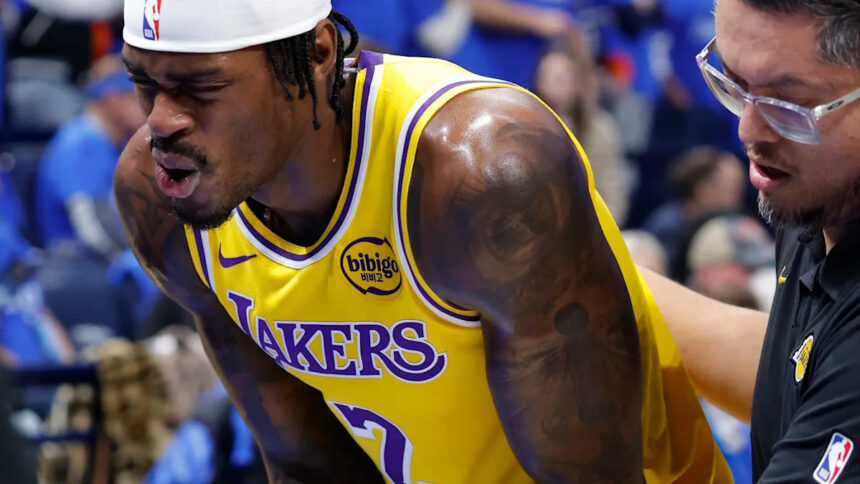
Lakers’ Jarred Vanderbilt Suffers Gruesome Pinky Dislocation, Expected to Miss Time vs. Thunder
The Los Angeles Lakers’ defensive identity took a brutal blow on Tuesday night, and it had nothing to do with a missed assignment or a blown rotation. It came from a freak collision between a 6’8″ wing and the glass backboard. Jarred Vanderbilt suffered a gruesome dislocation of his right pinky finger during the first half of Game 1 against the Oklahoma City Thunder, an injury so graphic that we won’t show the video here—but the reaction of the Thunder bench told you everything you needed to know. Players turned away. Coaches winced. The arena went silent for a moment as Vanderbilt crumpled to the floor in agony.
- The Freak Injury: How Vanderbilt’s Pinky Dislocation Happened
- Why Vanderbilt’s Absence Hurts the Lakers Defensively
- Offensive Adjustments: Can the Lakers Survive Without Their Defensive Anchor?
- Predictions: What’s Next for the Lakers and Jarred Vanderbilt?
- Conclusion: A Freak Play That Could Define the Series
What started as a hopeful playoff run for the Lakers now faces a critical defensive void. Vanderbilt, the team’s most versatile perimeter stopper, is expected to miss significant time. And after a 108-90 loss in Game 1, the timing could not be worse.
The Freak Injury: How Vanderbilt’s Pinky Dislocation Happened
The play itself was unremarkable until it wasn’t. With just over six minutes left in the first half, Thunder center Chet Holmgren sprinted toward the rim on a fast break, looking to finish an alley-oop. Vanderbilt, known for his relentless chase-down energy, leaped from the weak side to contest the dunk. As he swung his right arm to block the ball, his pinky finger caught the edge of the backboard with full force.
Vanderbilt immediately pulled his hand back and hit the deck. The dislocation was complete—the finger bent in a direction fingers are not supposed to go. Trainers rushed to his side as he writhed in pain. The Thunder bench, seated directly across from the play, offered the most telling visual: players covering their mouths, shaking their heads, and looking away. No one needed to see the replay to understand the severity.
After the game, Lakers head coach JJ Redick confirmed the diagnosis. “It’s a full dislocation. A freak injury,” Redick said. “You don’t see that every day. He’s tough, but that’s a significant one.”
Injury analyst Jeff Stotts of In Street Clothes provided the grim context. A standard pinky dislocation, while painful, rarely sidelines a player for more than a game or two. But if the injury involves a fracture—or if the bone broke through the skin (an open dislocation)—the recovery timeline expands dramatically. “If it’s a complex dislocation or a fracture-dislocation, Vanderbilt is likely out for most, if not all, of this series,” Stotts noted. The Lakers are awaiting further imaging results, but the early indicators are not optimistic.
Why Vanderbilt’s Absence Hurts the Lakers Defensively
Losing any rotation player in the playoffs is tough. Losing Jarred Vanderbilt is a specific kind of problem. At 6’8″ with a 7’1″ wingspan, Vanderbilt is the Lakers’ best point-of-attack defender and their most switchable wing. He can guard Shai Gilgeous-Alexander on the perimeter, slide onto Jalen Williams in isolations, and even battle bigger forwards in the post. His absence forces the Lakers to lean heavier on Rui Hachimura and Taurean Prince, both of whom lack Vanderbilt’s lateral quickness and disruptive length.
In the first round against the Houston Rockets, Vanderbilt averaged 13.4 minutes per game, contributing 3.6 points and 4.4 rebounds. The offensive numbers are modest—he’s not a floor spacer or a creator. But his value was never about scoring. He was the defensive eraser Redick used to neutralize Houston’s explosive guards and wings. In Game 6 of that series, however, Vanderbilt was benched for much of the game. The Rockets simply ignored him on offense, playing 5-on-4 and daring him to shoot. That offensive liability made it hard for Redick to keep him on the floor in crunch time.
Now, without Vanderbilt, the Lakers lose that defensive flexibility entirely. Against the Thunder, who boast one of the deepest rotations in the West, that’s a critical loss. Oklahoma City can attack with Gilgeous-Alexander, Holmgren, Isaiah Joe, and Cason Wallace—all of whom can score in different ways. Vanderbilt was the one player who could theoretically check three of them on a single possession.
Offensive Adjustments: Can the Lakers Survive Without Their Defensive Anchor?
Let’s be clear: Vanderbilt’s offensive limitations were already a problem. In the first round, his offensive rating plummeted in games where Houston packed the paint. He shot just 38% from the field in the series and attempted only one three-pointer total. Defenses sagged off him, clogging driving lanes for LeBron James and Anthony Davis.
But here’s the paradox: Without Vanderbilt, the Lakers’ defense becomes more vulnerable, which puts more pressure on the offense to score in bunches. That’s a dangerous equation against a Thunder team that just held L.A. to 90 points in Game 1. Oklahoma City’s switching defense, led by Luguentz Dort and Jalen Williams, thrives on forcing isolation plays. Without Vanderbilt’s ability to blow up actions and create turnovers, the Lakers will have to rely on D’Angelo Russell and Austin Reaves to generate clean looks—something they failed to do in the series opener.
Redick may have to get creative. Expect to see more minutes for Max Christie, who has shown flashes of defensive potential but lacks Vanderbilt’s experience. Christie is a better shooter, but he’s not the same disruptive force. The Lakers could also go smaller, sliding LeBron James to the four and playing Hachimura at the five in certain lineups. That would sacrifice rim protection but could open up the floor offensively.
One thing is certain: Vanderbilt’s absence changes the calculus of this series. The Thunder won Game 1 comfortably, and without their best perimeter defender, the Lakers face an uphill climb to even the series.
Predictions: What’s Next for the Lakers and Jarred Vanderbilt?
If the imaging confirms a fracture-dislocation or an open dislocation, Vanderbilt’s season is effectively over. Even a best-case scenario—a simple dislocation with no structural damage—would likely keep him out for at least 7-10 days. That means he would miss Games 2, 3, and possibly 4 of this series. By then, the Lakers could be down 3-1 or already eliminated.
The Lakers’ path to victory without Vanderbilt relies on two things: LeBron James playing at an MVP level and Anthony Davis dominating the paint. In Game 1, Davis finished with 24 points and 12 rebounds, but James looked hesitant, scoring just 18 points on 6-of-16 shooting. The supporting cast—Russell (6 points), Reaves (12 points), and Hachimura (8 points)—failed to provide consistent scoring.
Defensively, the Lakers will need to gamble more. Expect them to trap Gilgeous-Alexander more aggressively and force the Thunder’s role players to beat them. That worked for stretches in Game 1, but Oklahoma City’s depth—especially Isaiah Joe (15 points) and Cason Wallace (11 points)—stepped up when it mattered.
Prediction: The Thunder take Game 2 in Oklahoma City, pushing the Lakers to the brink. Vanderbilt’s injury proves to be the turning point in the series. Without his defensive versatility, the Lakers cannot contain Gilgeous-Alexander or slow down Oklahoma City’s second-unit scorers. The Thunder win the series in five games.
Conclusion: A Freak Play That Could Define the Series
Jarred Vanderbilt’s gruesome pinky dislocation is more than a gruesome highlight—it’s a potential series-altering event. The Lakers entered the playoffs with championship aspirations, built on a defense that could switch, scramble, and suffocate. Now, that defense is missing its most vital piece. The Thunder bench’s reaction told the story: this was bad. And for L.A., the pain is only just beginning.
Whether Vanderbilt returns in this series or not, his absence has already shifted the balance of power. The Lakers will need a near-perfect offensive performance to compensate. Against a deep, hungry Thunder team, that’s a tall order. For now, all the Lakers can do is wait for the MRI results—and hope that their defensive anchor’s season isn’t over.
Source: Based on news from Yahoo Sports.