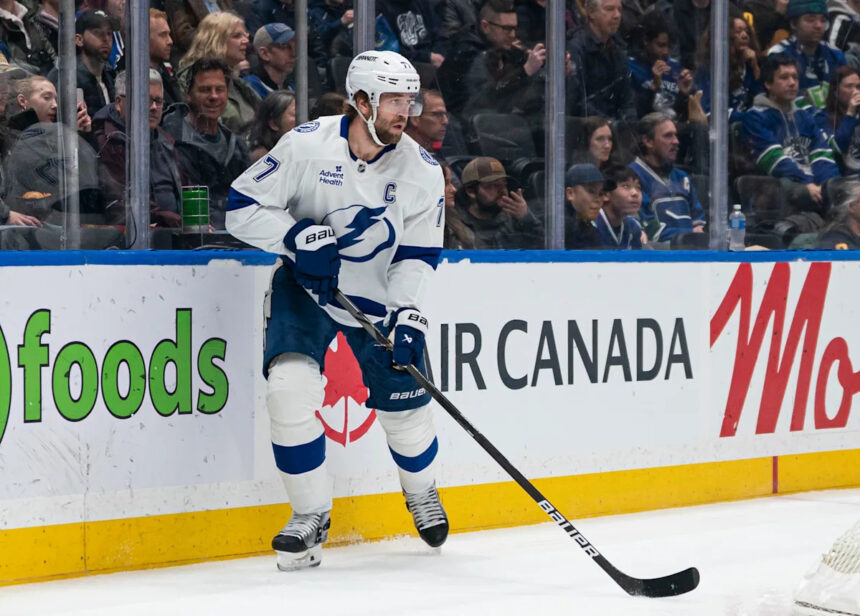
Victor Hedman Reveals He Missed End of Lightning Season to Focus on Mental Health: ‘The Right Decision’
TAMPA, Fla. — In a move that stunned the hockey world and reshaped the narrative of the Tampa Bay Lightning’s 2025 campaign, captain Victor Hedman revealed Tuesday that he voluntarily missed the final 15 games of the regular season and the entirety of the first round of the Stanley Cup Playoffs to prioritize his mental health. The announcement, made through a team statement two days after the Lightning’s heartbreaking 2-1 Game 7 loss to the Montreal Canadiens, marks a watershed moment in the NHL’s ongoing conversation about athlete well-being.
“Wearing this jersey — and serving as captain — is the greatest responsibility of my professional life,” Hedman said in the statement. “That responsibility doesn’t only apply on the ice. Over the past couple of months, I made the decision to step away and focus on my mental health. It was not an easy decision, but it was the right one.”
The 34-year-old Swedish defenseman, a two-time Stanley Cup champion and the 2020 Conn Smythe Trophy winner, had been on a temporary leave of absence since March. Initially shrouded in privacy, the extent of his absence became clear only after the Lightning’s season ended. Hedman rejoined the team for practices during the first-round series against Montreal but never dressed for a game, leaving fans and analysts to speculate about his condition. Now, with his candid revelation, Hedman has opened a critical dialogue about pressure, vulnerability, and the human cost of elite sport.
The Weight of the ‘C’: Why Hedman Stepped Away
Hedman’s decision to step away was not impulsive. According to sources close to the team, the captain had been grappling with mounting internal pressure since the start of the 2024-25 season. The Lightning, a perennial contender, entered the year with a retooled roster after key departures, and Hedman—now the longest-tenured member of the core—shouldered an even heavier leadership load. Combine that with the physical toll of 16 NHL seasons, and the result was a perfect storm of mental fatigue.
“Mental health is not a weakness; it’s a human condition,” said Dr. Rachel Torres, a sports psychologist who has worked with NHL players but is not affiliated with the Lightning. “What Hedman did is extraordinarily brave. In a culture that glorifies toughness and stoicism, he chose honesty. That sends a powerful message to every player in the league—and every fan watching.”
Hedman’s statement emphasized that his responsibility as captain extends beyond the ice. “That responsibility doesn’t only apply on the ice,” he wrote, directly challenging the traditional notion that a leader’s value is measured solely by goals, assists, or minutes played. By stepping away, he modeled a new kind of leadership: one that prioritizes long-term health over short-term sacrifice.
During his absence, Hedman remained in contact with teammates and coaching staff, but he largely disconnected from the daily grind of the NHL. He focused on therapy, rest, and reconnecting with his family in Sweden. “I’m in a much better place today,” he said, offering a rare glimpse into his recovery process.
Impact on the Lightning’s Playoff Run and Future
The timing of Hedman’s leave could not have been more critical. The Lightning were fighting for playoff positioning in the hyper-competitive Atlantic Division, and losing their captain—a Norris Trophy-caliber defenseman who averages over 23 minutes per game—was a seismic blow. Without Hedman, Tampa Bay went 8-6-1 in the final 15 games, barely securing a wild-card spot before facing the Canadiens in the first round.
In the playoffs, the Lightning’s defense struggled mightily without its anchor. Montreal’s young forwards, led by Cole Caufield and Nick Suzuki, exploited gaps in Tampa Bay’s zone coverage, generating high-danger chances at will. The series went the distance, with the Canadiens eking out a 2-1 victory in Game 7 on home ice. Hedman, who had rejoined practices but was not medically or mentally cleared to play, watched from the press box—a surreal sight for a player who had been the backbone of three Stanley Cup Finals appearances.
“You can’t replace a Victor Hedman,” said former NHL defenseman and TSN analyst Aaron Ward. “The Lightning’s system is built around his ability to break pucks out, quarterback the power play, and shut down top lines. Without him, they were a different team—one that lacked its usual swagger and composure in key moments.”
Looking ahead, the Lightning face a pivotal offseason. Hedman has two years remaining on his contract at a $7.875 million cap hit, and his health—both mental and physical—will be the organization’s top priority. General manager Julien BriseBois has already stated that the team will support Hedman “in every way possible,” but questions linger: Can the Lightning retool around an aging core? Will Hedman’s absence accelerate a rebuild, or will the captain’s return galvanize the roster?
One thing is certain: the Lightning’s championship window is not closed, but it is narrower. With stars like Nikita Kucherov and Brayden Point still in their primes, and goaltender Andrei Vasilevskiy anchoring the net, Tampa Bay remains a contender—but only if Hedman returns at full strength, both mentally and physically.
Expert Analysis: What Hedman’s Revelation Means for the NHL
Hedman’s announcement is part of a broader shift in professional sports. In recent years, players like Kevin Love (NBA), Naomi Osaka (tennis), and DeMar DeRozan (NBA) have spoken openly about their mental health struggles, breaking down stigmas that once kept such conversations in the shadows. But in the NHL—a league where “toughness” is often measured by playing through pain—Hedman’s admission carries unique weight.
“The NHL has a long way to go in normalizing mental health breaks,” said Dr. Torres. “But when a captain of a marquee franchise like Tampa Bay does this, it forces the league office, teams, and players to take notice. Hedman has essentially given permission for others to prioritize their well-being without fear of judgment.”
The NHL Players’ Association has publicly praised Hedman’s decision, and league commissioner Gary Bettman has emphasized the importance of mental health resources. However, critics argue that the NHL’s grueling 82-game schedule, combined with the physical demands of the sport, creates an environment where burnout is almost inevitable. Hedman’s case may accelerate calls for more robust support systems, including mandatory mental health days and increased access to sports psychologists.
From a tactical perspective, Hedman’s absence also raises questions about roster construction. The Lightning, like many teams, have historically prioritized durability and “grit” in their defensive corps. But as the game evolves, so must the definition of resilience. “Resilience isn’t just about blocking shots or playing through injuries,” Ward noted. “It’s about knowing when to step back so you can come back stronger. Hedman taught us that lesson this spring.”
Predictions: Where Does Hedman and the Lightning Go From Here?
Based on Hedman’s statement and the team’s public stance, several key predictions emerge for the 2025-26 season:
- Hedman will return at full capacity. His emphasis on being in a “much better place” suggests that his leave was proactive, not reactive. Expect him to report to training camp in September with a renewed sense of purpose.
- The Lightning will add depth on defense. BriseBois will likely target a veteran defenseman in free agency or via trade to reduce Hedman’s workload. Names like John Klingberg or Matt Dumba could be fits at a reasonable cap hit.
- Mental health will become a bigger part of the Lightning’s culture. The organization is already exploring partnerships with mental health professionals to provide year-round support for players and staff.
- Hedman’s legacy will transcend his on-ice achievements. While he is already a lock for the Hall of Fame, his willingness to prioritize mental health will cement his status as a trailblazer—a player who redefined what it means to be a captain.
Conclusion: A Captain’s True Strength
Victor Hedman’s decision to step away from the game he loves was not a sign of weakness. It was a testament to his character, his self-awareness, and his understanding that true leadership sometimes means putting your own well-being first. In a sport that often demands everything from its players—blood, sweat, and tears—Hedman chose to protect something more valuable: his mind.
“I made the decision to step away and focus on my mental health,” he said. “It was not an easy decision, but it was the right one.”
For the Lightning, the 2025 season ended earlier than expected. But in the long arc of hockey history, Hedman’s revelation may prove more impactful than any playoff run. He has shown that the greatest responsibility of a captain isn’t just lifting a trophy—it’s lifting the conversation. And in doing so, he has given every player, every fan, and every person struggling in silence the courage to say: I need a break. And that’s okay.
Source: Based on news from Yahoo Sports.