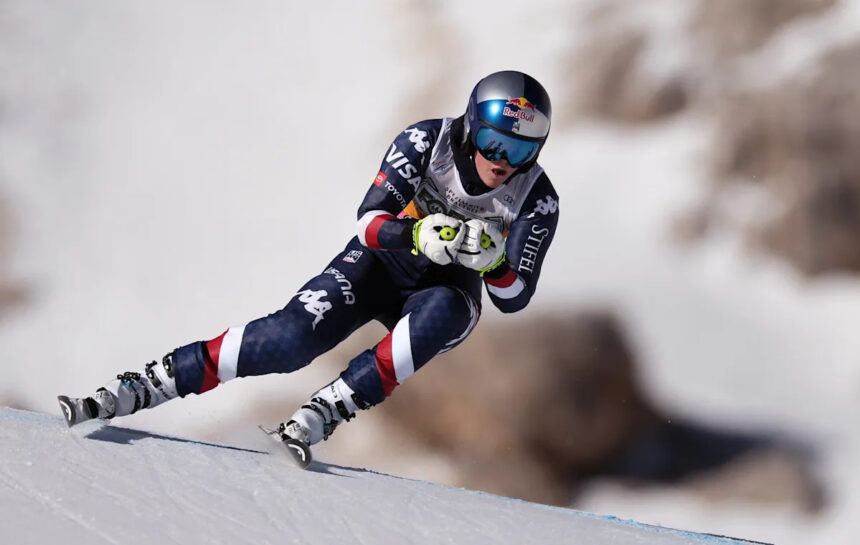
Lindsey Vonn’s Impossible Comeback: The Grit, The Injury, and The 2026 Olympic Dream
The narrative of an athlete’s twilight is often one of graceful decline, a quiet farewell tour bathed in nostalgia. Lindsey Vonn, true to her entire career, is shredding that script into a million pieces. In a story that defies conventional sports medicine, logic, and perhaps even gravity itself, the greatest female skier of all time is not just returning from retirement for the 2026 Milano Cortina Olympics—she’s doing it with a ruptured ACL at 41 years old. This isn’t a farewell tour; it’s a raw, visceral declaration of will, a testament to a spirit that refuses to acknowledge the word “impossible.”
Vonn’s journey to the start gate in Cortina is arguably her most treacherous run yet. It’s a path paved with titanium, scar tissue, and an unbreakable belief that has become her signature. To understand the magnitude of this moment is to look beyond the recent injury and into the profound physical reconstruction she has endured just to stand on snow again.
The Anatomy of Resilience: A Body Reforged
Lindsey Vonn’s medical chart reads more like a blueprint for a bionic woman than an athlete’s file. Her career, while decorated with 82 World Cup wins, four overall globes, and three Olympic medals, has been a relentless war of attrition against her own body. The litany of injuries is staggering: broken bones, concussions, and a relationship with her knees so fraught it became a central storyline.
But the pivotal event that frames this comeback occurred in 2024. Years of catastrophic damage—including multiple torn ACLs, fractures, and bone-on-bone grinding—culminated in a procedure few elite athletes in their 30s ever face: a partial knee replacement. This wasn’t another repair; it was a reconstruction. Surgeons removed degenerated bone and cartilage, replacing it with metal and plastic. For most, this surgery promises a pain-free life of walking and light activity. For Vonn, it was merely the foundation upon which she would attempt to rebuild world-class speed.
Then, in a cruel twist of fate, during a training session on January 30, 2026, just days before the Olympic flame was lit, Vonn’s other knee gave way. She suffered a ruptured ACL. In an instant, the dream seemed over. Yet, in what can only be described as a superhuman feat of proprioception and strength, Vonn completed a crucial training run on February 6 with no reported issues, officially qualifying her for the downhill race on February 8. The sporting world was left with one, staggering question: How?
The “Why”: Unfinished Business and a Legacy of Defiance
To ask why Lindsey Vonn is doing this is to misunderstand her core identity. Retirement, which she initially entered in 2019, never truly fit. The pull of the mountains, the roar of the wind, the singular focus of a downhill course—these are elements she could not replicate in civilian life. But beyond the addiction to speed, there is a powerful, unresolved chord in her Olympic symphony.
- Unfinished Olympic Business: Vonn’s Olympic story is one of brilliant triumph (downhill gold in 2010) and heartbreaking misfortune (injuries in 2006, 2014). Milano Cortina represents a chance to author her own ending, on her own terms.
- A Message to the Next Generation: Vonn has always been a vocal advocate for mental health and perseverance. This comeback is a living, breathing lesson in resilience for young athletes, especially young women, showing that limits are often mental constructs.
- The Ultimate Test of Self-Belief: As she has stated, Lindsey Vonn believes in herself. This endeavor is the ultimate validation of that belief, a challenge thrown not at her competitors, but at the very nature of aging and athletic decline.
This is not a quest for another medal, though that would be a miraculous subplot. This is a mission to complete a journey, to stare down every demon of pain and doubt that has ever chased her down a mountain, and to cross the finish line—upright and on her own power.
Expert Analysis: Can She Actually Compete?
From a physiological standpoint, Vonn’s situation is unprecedented. Sports medicine experts are cautiously astounded. “What she is attempting rewrites the textbooks,” says Dr. Anya Petrova, a leading orthopedic surgeon specializing in ski injuries. “A partial knee replacement provides stability and alleviates pain from arthritis, but it does not restore the native, dynamic function of a young knee. The forces in a downhill race are colossal. To then compound that with a fresh ACL tear in the contralateral knee… her ability to compete is less about medical science and more about sheer neurological override and muscle memory.”
Vonn’s viability hinges on several non-traditional factors:
- Unparalleled Technique: Her form is so deeply ingrained that she can likely execute turns with exceptional efficiency, minimizing erratic, load-bearing movements.
- Strategic Racing: She will not be able to ski “on the limit” as she once did. Her run will be a masterpiece of calculated risk, choosing where to bleed speed to maintain control.
- Mental Fortitude: The psychological battle will be fiercer than the physical one. Trusting a surgically rebuilt knee and a torn ligament at 80+ mph requires a mindset few possess.
Her performance will not be judged against the clock of her 2010 self, but against the clock of human potential. Simply starting the race is a victory lap.
Predictions and Lasting Impact
Realistically, contending for a podium spot against skiers with intact, younger knees is a Herculean task. The field has grown faster and more technical during her absence. However, to predict Lindsey Vonn’s outcome based on data alone has always been a fool’s errand.
Prediction: Vonn will start the downhill. She will finish the downhill. Where she places is almost irrelevant. The image of her charging down the Olympia delle Tofane course will instantly become an iconic Olympic moment, etched alongside the “Miracle on Ice” and Kerri Strug’s vault. It will be a celebration of pure spirit over physical limitation.
Her impact will resonate far beyond the Alps. She is redefining what is possible for athletes in the latter stages of their careers, challenging the industry’s obsession with peak age. Sponsors, media, and fans are witnessing a new paradigm: legacy defined by defiance. This comeback will inspire a generation to view comebacks, setbacks, and aging not as endpoints, but as new, challenging terrain to be mastered.
Conclusion: The Final Descent
Lindsey Vonn’s return for the 2026 Winter Olympics is the culmination of a lifetime spent dancing with the edge. It is not a denial of age or injury, but a profound acceptance of them—and a decision to race anyway. With a partial knee replacement in one leg and a ruptured ACL in the other, she is stepping into the start gate not as the indestructible champion of old, but as something more powerful: a symbol of unyielding human will.
When she pushes out of the gate on February 8, she carries the hopes of anyone who has ever been told “you can’t.” She is skiing for the comeback kids, the injured, the counted-out, and the resilient. Regardless of the time on the scoreboard, her final Olympic descent will be her greatest victory. It will be a run not for gold, but for the soul of sport itself—a breathtaking, thunderous reminder that the most important thing you can ever win is the right to define your own limits. The mountain awaits, and Lindsey Vonn is ready to conquer it one last time, on her own impossible terms.
Source: Based on news from Yahoo Sports.