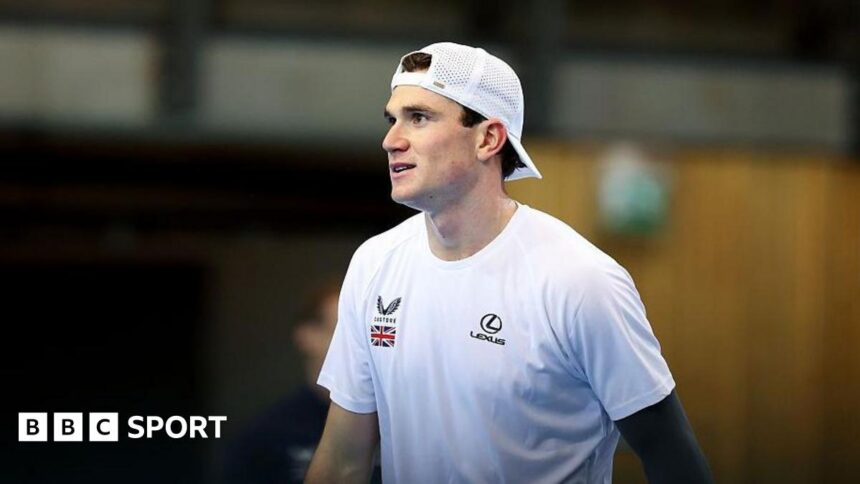
‘Lots of Dark Moments’: How Jack Draper’s Resilience Forges a Davis Cup Return
The ascent to the summit of men’s tennis is rarely a linear climb. For Britain’s Jack Draper, the dizzying heights of a top-five ranking in 2024 were swiftly followed by a precipitous fall into the shadows of injury and uncertainty. As he prepares to spearhead Great Britain’s Davis Cup qualifier against Norway in Oslo, the narrative surrounding the 24-year-old has shifted from breakthrough star to a testament of resilience. Draper’s candid admission of enduring “lots of dark moments” during a debilitating upper-arm injury reveals a battle fought off the court, one that makes his return to national duty not just a sporting comeback, but a deeply personal triumph.
A Meteoric Rise and a Brutal Halt
To understand the weight of Draper’s absence, one must first appreciate the spectacular trajectory he was on. The 2024 season was a coronation for the powerful left-hander. He announced himself as a genuine Grand Slam threat with a fourth-round run at the Australian Open, a feat he replicated on the clay of Roland Garros. The pinnacle came in the California desert, where Draper conquered the prestigious BNP Paribas Open in Indian Wells to claim his maiden Masters 1000 title. By June, he had ascended to a career-high world number four, establishing himself as Britain’s undisputed number one and a leading figure in the new generation of ATP stars.
However, the physical demands of his explosive, all-court style began to exact a toll. A persistent issue in his upper left arm, first felt during the clay-court swing, escalated into a full-blown crisis. After a second-round exit at Wimbledon, Draper’s season effectively ground to a halt. He would play just one more singles match in 2024—a brief, aborted comeback at the US Open where he won his first round before withdrawing, a decision that underscored the severity of the issue.
Navigating the Shadows: The Mental Battle of Rehabilitation
For an athlete at the peak of his powers, an extended layoff is more than a physical challenge; it is a profound psychological test. Draper’s reference to “dark moments” speaks volumes about this often-hidden struggle.
- The Isolation: While rivals competed in tournaments he targeted, Draper was confined to treatment rooms and cautious rehabilitation.
- The Uncertainty: Arm injuries for a tennis professional are particularly nefarious, casting doubt on the very foundation of their craft—their serve and groundstrokes.
- The Erosion of Momentum: Watching hard-earned ranking points evaporate and a season of potential slip away can be a corrosive experience.
His attempt to return in New York, including a mixed doubles partnership with Jessica Pegula, was a clear signal of his desperation to compete. Yet, the subsequent withdrawal confirmed that the path back would require patience, a virtue in short supply for a competitor of his caliber. This period wasn’t just about healing tissue; it was about maintaining belief when the immediate future offered no guarantees.
The Davis Cup as the Perfect Crucible
His return in the cauldron of Davis Cup competition is a strategically and symbolically potent choice. The team environment offers a unique support system absent from the solitary grind of the tour.
Captain Leon Smith provides a trusted guide, while teammates like Cameron Norrie and Dan Evans understand the unique pressures of comeback. Representing nation, rather than self, can alleviate the individual burden of expectation, allowing Draper to channel his energy into a collective cause. The format—a best-of-five match tie—also provides a controlled, high-stakes environment to test his physical readiness against a talented opponent like Norway’s Casper Ruud, without the week-in, week-out demand of a full tournament.
Draper’s Davis Cup record—one win and three losses in singles—adds another layer of motivation. This is an opportunity to redefine his contributions to the British team, to transition from a promising debutant to a leader who can anchor the side. The unique pressure of Davis Cup, which has broken some, has the potential to forge Draper’s competitive mettle anew.
Analysis & Predictions: What Can We Expect in Oslo and Beyond?
Expert analysis suggests a cautious optimism surrounds Draper’s return. The nature of his injury means his devastating serve and whip-like forehand will be under the microscope. Early matches will be less about the result and more about gauging his comfort, pain-free range of motion, and ability to sustain his intensity over multiple sets.
Key indicators to watch in Oslo will be his first-serve percentage and his willingness to unload on his backhand side. A tentative Draper is an inhibited Draper; the world’s top four player was built on aggression and self-belief. The prediction here is not for an immediate return to his Indian Wells level, but for a performance rich in fight and signs of his foundational game. A win, against any opponent, would be a massive psychological boost.
Looking beyond Oslo, the 2025 season now becomes a carefully managed project. The primary goal shifts from immediate titles to sustained health. His schedule will likely be meticulously planned, with an emphasis on recovery periods. However, if his body cooperates, Draper possesses a game that has already proven it can dominate on all surfaces. The raw materials for Grand Slam contention remain intact; the next six months are about reassembling the engine.
Conclusion: Forged in Darkness, Ready for the Light
Jack Draper’s journey back to the Davis Cup court is a powerful narrative in modern sport. It transcends tennis, touching on universal themes of adversity, patience, and the quiet courage required to climb back from despair. The “dark moments” he endured were not a sign of weakness, but the inevitable landscape of a serious athletic ordeal.
His return in the blue of Great Britain is a statement. It signals that the physical battle is, he believes, won. Now begins the process of reclaiming the momentum that was so cruelly snatched away. For British tennis fans and neutrals alike, Draper’s story adds a compelling layer of humanity to his formidable talent. The player who arrives in Oslo is not just the British number one with a Masters title to his name; he is a competitor tempered by struggle, whose greatest victory to date may have occurred far from the cheering crowds. The court is now set for his next chapter.
Source: Based on news from BBC Sport.