Lou Holtz, Legendary Notre Dame Football Coach and 1988 National Champion, Dies at 89
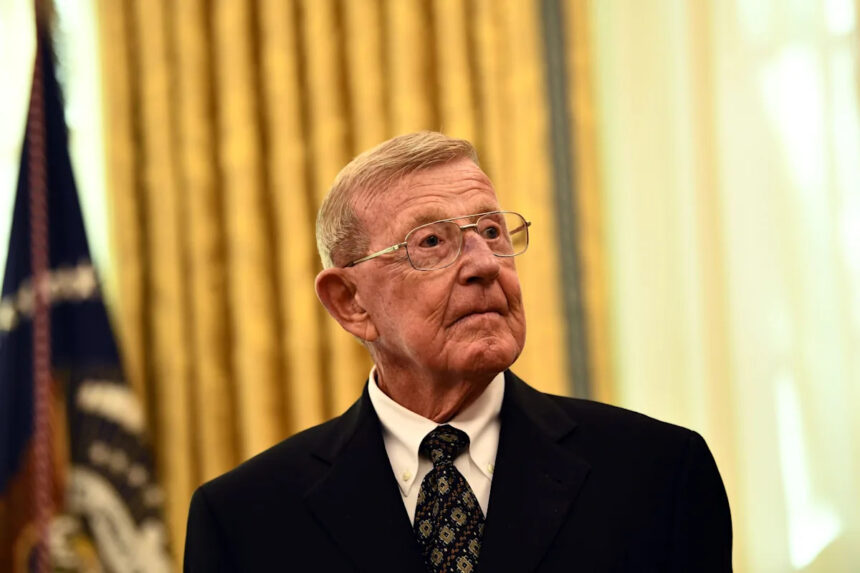
The world of college football has lost one of its most iconic and charismatic figures. Lou Holtz, the former Notre Dame head coach who restored the Fighting Irish to glory and led them to a consensus national championship in 1988, died Wednesday in Orlando, surrounded by his family. He was 89. The news, announced jointly by the University of Notre Dame and the Holtz family, marks the end of an era for a coach whose impact was measured not only in victories but in the profound life lessons he imparted to generations of players.
A Legacy Forged in Grit and Unwavering Belief
Lou Holtz’s journey to the pinnacle of college football was anything but preordained. Standing a slight 5’10” and speaking with a distinctive lisp, he was the antithesis of the prototypical football titan. Yet, what he lacked in physical stature, he compensated for with a towering intellect, an unmatched motivational genius, and a relentless work ethic. His coaching philosophy was a direct reflection of his own life story: that through discipline, faith, and a positive attitude, any obstacle could be overcome and any goal achieved.
His family’s statement captured this essence perfectly: “Holtz is remembered for his enduring values of faith, family, service, and an unwavering belief in the potential of others.” This belief was the bedrock of his coaching. He famously created detailed “Do Right” lists for his players and delivered pep talks that were equal parts strategy session and life sermon. His influence, as noted, “extended far beyond the football field through the Holtz Charitable Foundation and the many players, colleagues, and communities shaped by his leadership.”
The Notre Dame Resurrection: Building a Champion
When Lou Holtz arrived in South Bend in 1986, he inherited a Notre Dame program that had lost its way, suffering through five consecutive non-winning seasons. The challenge was Herculean, but it was the perfect stage for Holtz’s unique talents. He immediately instilled a culture of accountability and excellence. The results were nothing short of spectacular.
From 1986 to 1996, Holtz engineered one of the most dominant runs in modern Notre Dame history:
- 100 victories with the Fighting Irish, placing him among the winningest coaches in the school’s storied history.
- A monumental 23-game winning streak spanning the 1988 and 1989 seasons.
- The program’s first back-to-back 12-win seasons in 1988 and 1989.
- Nine consecutive New Year’s Day bowl game appearances.
But the crown jewel was the 1988 national championship season. Holtz’s Irish, led by quarterback Tony Rice and a ferocious defense, marched to a perfect 12-0 record. The season culminated in a decisive 34-21 victory over West Virginia in the 1989 Fiesta Bowl, securing the consensus national title. That team, known for its toughness and unity, remains the gold standard in South Bend and embodied Holtz’s “us against the world” mentality.
A Coaching Odyssey: From William & Mary to the NFL
While Notre Dame is where Lou Holtz cemented his legend, his coaching tapestry was woven across the entire landscape of football. He was a true program builder, taking on challenges at every level. His career was a testament to his adaptability and teaching prowess.
His head coaching journey began at William & Mary (1969-1971), where he won a Southern Conference title. He then revitalized Arkansas (1977-1983), leading the Razorbacks to multiple bowl wins and a share of the Southwest Conference title in 1979. A brief stint at Minnesota (1984-1985) saw him pull the Gophers out of the cellar. After his storied Notre Dame tenure, he came out of a short retirement to launch South Carolina’s (1999-2004) program into the SEC, famously delivering back-to-back Outback Bowl victories over Ohio State.
Sandwiched within this was a single, tumultuous season with the New York Jets (1976). The NFL experiment was unsuccessful (3-10), but it highlighted a key truth about Holtz: his magic was most potent in the collegiate environment, where he could mold young men holistically. His final career record of 249-132-7 across 33 seasons places him among the winningest coaches in college football history.
Holtz’s Enduring Impact and the Future of His Legacy
In the immediate wake of his passing, the sports world is flooded with tributes from former players, rivals, and analysts, all echoing a similar theme: Lou Holtz changed lives. His legacy is not confined to trophy cases or record books; it lives on in the doctors, businessmen, coaches, and fathers that his players became. His famous quips and motivational one-liners—”Don’t tell me your problems. Ninety percent of them will go away by themselves, and the other ten percent, you can’t do anything about anyway”—will continue to resonate.
From an analytical perspective, Holtz’s death forces a reflection on the evolving nature of coaching. In an era dominated by transfer portals, NIL deals, and high-powered offensive schemes, the Holtz model—built on fundamental toughness, intricate special teams play, and deep personal relationships—feels both nostalgic and timeless. Expert analysis suggests his true legacy is a reminder that culture-building and personal development remain the non-negotiable foundations of sustained success, even as the game’s mechanics change.
Predictions for how he will be remembered are clear: as the last of a certain breed of all-encompassing, program patriarchs. Future coaches will study his ability to maximize talent and instill belief. The Holtz Charitable Foundation, supporting education and religion, ensures his commitment to service endures. At Notre Dame, his shadow will forever loom over the program, a constant benchmark for what is possible when leadership is rooted in conviction and character.
Conclusion: More Than a Coach, A Lifelong Teacher
Lou Holtz’s story is ultimately an American story—of rising from humble beginnings through sheer force of will, intellect, and an unshakeable positive attitude. He was a strategist, a comedian, a father figure, and a philosopher, all rolled into one compact, energetic package. He didn’t just win football games; he won the hearts and minds of those he led, teaching them that the lessons of the practice field—perseverance, teamwork, attention to detail—were the very lessons needed to win at life.
As the Notre Dame family and the wider football world mourn his passing, they also celebrate a life monumentally well-lived. The echoes of his voice in a crowded locker room, his scribbled notes on a locker room whiteboard, and his steadfast values of faith, family, and service will continue to inspire long after the final whistle. Lou Holtz proved that you could build champions without compromising character, and in doing so, he became a champion for us all.
Source: Based on news from Yahoo Sports.