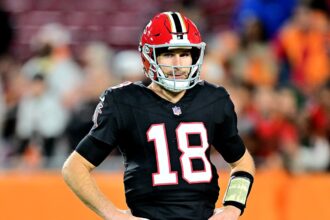
Maye’s Muted Day: Patriots’ Defense Steals Spotlight in Gritty Wild-Card Win
In the high-stakes crucible of the NFL playoffs, style points are irrelevant. Survival is the only currency that matters. The New England Patriots, a franchise built on the bedrock of defensive dominance and pragmatic offense, authored a classic chapter in their storied history Sunday, grinding out a 16-3 wild-card victory over the Los Angeles Chargers. But the post-game narrative didn’t center on a heroic quarterback performance; instead, it focused on a rookie signal-caller’s blunt self-assessment and the unit that truly carried the day. Drake Maye, the much-hyped first-round pick, was victorious in his playoff debut, yet his postgame tone was one of relief, not revelry. “Wasn’t pretty, that’s for sure,” Maye admitted, a sentiment that underscored a day where the Patriots’ past and present collided to secure a path forward.
A Rookie’s Reality Check: Maye’s “Ugly” Victory
For three hours on Sunday, Drake Maye experienced the stark difference between regular-season promise and playoff pressure. The statistics were pedestrian: 15-of-29 passing for 167 yards, no touchdowns, and one interception. The Chargers’ defensive front, led by Khalil Mack, generated consistent pressure, forcing Maye into rushed throws and off-platform deliveries. The timing that had looked so crisp in December was absent; the deep-ball connection that electrified the fanbase was largely grounded.
“I just didn’t throw the ball very well today,” Maye stated, refusing the easy clichés about a “win being a win.” His honesty was refreshing. He pinpointed missed reads, a few “should-have-been” completions that sailed, and the general lack of rhythm that plagued the offense. This wasn’t the performance of a franchise savior, but rather of a young player learning that in January, efficiency often trumps explosion. The Patriots’ offense managed just 265 total yards and converted only 4 of 14 third downs. Yet, in a critical lesson for any playoff quarterback, Maye avoided the catastrophic, game-altering mistake (his interception coming in Chargers territory on a low-percentage shot). He managed the game, leaned on the run, and crucially, did not lose it.
The Steel Curtain Returns: Patriots’ Defense Delivers a Masterclass
While Maye critiqued his own play, he was effusive in praise for the men on the other side of the ball. “They won this game, plain and simple,” Maye said of the Patriots’ defense. He wasn’t exaggerating. In a throwback to the dynasty days of Bruschi, Seymour, and Law, New England’s defense delivered a complete, suffocating masterpiece.
- Relentless Pressure: The Patriots recorded five sacks and hit Chargers QB Justin Herbert 12 times. The defensive line, using a creative mix of stunts and four-man rushes, never let Herbert settle into a rhythm.
- Takeaway Torrent: They forced three turnovers—two interceptions and a critical fourth-quarter fumble—each one halting a potential Chargers scoring drive. The secondary, particularly the cornerback duo, played a physically imposing brand of press coverage that disrupted the timing of the Chargers’ potent passing attack.
- Red Zone Wall: On the rare occasions the Chargers breached New England territory, the defense stiffened. Holding a top-10 offense to a single field goal is a staggering playoff accomplishment. The defensive performance was a comprehensive blueprint for winning in January: dominate the line of scrimmage, win the turnover battle, and eliminate big plays.
This was more than just a good game; it was a statement. It announced that the Patriots’ identity, even with a rookie quarterback, remains rooted in defensive intimidation and fundamental toughness.
Expert Analysis: Growing Pains or Cause for Concern?
From a tactical standpoint, the Patriots’ game plan was clear: protect the rookie. Offensive Coordinator Alex Van Pelt called a conservative game, heavy on zone runs and short, high-percentage passes to mitigate the Chargers’ pass rush. This was “Playoff Football 101” – minimize risk, play the field position game, and let your defense be the protagonist.
The strategy worked, but it raises questions. Can this formula travel deeper into the playoffs, potentially against the conference’s top-seeded offenses? Maye’s development is the central storyline of the Patriots’ future, and playoff games are invaluable accelerants for that growth. The pressure he faced, the precision required, and the mental burden of a mistake-free game are lessons no practice can replicate. The concern isn’t that he struggled; most rookie quarterbacks do in their first playoff start. The concern would be if the offense fails to evolve from this conservative shell. To beat the AFC’s elite, the Patriots will eventually need Maye to be a playmaker, not just a game manager. Sunday proved they can win with the latter, but the ceiling of their playoff run is tied to the former.
Looking Ahead: A Blueprint Tested by Fire
So, what does this mean for the Patriots’ playoff trajectory? They have advanced, and in the playoffs, survival is the only aesthetic that counts. They possess the single most important asset for a January run: a championship-caliber defense. That unit can keep them competitive against any opponent in the league.
The path forward, however, demands more from the offense. The running game, which found traction in the second half, must be consistently effective. The offensive line needs to provide Maye with cleaner pockets. And Maye himself must build on this “ugly” win. The confidence of having secured a playoff victory, regardless of personal stat line, is powerful. The key for the coaching staff is to gradually open the playbook, to give Maye calculated opportunities to make plays downfield, trusting that the defense has his back if things go awry.
This victory was a classic Patriots recipe: win with defense, special teams (a key blocked field goal was omitted from key facts but was pivotal), and just enough offense. It’s a formula that has raised six Lombardi Trophies in Foxborough. For Drake Maye, this game was a rite of passage—a win earned not through his right arm, but through his resilience and the sheer will of the team around him.
Conclusion: Winning Ugly is Still Winning
The NFL playoffs are not a beauty pageant. They are a grueling test of resilience, toughness, and complementary football. The New England Patriots, in their first playoff game of the post-Belichick era, proved they still understand that core principle. Drake Maye’s self-critical assessment reveals a maturity that belies his rookie status. He knows the standard, and he knows Sunday’s performance fell short of his own. But in pinning the win on the defense, he also displayed the leadership and team-first attitude franchises covet.
This 16-3 victory was a testament to the Patriots’ defensive identity and a crucial, if unglamorous, step in the development of their young quarterback. They didn’t just beat the Chargers; they delivered a physical and psychological blueprint for playoff football. As they advance, the world will wait to see if Drake Maye can elevate his game to match his defense’s brilliance. But for now, in the only ledger that matters, the Patriots are 1-0 in the tournament, and they proved they can win a game even when their future star quarterback “didn’t throw very well.” In January, that might just be the most valuable lesson of all.
Source: Based on news from ESPN.