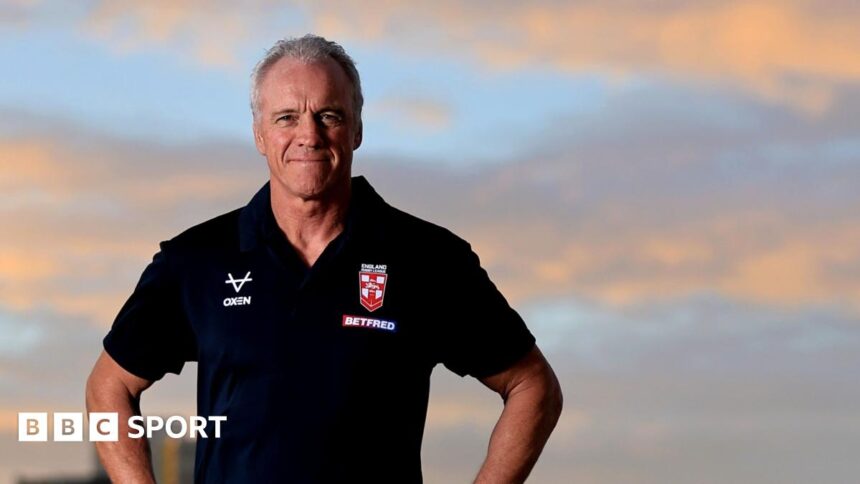
Brian McDermott Appointed as England Men’s Rugby League World Cup Head Coach
In a move that signals a return to proven, trophy-laden leadership, the Rugby Football League has appointed Brian McDermott as the new head coach of the England men’s team for this autumn’s Rugby League World Cup. The 56-year-old Yorkshireman, a figure synonymous with success during his storied tenure at Leeds Rhinos, steps into the role on a part-time basis, tasked with marshalling the nation’s best talent on the sport’s biggest stage. His appointment concludes a meticulous search following Shaun Wane’s departure in January and places a hardened winner at the helm of a nation desperate to end its long wait for global glory.
A Pedigree of Success: The McDermott Blueprint
Brian McDermott’s coaching CV is not just impressive; it is the gold standard in the modern British game. His eight-year reign at Headingley from 2010 to 2018 was a period of unprecedented domestic dominance. Under his steely guidance, Leeds Rhinos transformed into a relentless winning machine, capturing an astonishing eight major trophies. This haul included:
- Four Super League Grand Finals (2011, 2012, 2015, 2017)
- Two Challenge Cups (2014, 2015)
- Three League Leaders’ Shields (2015, 2017, 2018)
- The 2012 World Club Challenge
This record is critical to understanding the RFL’s decision. McDermott is a coach who knows how to construct teams for knockout football, for the high-pressure cauldron of a final. His Leeds sides were renowned for their physicality, resilience, and tactical nous—qualities that have sometimes been found wanting in England’s previous World Cup campaigns. His current role as an assistant at the NRL’s Gold Coast Titans also provides a crucial, up-to-the-minute insight into the Australian rugby league psyche, the very obstacle England must overcome to lift the Paul Barrière Trophy.
Navigating the Part-Time Paradox and a Competitive Shortlist
The most intriguing aspect of McDermott’s appointment is its part-time nature, a stark contrast to the full-time regime of his predecessor, Shaun Wane. This structure presents both a challenge and a potential masterstroke. The challenge is clear: building cohesion, implementing complex systems, and fostering a deep coach-player connection is inherently more difficult without day-to-day involvement.
However, the potential upside is significant. McDermott’s part-time role with England allows him to remain immersed in the day-to-day intensity of the NRL, arguably the world’s toughest competition. He will be scouting opponents, analysing trends, and working at the cutting edge of the sport, knowledge he can directly import into the England setup. It requires a coach of immense organisational skill and clarity of vision—traits McDermott has in abundance.
His selection also came from a position of strength. The RFL’s five-man shortlist was packed with credible alternatives: the experienced Brad Arthur, the fiery Sam Burgess, the innovative Paul Rowley, and the internationally seasoned Steve McNamara. Choosing McDermott from this field indicates the selection panel prioritised proven, big-game trophy experience above all else. It is a safe-hands appointment, but one made with the specific, pressurized context of a World Cup in mind.
Expert Analysis: What McDermott Brings to the England Camp
McDermott’s England will likely be built on the foundational principles that served him so well at Leeds: uncompromising forward dominance, disciplined execution, and a relentless work ethic. He is not a coach known for flamboyant, off-the-cuff attacking structures; instead, he focuses on winning the middle, earning the right to play, and being brutally effective in the opposition’s red zone. This pragmatic approach could be perfectly suited to tournament football, where errors are punished mercilessly.
His man-management will be key. McDermott, a former Royal Marine, has a unique ability to build hardened, united squads. He commands respect not just through his achievements, but through a direct, no-nonsense communication style. His task will be to quickly forge a singular identity from a squad comprising stars from rival Super League clubs and the NRL. Furthermore, his experience in handling elite, big-match players—think Kevin Sinfield, Jamie Peacock, and Danny McGuire at Leeds—will be invaluable in managing the expectations and pressures on stars like George Williams, Harry Newman, and Tom Burgess.
The major question mark will be how his tactical approach translates against the fluid, high-speed game of Australia and New Zealand. Can a part-time coach develop the nuanced systems needed to break down these giants? McDermott’s counter-argument is his track record: he repeatedly found a way to win when it mattered most.
World Cup Predictions: A New Hope for English Rugby League?
The 2025 Rugby League World Cup presents a monumental opportunity for England on home soil. With McDermott at the helm, expectations will rightly elevate. Here is what we can anticipate:
- A Physically Imposing England: The pack will be the heartbeat of the campaign. Expect a focus on size, power, and quick play-the-balls to lay the platform.
- Selection Certainty: McDermott is unlikely to tolerate inconsistency. Players will be selected on form and their ability to execute a specific, demanding role within the team structure.
- The Key Challenge: Beating Australia or New Zealand in a semi-final or final. McDermott’s job will be judged on this single metric. His experience in one-off finals is his greatest asset heading into this challenge.
- The Verdict: McDermott’s appointment makes England a more formidable and predictable opponent. It significantly increases the likelihood of a strong, deep tournament run culminating in a final appearance. Whether it provides the final, marginal gain to topple the southern hemisphere giants remains the sport’s defining question.
Conclusion: A Leader Forged in the Crucible of Success
The Rugby Football League has chosen a path defined by proven pedigree. In appointing Brian McDermott, they have selected a leader whose very career is a blueprint for winning the biggest games under the brightest lights. While the part-time model is an experiment, it is one conducted with a coach who possesses the tactical acumen, the fierce mentality, and, most importantly, the medal collection to justify the gamble.
This autumn, England will not be led by a theorist or a long-term project manager, but by a winner. McDermott’s task is not to reinvent English rugby league, but to refine it, harden it, and instill the cold, clinical mindset that has eluded the national side at the final hurdle for decades. The message is clear: England are not just coming to compete in the World Cup; under Brian McDermott, they are coming to win it.
Source: Based on news from BBC Sport.