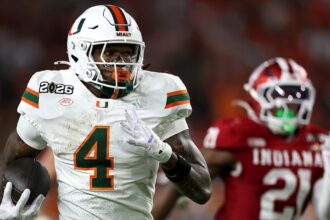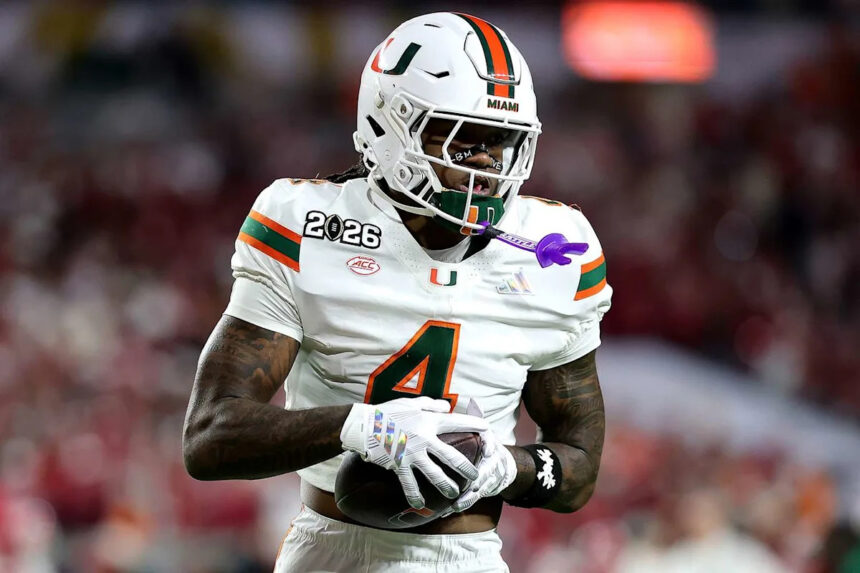
Championship Chaos: Miami’s Mark Fletcher Jr. Throws Punch at Indiana’s Tyrique Tucker in Post-Game Melee
The confetti had barely settled on the Lucas Oil Stadium turf, the echoes of Indiana’s historic, program-altering victory still ringing in the rafters. But in the shadow of the Hoosiers’ crowning moment, a starkly different scene unfolded. Moments after Indiana sealed its first-ever national championship, a shocking altercation erupted, as Miami Hurricanes star running back Mark Fletcher Jr. threw a punch at Indiana defensive back Tyrique Tucker, casting a pall over the celebration and igniting an immediate firestorm of controversy.
A Collision of Emotion in the Aftermath of History
For Indiana, the 34-31 victory was nothing short of a fairy tale. The program, long saddled with the unenviable moniker of “the once most-losingest school in college football,” had finally reached the mountaintop. For Miami, it was a crushing end to a brilliant season, a dream denied on the grandest stage. This volatile cocktail of euphoria and devastation set the scene. As players from both teams began to intermingle—some offering congratulations, others grappling with despair—tempers flared near the Miami sideline.
Witnesses and video footage show Fletcher, the Hurricanes’ powerful offensive engine, in a heated verbal exchange with Tucker, a key part of Indiana’s secondary. The conversation escalated rapidly. In a flash of raw emotion, Fletcher lunged forward and threw a punch in Tucker’s direction. Tucker, showing restraint, quickly backpedaled to avoid the blow, as teammates and staff rushed in to separate the two players. The incident was brief but explosive, a jarring contrast to the sportsmanship Fletcher displayed just minutes earlier when he sought out and congratulated Indiana quarterback Fernando Mendoza.
Deconstructing the Flashpoint: What Went Wrong?
This incident presents a complex case study in competitive emotion. The immediate post-game environment is a pressure cooker of adrenaline, heartbreak, and exhaustion. Expert analysis from sports psychologists suggests such altercations are rarely about a single play, but rather the culmination of a game’s physical and mental toll.
- Emotional Whiplash: Fletcher had just experienced the most devastating loss of his career mere seconds before the confrontation. The human brain, flooded with stress hormones, can lash out irrationally.
- Trash Talk Turning Toxic: It is highly likely that verbal sparring, a constant throughout the intense championship battle, continued after the whistle. What is competitive banter during play can become incendiary fuel in a loss.
- The Restraint of the Victor: Tyrique Tucker’s decision to back away was critically important. It prevented a full-scale brawl and demonstrated a level of composure that often comes from being on the winning side.
- The Duality of Fletcher: The running back’s actions present a paradox—the same player who could engage in a violent act also made a point to seek out and honor his opponent, Mendoza. This underscores how emotion can fracture a player’s conduct in seconds.
The heated confrontation raises immediate questions about player safety protocols once the clock hits zero and the lines between competition and conflict blur.
Immediate Fallout and Long-Term Ramifications
The repercussions of this incident will be swift and significant. Both universities and the NCAA will undoubtedly launch investigations. The focus will be on Fletcher’s actions, but officials will review the entire sequence to assign responsibility.
Potential consequences for Mark Fletcher Jr. could include:
- Suspension: A multi-game suspension to start the next season is the most likely outcome, setting back both the player and the Miami offense.
- Internal Discipline: Miami head coach Mario Cristobal is known for a disciplined program. Internal sanctions, including mandatory counseling and community service, are assured.
- Draft Stock Impact: For a player of Fletcher’s caliber, NFL scouts note everything. An incident labeled as “poor emotional control” in a high-stakes moment can become a red flag on draft boards.
- Program Perception: While Indiana’s program is forever elevated, Miami risks being defined by this moment of poor sportsmanship, a stain on an otherwise remarkable season.
For Indiana, the incident is an unfortunate footnote to their triumph. Tyrique Tucker’s composed response will be praised, and the program will likely use the event as a teaching moment on handling victory with grace.
Looking Ahead: Lessons for the Sport
This national championship game will be remembered for two histories: Indiana’s miraculous rise and the post-game punch that threatened to overshadow it. As the dust settles, the college football world must look forward and adapt.
Predictions for the coming months include a standard one-to-two-game suspension for Fletcher, coupled with a public apology. More broadly, we may see conferences implement more structured post-game protocols, potentially involving officiating crews remaining on the field longer or designated “cooling-off” periods before teams intermingle. Coaches will undoubtedly place renewed emphasis on finish-the-game drills in practice, teaching players how to transition from warrior to sportsman in the blink of an eye.
The legacy of this game is now bifurcated. Indiana’s victory is immortal, a testament to perseverance. But the altercation serves as a powerful, cautionary tale. It reminds us that the line between passion and peril is razor-thin, and that true championship character is tested not only in the struggle to win, but in the grace with which one handles both victory and defeat. The hope is that from this unsavory moment, both players and the sport they love can learn, grow, and ensure that the focus remains where it belongs—on the historic achievements forged between the whistles, not the chaos that followed.
Source: Based on news from Yahoo Sports.