


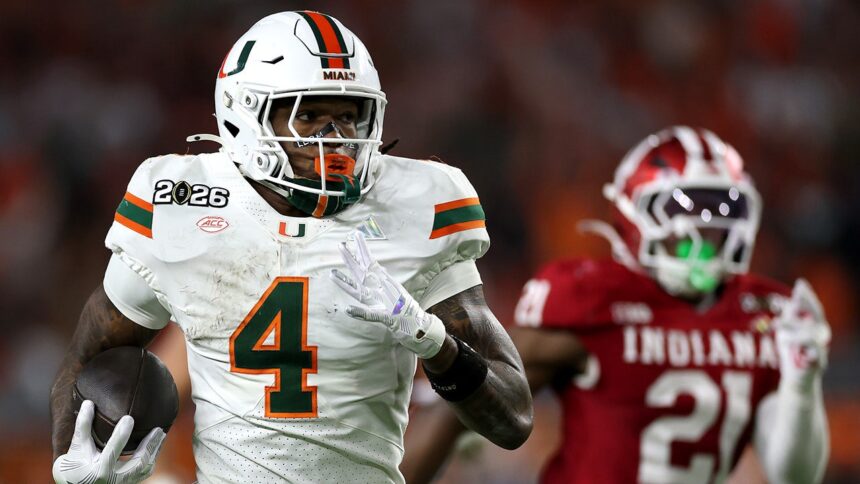
Miami’s Mark Fletcher Jr. Throws Punch at Indiana Player in Stunning Post-Game Eruption
In a shocking coda to a fiercely contested national championship, the raw emotion of a crushing defeat boiled over into an ugly physical confrontation. Moments after the Indiana Hoosiers sealed a dramatic 27-21 victory over the Miami Hurricanes to claim the 2026 College Football Playoff title at Hard Rock Stadium, ESPN cameras captured Miami star running back Mark Fletcher Jr. throwing a punch at Indiana defensive lineman Tyrique Tucker. The incident, unfolding amidst the confetti and chaos, instantly overshadowed the Hoosiers’ triumph and cast a pall over the culmination of the college football season. The altercation occurred just yards away from a VIP section that included former President Donald Trump, who attended the game with his daughter Ivanka and her son Kai, adding an unexpected political lens to the sports controversy.
A Championship Dream Ends, A Flashpoint Ignites
The game itself was an instant classic. Led by Fletcher’s powerful running, Miami battled back from a 10-point deficit, bringing the home crowd to a fever pitch. With under two minutes to play, the Hurricanes drove deep into Indiana territory, trailing by six. On a critical 4th-and-3, Fletcher took a swing pass but was stopped a yard short by a swarm of Hoosiers, a group that prominently featured Tyrique Tucker. The turnover on downs sealed Indiana’s first national championship and sent their sideline into delirium.
As both teams began to converge on the field for post-game handshakes, the ESPN broadcast caught Fletcher and Tucker in a heated verbal exchange. Words were exchanged, faces contorted with emotion. Then, clearly visible to millions watching, Fletcher stepped forward and threw a right-handed punch toward Tucker’s head. Tucker appeared to duck or deflect the blow, and staff and players from both teams immediately rushed in to separate the two, restraining a visibly furious Fletcher from escalating the fight further.
The scene was one of stark contrast: on one side, Indiana players celebrating a lifelong achievement; on the other, a Miami player’s dream disintegrating into a moment of infamy. The presence of high-profile spectators, including the former president, only amplified the national spotlight on the transgression.
Expert Analysis: The Psychology of a Crushing Loss
To understand the eruption, one must understand the stakes. We spoke with Dr. Elena Rodriguez, a sports psychologist who has worked with collegiate athletes. “This is the pinnacle of emotional investment,” she explained. “Mark Fletcher Jr. isn’t just losing a game; he’s watching a national championship, likely a childhood dream, slip away in front of his home fans. The brain in that moment is in a state of high stress, threat, and profound loss. The prefrontal cortex—responsible for impulse control and decision-making—is essentially hijacked by the amygdala, the emotional center.”
Dr. Rodriguez emphasized that this is not an excuse, but a framework. “The exchange with the Indiana player was the trigger. In that heightened state, any perceived taunt, glare, or comment can feel like a profound disrespect that demands a physical response. It’s a primitive, fight-or-flight reaction in a setting that demands absolute composure. The fact that it happened on national television, under the brightest lights, will only compound the personal and professional repercussions for Fletcher.”
Key factors that likely contributed to the flashpoint:
- The Nature of the Defeat: A close, winnable game lost on a final, failed drive where Fletcher was directly involved.
- Individual Matchup: Fletcher and Tucker had been battling in the trenches all night; the final stop created a natural victor-vanquished dynamic.
- Home Stadium Setting: Losing at home amplifies feelings of embarrassment and letting down one’s community.
- Immediate Aftermath: There is no cooling-off period; the loss and the opponent’s celebration are simultaneous.
Immediate Repercussions and Long-Term Fallout
The fallout from the punch will be swift and severe. The NCAA, conferences, and individual universities have strict codes of conduct regarding sportsmanship, especially in post-game settings. Miami’s athletic department released a terse statement in the early hours of Tuesday morning: “We are aware of the incident involving Mark Fletcher Jr. after tonight’s game. We are gathering all available information and will handle this matter internally in accordance with university and ACC policies. This behavior does not represent the values of our university or our football program.”
Potential consequences for Mark Fletcher Jr. could include:
- A multi-game suspension to start the 2026 season, if he returns for another college year.
- Mandatory anger management and sports psychology counseling.
- A permanent stain on his collegiate legacy, overshadowing his on-field accomplishments.
- Impact on his NFL Draft stock, as teams rigorously assess character and composure under pressure.
For the Miami program, the incident mars what was otherwise a resurgent season that ended in the national title game. Head coach Mario Cristobal, known for preaching discipline and “culture,” now faces his first major crisis of character within his roster. How he handles the punishment and messaging will be scrutinized heavily on the recruiting trail.
Indiana, meanwhile, must navigate having its championship moment partially defined by an opponent’s actions. Tyrique Tucker and the Hoosiers’ staff handled the de-escalation professionally, a fact that will work in their favor in the court of public opinion.
Looking Ahead: A Defining Moment for Player and Program
This single moment becomes a fork in the road for all involved. For Mark Fletcher Jr., this is now a defining moment of his young career. His response in the coming weeks and months will reveal his true character. A sincere, public apology, acceptance of full punishment, and a demonstrable commitment to personal growth can begin the long process of reputation repair. If he declares for the NFL Draft, he will face a barrage of questions about this incident in every team interview.
For the Miami Hurricanes, this is a critical test of institutional control. The program’s return to “The U” of old must be built on talent and swagger, not unchecked emotion and post-game violence. Cristobal’s response must be firm, fair, and transparent to send a clear message to his locker room and to the nation.
For college football, it’s a stark reminder of the volatile intersection of elite competition, youthful emotion, and immense pressure. The sport celebrates passion, but the line between passion and disgrace is razor-thin, especially when millions are watching, and history is being written.
Conclusion: A Championship Marred, Lessons to be Learned
Indiana’s 27-21 victory will forever be remembered as their first national championship. Unfortunately, for many, the first memory that will surface is the sight of Miami’s star running back throwing a punch in defeat. The incident, witnessed by a former president and a nation, lays bare the brutal psychological toll of coming up short on sports’ biggest stages.
While the Hoosiers will rightfully celebrate their achievement, the story exiting the 2026 season is one of a moment lost to anger. The hope now is that this public failure becomes a catalyst for private growth. Mark Fletcher Jr.’s powerful running brought Miami to the brink of glory; his inability to control his fury in its aftermath is the lesson he must now carry forward. In the end, the true measure of an athlete is not just how they perform in victory, but how they conduct themselves in the most shattering of defeats. That test was failed on Monday night, and the consequences will echo long after the championship confetti is swept away.
Source: Based on news from Fox Sports.


