The Most Carson Beck Ending: Social Media Erupts as Interception Seals Miami’s Title Game Fate
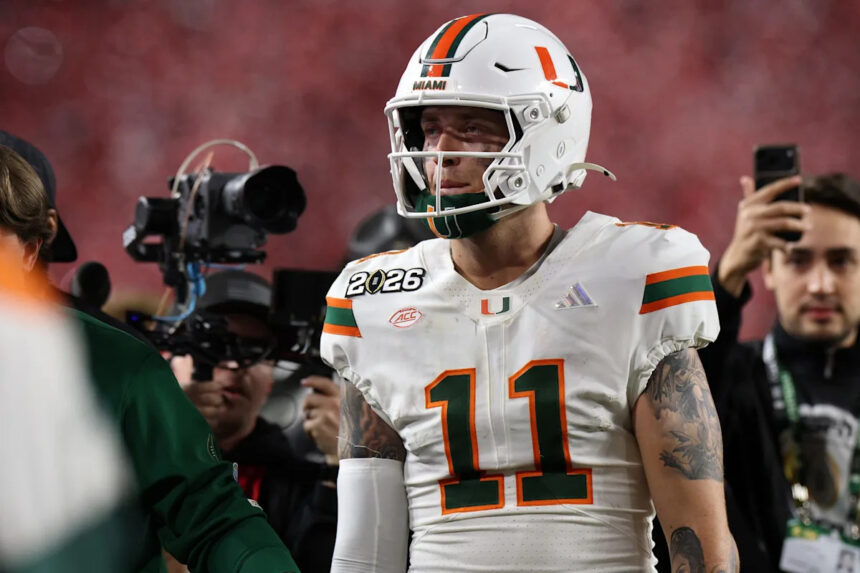
In the cavernous silence of Hard Rock Stadium, with 44 seconds separating the Miami Hurricanes from a potential storybook ending, the narrative chose its author. Carson Beck, the celebrated transfer brought home to deliver a national championship, dropped back, looked left, and released his final pass in orange and green. Indiana safety Jamari Sharpe cut in front of the receiver, cradled the football, and with it, the hopes of a city. As the Hoosiers’ sideline erupted in confetti-soaked jubilation, a familiar, gut-wrenching quiet fell over the Miami faithful. It was, in every tragic, predictable, and brilliant way, the most Carson Beck ending imaginable. And social media, as it does, immediately began to write the epitaph for a career defined by dazzling highs and devastating lows.
A Transfer Tale of Triumph and Tribulation
When Carson Beck announced his decision to transfer from Georgia to Miami, it was hailed as a program-altering coup. He was the polished, pro-ready quarterback chosen to replace the dynamic Cam Ward and pilot Mario Cristobal’s Hurricanes on their long-awaited College Football Playoff run. By most statistical measures, Beck delivered on that monumental promise. He orchestrated a lethal offense, finishing second in the nation with a .733 completion percentage and throwing for 3,581 yards and a career-best 29 touchdowns. His precision was a weapon, his arm talent undeniable. He engineered a thrilling comeback in the semifinal and, even in the title game loss, showcased resilience, shaking off a historically bad first half to put Miami in position to win.
Yet, woven into the fabric of this successful season was a persistent, fraying thread: the untimely interception. Beck’s 2024 campaign was a paradox of elite efficiency punctuated by catastrophic mistakes. The numbers tell a stark story:
- 12 total interceptions thrown during the season, leading his conference for the second consecutive year.
- 7 of those 12 picks occurred in Miami’s three losses.
- Against Louisville: A fourth interception sealed a defeat.
- At SMU: His second INT came on Miami’s first overtime possession.
- Versus Indiana: The only turnover of the game ended the national championship.
Beck returned for his final college season, in part, to shed the “interception-prone” label that followed him from Athens. Instead, in the brightest spotlight, it became his defining legacy.
Social Media Reacts: From Sympathy to Scorn
In the immediate aftermath of the interception, the digital town square fractured into distinct camps. The reaction was a raw, unfiltered dissection of a quarterback’s entire career in 280-character bursts.
One segment of fans and analysts framed the moment with heartbreaking context. They highlighted Beck’s heroic second-half performance, where he went 10 of 17 for 183 yards and a dazzling touch-pass touchdown to Malachi Toney, nearly willing a dead offense back to life. “People will only remember the pick,” tweeted one prominent CFB writer, “but without Beck, Miami isn’t even in that game after that first half. The offense had 69 total yards. He almost pulled off a miracle.” This camp viewed the ending as a cruel, cinematic tragedy—the flawed hero succumbing to his one fatal flaw at the climax.
Conversely, a louder, more visceral wave of response focused solely on the result. Memes comparing Beck to infamous Miami quarterbacks of past failures flooded timelines. Jokes about the “Georgia transfer curse” gained traction. The sheer predictability of the moment became its own punchline. “You could see it coming from the tailgate,” read one viral post. “Third loss, final drive, Beck pick. It was written in the stars.” For this group, the final offensive play of the national championship game wasn’t an anomaly; it was the inevitable conclusion of a season-long pattern.
Perhaps the most poignant reactions came from those who saw the play as a metaphor for Beck’s complex career. “Carson Beck is the quarterback who can make every throw on the planet,” observed a former NFL scout, “except the one you need him to make with the season on the line. His highlight reel and his lowlight reel are both All-American caliber.” This dichotomy—the sublime talent versus the crippling mistake—became the central theme of the night’s discourse.
Expert Analysis: The Weight of the Moment
Breaking down the play itself, several factors converged to create “The Most Carson Beck Ending.” First, the context: a historically poor first half by the entire Miami offense placed an unsustainable burden on Beck’s shoulders. The Hurricanes’ 69 first-half yards were the lowest ever in a CFP national championship game, forcing Beck into a perpetual comeback mode against a disciplined Indiana defense.
Second, the decision. On the fateful 2nd-and-10, Beck appeared to lock onto his primary receiver from the snap. Indiana’s Sharpe, reading Beck’s eyes and plant foot the entire way, made a break on the ball that Beck either didn’t see or believed he could beat. It was not an arm-punt under pressure; it was an aggressive, in-rhythm throw into coverage—the kind of risk that had fueled Miami’s comeback but also haunted their losses.
“This is the Carson Beck conundrum in a nutshell,” said an ESPN analyst post-game. “The same aggressive confidence that gets you 183 second-half yards in a title game is the one that can lose it. He doesn’t play scared. But tonight, against that coverage, it needed to be a throwaway. The legacy of a quarterback is often defined by about five throws in their entire career. This one will define his.”
The analysis underscores a brutal truth in sports: narrative is often dictated by the final chapter. Beck’s 29 touchdowns, his record completion percentage, and his playoff run will be footnotes for many. The interception that plagued Beck all season returned at the absolute worst time, etching his name in a specific and painful category of college football history.
Looking Ahead: Legacy and the NFL Draft
Where does this ending leave Carson Beck’s legacy and his professional future? The immediate aftermath is a storm of disappointment, but NFL scouts have been evaluating his entire body of work for years. His draft stock will be a fascinating case study in how teams weigh tangible traits against intangible clutch performance.
Beck’s NFL prospects remain solid, likely in the Day 2 range. His size, pocket presence, and elite accuracy on short-to-intermediate throws are coveted traits. However, the championship game tape will be a central part of every pre-draft interview. Teams will ask pointed questions about decision-making under pressure and his propensity for turnovers in big games. He will need to convince a franchise that the final throw was a correctable error, not a character trait.
For the Miami Hurricanes, the path forward is both painful and clear. The program proved it could reach the summit under Cristobal, but the final step remains elusive. The search for a new quarterback begins, with the memory of this ending serving as a stark reminder of the fine line between glory and heartbreak. The ‘Canes must find a signal-caller who can harness Beck’s undeniable gifts while excising the catastrophic mistake.
As for Beck, his college career concludes not with a Heisman or a championship ring, but with a haunting, viral moment. He accomplished his goal of taking Miami to the playoff, yet failed in his mission to rewrite his own story. In the end, the quarterback who transferred home to create a new ending instead authored the perfect, tragic final sentence to his old one.
Conclusion: The Unforgiving Final Frame
Sports history is a ruthless editor. It often discards the compelling middle chapters and fixates on the first and last pages. For Carson Beck, his Miami story will be bookended by immense hope and a single, devastating interception. “The Most Carson Beck Ending” is not a critique of his talent, which is prodigious, nor his toughness, which was displayed in a valiant second-half fight. It is an acknowledgment of a cruel poetic consistency. In all three of Miami’s losses, the final offensive play was a Carson Beck interception. That is not a coincidence; it is a pattern, and patterns become legacies.
On social media, the reactions—angry, sympathetic, meme-ready—will fade. The highlight of Jamari Sharpe’s interception will be condensed into montages of championship moments for years to come. And Carson Beck will move on, likely to an NFL field, carrying with him the weight of a throw that, fair or not, came to define him. In college football, where legend and lament are separated by inches and seconds, the final frame is often the only one that remains in focus. For Beck and Miami, that frame is forever frozen, a heartbreaking snapshot of a dream ending in the most predictable, and thus most devastating, way possible.
Source: Based on news from Yahoo Sports.