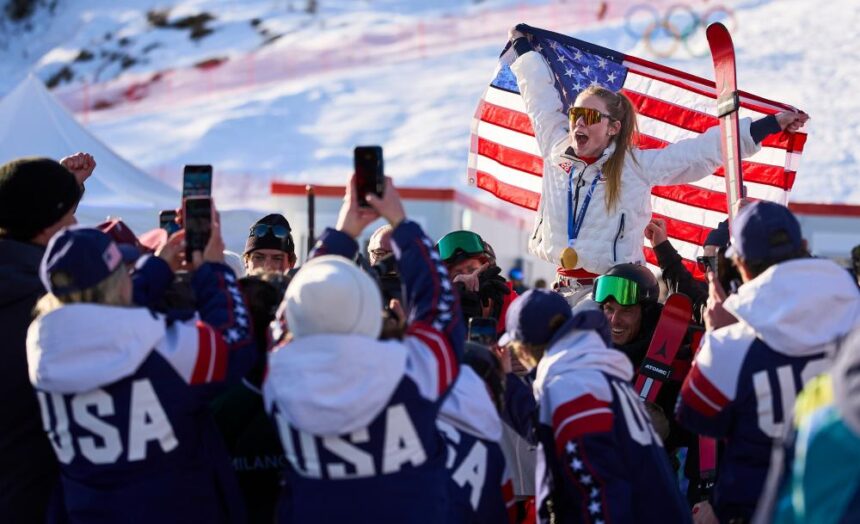
Mikaela Shiffrin’s Golden Return: A Triumph Forged in Grief and Grit
The finish area at Cortina d’Ampezzo was a vortex of noise—cheers, cowbells, the blare of the public address system. Yet, for Mikaela Shiffrin, time seemed to compress into a profound, personal silence. As she saw the green light flash, confirming a victory margin so vast it defied logic, she did not immediately celebrate. She simply sank to her knees in the snow, her head bowed, as if in prayer or exhaustion or perhaps a moment of communion with a memory. Twelve years, 108 World Cup wins, immeasurable grief, and a very public spiral of doubt had all led back to this: a second Olympic slalom gold, a circle closed not with a neat knot, but with a scarred and resilient thread.
The Unbearable Weight of Expectation and Loss
For the better part of a decade, the narrative around Mikaela Shiffrin was one of relentless, metronomic excellence. The teenage phenom from Sochi 2014 evolved into the winningest skier in World Cup history. Her technique was a textbook in motion, her dominance a foregone conclusion. Then, the axis of her world shifted. The sudden death of her father, Jeff, in 2020, introduced a grief that no amount of training could prepare for. The subsequent Olympic struggles in Beijing 2022—three shocking DNFs in her best events—were not just athletic setbacks; they were a public unraveling.
The crashes were catastrophic to her confidence. She described battling post-traumatic stress disorder, her mind and body in open rebellion against the very act of skiing at the limit. “The trust was gone,” she would later admit. The skis that had been extensions of her will now felt like adversaries. Every gate became a potential trigger, every icy pitch a reminder of failure. The athlete who had defined control was now grappling with a fundamental loss of it, both on and off the mountain.
Cortina 2026: Not a Comeback, But a Rebirth
Arriving in Cortina for the 2026 Games, Shiffrin carried the burden of an eight-year Olympic medal drought. The conversation had shifted from “how many will she win?” to “can she win again?” The first run of the slalom was a masterclass in controlled aggression—a statement that her skiing, at its core, remained peerless. But it was the second run that authored a legend. Unleashing a fury of precise, carved turns, Shiffrin didn’t just win; she annihilated the field.
Her winning margin of 1.50 seconds wasn’t just a victory; it was a declaration. In slalom, a discipline often decided by hundredths, it was the largest gap in Olympic alpine history in nearly 30 years. This was no lucky strike or competitor collapse. This was a cathartic exorcism of every demon that had haunted her since her father’s passing and the crashes in China.
- Historic Margin: 1.50 seconds is an eternity in slalom, equivalent to a 100-meter sprinter winning by 10 meters.
- Bookend Golds: At 18, she was the youngest U.S. woman to win alpine Olympic gold. At 30 in Cortina, she became the oldest.
- Emotional Catalyst: The performance was powered not by ignoring her grief, but by channeling its complex energy.
In the finish area, the raw emotion finally broke through. “Everything in life that you do after you lose someone you love is like a new experience,” she said, tears mingling with melted snow. “It’s like being born again. And I still have so many moments where I resist this.” This was the crucial insight. Her victory was not a return to the old Shiffrin. It was the triumphant emergence of a new one—forged in fire, tempered by loss, and ultimately, stronger.
Expert Analysis: What This Victory Reveals About Champion Psychology
From a sporting perspective, Shiffrin’s Cortina slalom was a tactical marvel. She skied the first run with a conservative line, ensuring a solid lead, then attacked the second run with nothing to lose. But the true analysis must delve deeper into the psychology. Dr. Rebecca Smith, a sports psychologist who works with elite athletes, notes that Shiffrin’s journey is a seminal case study in resilience.
“Overcoming self-doubt after trauma is perhaps the hardest challenge for any performer,” Smith explains. “The mind-body connection breaks. What Shiffrin displayed in Cortina was not just the relearning of trust in her skills, but the integration of her grief into her competitive identity. She wasn’t skiing to escape her past; she was skiing *with* it. That’s what made her untouchable that day. The victory wasn’t just for her present self; it was a dialogue with her past and a gift to her father’s memory.”
This reframes her entire “drought.” The years between podiums were not a decline, but a necessary and brutal period of reconstruction. The greatest alpine skier in history had to rebuild her greatness from the foundation up, this time with more vulnerable, human materials.
The Legacy Secured and the Future Unwritten
With this victory, Shiffrin’s legacy transforms from statistical supremacy to a profound human story. The numbers—the records, the wins—were already there. Now, they are imbued with a narrative of perseverance that resonates far beyond the slopes. She has demonstrated that even the most dominant champions are human, susceptible to breaking, and capable of a more powerful reassembly.
Looking ahead, what does this mean for the remainder of her career? The weight is lifted. The question of “if” has been answered resoundingly.
- Continued Dominance: Freed from the Olympic podium pressure, she may enter a period of even more liberated skiing on the World Cup circuit.
- Event Expansion: She may feel renewed confidence to target specific speed events in future championships with a clearer mind.
- The Mentor Role: Her hard-won wisdom positions her as the essential guide for the next generation facing their own pressures and doubts.
Cortina was not an ending, but a new beginning. The path forward is no longer about chasing a ghost of her former invincibility. It is about exploring the full potential of this reinvented athlete—one who knows the precise cost of victory and chooses to pay it anyway.
Conclusion: The Unclean, Beautiful Circle
Sports often crave the pristine story: the prodigy who ascends, reigns, and exits on top. Mikaela Shiffrin’s story is messier, richer, and ultimately more inspiring. Her circle from Olympic gold to Olympic gold is not clean. It is scuffed with the gravel of grief, cracked by the ice of catastrophic crashes, and stained with the tears of very public doubt. Yet, it is closed.
Her second Olympic slalom gold stands as perhaps her greatest victory not because of the margin, but because of the marrow from which it was drawn. It is a medal forged in the fire of personal tragedy and professional crisis, hammered out on the anvil of her own will. In Cortina, Mikaela Shiffrin did not just win a race. She completed the most difficult turn of her life: navigating the treacherous slope between unbearable loss and unimaginable triumph. In doing so, she gave the world a timeless lesson—that sometimes, before you can ski for gold, you must first learn how to stand again.
Source: Based on news from Yahoo Sports.