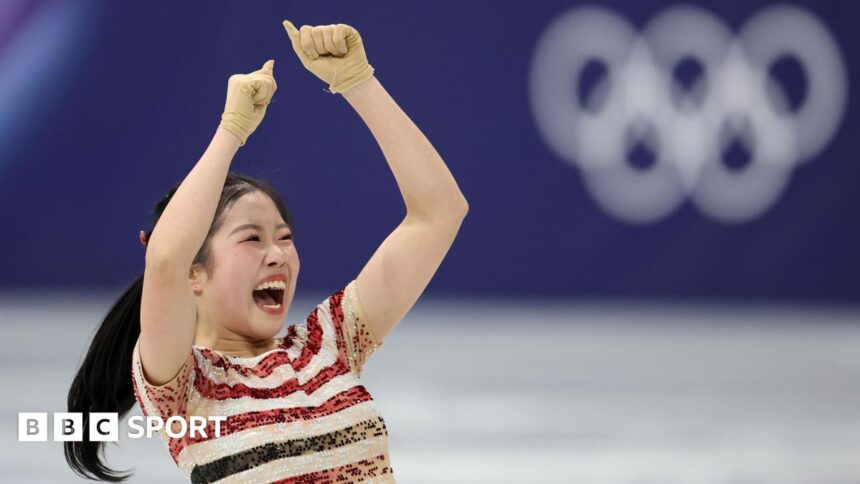
Nakai, 17, Storms to Short Program Lead as Japan’s Skaters Dominate Olympic Stage
The ice at the 2026 Milan-Cortina Winter Olympics witnessed a seismic shift in the women’s figure skating landscape on Wednesday. In a stunning display of precision and poise, 17-year-old Ami Nakai of Japan delivered a career-defining performance to seize the lead in the women’s short program, spearheading a commanding Japanese assault on the podium. With three skaters in the top four, Japan has not just entered the conversation for gold; they have authored its opening chapter, leaving a stunned field of global contenders in their elegant wake.
A Star is Born: Nakai’s Flawless Ascent
Under the immense pressure of the Olympic spotlight, Ami Nakai transformed potential into perfection. Skating with a maturity that belied her 17 years, Nakai executed a pristine program that earned a season-best score of 78.71. Every element, from her soaring triple flip-triple toe loop combination to her lightning-fast spins, was delivered with unwavering confidence. Her performance was more than just technical mastery; it was a narrative of a new generation fearlessly claiming its moment. “To skate like that here, it was my dream,” Nakai said through a translator post-skate. The score, a personal triumph, also served as a statement of intent, placing her ahead of established champions and setting a formidable benchmark.
The contrast in fortunes was starkest when compared to the American camp. Reigning world champion Alysa Liu, heavily favored for gold, faltered on her opening combination, a mistake that relegated her to third place despite a valiant recovery. Her teammate, the powerful Amber Glenn, suffered a more devastating fate, with two major errors leaving her well outside the top ten. Japan’s skaters took full advantage of errors by the fancied Americans, capitalizing on the opening with clinical precision. This wasn’t merely about skating clean; it was about seizing an Olympic opportunity with both hands.
Japan’s Depth: A Dynasty in the Making
Nakai’s headline-grabbing performance was merely the apex of a broader Japanese dominance. The nation’s strength in depth was on full display, showcasing a pipeline of talent that is the envy of the skating world.
- Kaori Sakamoto (2nd Place): The three-time world champion and reigning Olympic bronze medalist brought her signature powerful skating and unmatched speed. While not perfect, her championship composure kept her firmly in the hunt, a mere 1.52 points behind her younger teammate. Sakamoto’s experience in the long program will be a massive factor.
- Mone Chiba (4th Place): The bronze medalist at last year’s worlds delivered a lyrical and graceful program. Sitting in fourth, she remains a potent threat, capable of vaulting onto the podium with the explosive free skate she is known for.
This collective strength creates a unique psychological advantage. The Japanese skaters, training mates and compatriots, draw strength from each other’s success, forming a wave of momentum that can overwhelm isolated contenders. Their technical consistency, artistic refinement, and mental fortitude have converged at the perfect time, establishing Japan as the dominant force in women’s figure skating.
The Stage is Set: A High-Stakes Free Skate Showdown
With the short program order reshuffling the expected hierarchy, the free skate on Thursday evening promises a dramatic and unpredictable battle. All eyes will be on the final flight, where the podium places will be decided in a tense, high-stakes showdown.
Ami Nakai will skate last of the 24 contenders, a position of both privilege and immense pressure. Holding the lead means she will know exactly what she needs to do to win Olympic gold. However, the weight of expectation and the gaze of the world will test her young nerves. Can she replicate the magic of the short program under even brighter lights?
Chasing her will be a vengeful Kaori Sakamoto. The veteran knows how to win on the biggest stages and will unleash a technically demanding program to reclaim the top spot. Alysa Liu, sitting in third, is the ultimate wildcard. Known for her jumping prowess, she is more than capable of landing the quadruple jumps needed to make up the deficit, setting the stage for a potential epic comeback. The question is whether the short program stumble has fractured her confidence or fueled her fire.
Predictions and Legacy: Who Will Stand on the Podium?
Predicting the final outcome is perilous, but the contours of the battle are clear. The gold medal will likely be decided between the youthful brilliance of Nakai and the seasoned excellence of Sakamoto. Nakai’s lead is slim, and Sakamoto’s free skate scoring potential is historically higher. This sets up a clash of styles and generations that will define the event.
The battle for bronze is a wide-open contest. Mone Chiba is perfectly positioned to pounce on any mistake from the skaters above her. Meanwhile, Alysa Liu possesses the technical arsenal to skyrocket up the standings, but she must skate flawlessly. The pressure of chasing, rather than leading, is a new and unfamiliar challenge for the world champion.
Regardless of the final order, one legacy is already cemented: Japan dominated the short program in a way that announces a new era. Their systemic approach to development, emphasizing both technical rigor and artistic expression, has produced a golden generation. They have turned the Olympic ice into their home rink.
Conclusion: An Olympic Night for the Ages Awaits
The women’s figure skating competition at Milan-Cortina 2026 has been irrevocably transformed. Ami Nakai’s stunning lead, supported by the formidable presence of Sakamoto and Chiba, has rewritten the script. What was anticipated as a coronation for the American favorites has become a showcase for Japanese supremacy. The errors by the fancied Americans opened the door, and Japan’s skaters didn’t just walk through—they stormed it.
As the skaters prepare for the free skate, the Olympic motto “Citius, Altius, Fortius – Communiter” (Faster, Higher, Stronger – Together) finds a poignant embodiment in the Japanese team. Together, they have raised the bar. Now, one by one, they will take to the ice for one final, solitary effort to secure their place in history. Thursday evening is not just a free skate; it is a battle for Olympic glory, a test of nerve, and the culmination of a dream. The ice is prepared, the contenders are set, and the world will be watching.
Source: Based on news from BBC Sport.