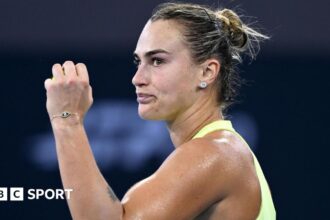
New Australian Daria Kasatkina Can ‘Finally Breathe’ in Melbourne Breakthrough
The roar that greeted Daria Kasatkina’s match point on Margaret Court Arena carried a different timbre. It wasn’t just applause for a stunning backhand winner or appreciation for a hard-fought victory. It was a welcoming, full-throated embrace. For the first time, the world number 48 was not just a visitor at the Australian Open; she was playing for the crowd, as one of their own. In a tournament defined by power and precision, Kasatkina’s journey to the 2025 fourth round is a profound story of personal liberation, political refuge, and the powerful, simple act of being able to breathe freely.
A Neutral No More: From Statelessness to Citizenship
Since Russia’s full-scale invasion of Ukraine in February 2022, Daria Kasatkina’s life and career have existed in a state of suspended animation. Like her compatriots, she was barred from competing under her nation’s flag or hearing its anthem. She became a “neutral athlete,” a bureaucratic label that belied the immense personal weight she carried. Her tennis, a beautiful, crafty blend of spins, slices, and tactical genius, continued. But the person wielding the racket was navigating a profound crisis of identity and safety.
This changed in the lead-up to the 2025 Australian Open. Kasatkina, after a period of residency and a deeply personal commitment, was granted Australian citizenship. The significance cannot be overstated. This wasn’t merely a change of paperwork; it was the acquisition of a shield, a home, and a voice.
- Neutral Athlete Status Lifted: She no longer competes under the sterile “neutral” banner imposed by tennis governing bodies.
- A Public Stand: Kasatkina had been one of the few prominent Russian athletes to openly criticize the war in Ukraine, calling it a “nightmare,” and to come out as gay in a country where “LGBT propaganda” is illegal.
- No Pathway Back: These courageous acts made a return to her birthplace not just unlikely, but potentially dangerous. Australia offered not just a sporting future, but a personal one.
“Finally I can just breathe,” Kasatkina said, her words resonating far beyond the baseline. “I can live and just do my job and not be worried about the things which are not in my control.” This statement is the core of her transformation. The constant, low-grade anxiety of politics, prejudice, and peril has been replaced by the singular focus of sport.
Analysis: How Freedom Fuels Form on Court
From a tactical standpoint, Kasatkina’s game has always been a cerebral counterpunch to the WTA’s power brokers. She lacks the raw, overwhelming force of some contemporaries, instead constructing points with the patience of a chess master. But what happens when the mind, the instrument she relies on most, is burdened by existential worry?
Sports psychology experts point to the immense cognitive load carried by athletes in high-stress personal situations. Every ounce of mental energy spent on concerns outside the court is energy not spent on reading an opponent’s serve or anticipating a passing shot. For nearly three years, Kasatkina played with this invisible anchor. Her results, while solid, saw her drift from a career-high ranking of world number eight.
Her run in Melbourne this year, however, showcases a player unshackled. There is a visible lightness to her movement, a clarity in her decision-making under pressure. The mental fortitude required to close out tight sets—a hallmark of her fourth-round qualification—seems renewed. She is playing not just to win points, but with a palpable sense of belonging. The crowd’s energy, now unequivocally hers to harness, acts as a tangible force multiplier. She is no longer a guest in the arena; she is its host.
The Road Ahead: Predictions for Australia’s New Star
Kasatkina’s immediate future in this tournament is a fascinating proposition. The fourth round of a Grand Slam is where contenders are separated from the pack. She will face a top-tier opponent, likely a top-10 seed, where her new-found mental peace will face its ultimate stress test. The key question is whether the liberation from external pressure can translate into the internal steel needed to challenge for the sport’s highest honors.
Looking beyond the 2025 Australian Open, the landscape changes dramatically for the now 28-year-old.
- Home-Support Advantage: The Australian summer of tennis, with the United Cup and the Open, will become a true fortress. The crowd’s adoption of her will only deepen.
- Sponsorship and Stability: As an Australian representing the nation, commercial opportunities and long-term career stability, previously clouded by geopolitical uncertainty, will solidify.
- Olympic Dreams: The path to representing Australia at the 2028 Los Angeles Olympics is now clear, a goal that seemed impossible just years ago.
Prediction: While a Grand Slam title remains a formidable challenge in a fiercely competitive era, Kasatkina is poised for a major ranking resurgence. Expect her to comfortably re-enter the top 20 and become a consistent threat on all surfaces. More importantly, she will become a central, beloved figure in Australian tennis, inspiring not just with her crafty game, but with her profound story of resilience.
A Victory Beyond the Scoreboard
Daria Kasatkina’s fourth-round appearance at the 2025 Australian Open will be recorded in the history books as a solid sporting achievement. But its true legacy is etched in the human spirit. Her journey from a neutral athlete in exile to a celebrated home player represents one of the most powerful narratives in modern sports.
In a world where athletes are often told to “stick to sports,” Kasatkina’s courage to speak on love and war cost her a homeland but ultimately led her to a new one. Her story underscores that peak athletic performance is not just a product of physical training and diet, but of psychological safety and personal authenticity. When she says she can “finally breathe,” she is describing the most fundamental prerequisite for not just a champion athlete, but a fulfilled human being.
As the Australian Open progresses, every slice backhand, every clever drop shot, and every fist-pump to the roaring Melbourne crowd will be a testament to that hard-won breath. Daria Kasatkina is no longer just playing tennis. She is playing free.
Source: Based on news from BBC Sport.