


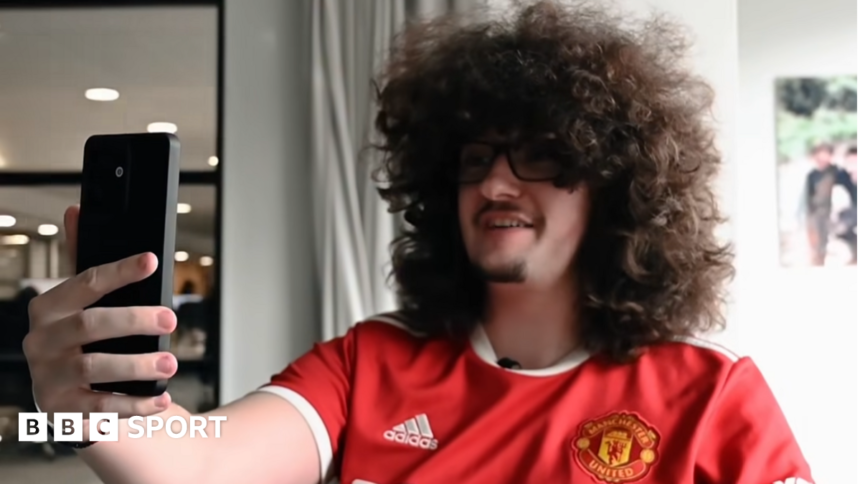
No Win, No Trim: How a Fan’s Haircut Vow Became Manchester United’s Unlikely Albatross
In the grand, often absurd theatre of modern football fandom, where gestures of loyalty range from the poetic to the painfully permanent, a new archetype has emerged: the harbinger of hope, his prophecy written not in stars, but in split ends. His name is Frank Ilett, known to the online world as ‘The United Strand.’ What began 493 days ago as a whimsical personal pact has morphed into a sprawling, commercially-backed phenomenon, holding up a mirror to the cyclical struggles of the club he loves. The premise is simple, the execution increasingly hairy: no haircut until Manchester United wins five consecutive games. As the Red Devils’ form continues to stutter and snatch draws from the jaws of victory, a pressing, follicular question hangs over Old Trafford: has a simple haircut become the club’s most bizarre and telling problem?
From Whimsy to Web Phenomenon: The Birth of The United Strand
On October 5, 2024, Frank Ilett filmed a video for his then-modest social media following. With clippers in hand, he gave himself what he dubbed his “last trim” until Manchester United achieved a feat that once seemed routine: five wins on the bounce. He posted a poll, a light-hearted piece of engagement, asking his followers when the next cut would come: 2024, 2025, or 2026? The response was a deafening vote of no confidence. A staggering 90% of the 27,000 respondents predicted 2026. At the time, it was a joke shared among fans weary of false dawns. Today, after a 1-1 draw with West Ham extended the run to just one win in five, it feels less like a punchline and more like a prophecy.
Ilett’s challenge has since exploded, transcending the typical fan pledge. His commitment has resonated in a way that pure statistics cannot, embodying the endurance and frustration of a global fanbase. Commercial brands have now partnered with the venture, seeing the potent mix of narrative, loyalty, and dark humour. What was personal is now professional, a symbol packaged and amplified. The United Strand is no longer just a man with growing hair; it is a barometer for institutional performance, a living, breathing measure of a team’s inability to find consistency, rhythm, or the killer instinct required for a mere five-game streak.
A Follicular Fable Reflecting On-Pitch Fragility
Expert analysis of Manchester United’s woes typically focuses on tactical incoherence, recruitment missteps, or a fractured club culture. Ilett’s journey, however, provides an unintentionally profound allegory for these very issues. The hair’s unkempt, uncontrolled growth parallels the team’s often shapeless and undisciplined performances. Just as the challenge persists game after game, so too does United’s cycle of promising build-up followed by self-sabotage.
The sheer statistical improbability of the situation underscores the club’s fall. Consider this: in the post-Sir Alex Ferguson era, United have managed a five-game winning run in the Premier League on several occasions, even during troubled seasons. The current drought, stretching back well before Ilett’s vow, highlights a new low in consistency. The challenge has outlasted managerial game plans, individual player streaks, and countless “turning points.” Its endurance speaks to a chronic condition, not a temporary ailment. The United Strand has become an accidental archive, each centimetre of growth representing another dropped lead, another missed opportunity, another moment of lost composure.
- Psychological Weight: While humorous, the saga’s visibility potentially adds a subtle, strange pressure. Players and managers are acutely aware of the narratives surrounding the club. Could the quest to “get Frank a haircut” become a distracting subplot in a high-pressure moment?
- Fan Engagement Metric: The commercial partnerships prove the story’s power. In the absence of sustained on-pitch success, the club’s ecosystem, including fan creators, is generating its own compelling content—often rooted in the team’s failures.
- Global Symbolism: For fans worldwide, checking on The United Strand’s latest update has become as ritualistic as checking the league table. It’s a shared experience of stubborn loyalty, a bond formed not in glory, but in the communal wait.
The Road to a Trim: Predictions and Pivotal Fixtures
So, when will it end? Predicting Frank Ilett’s salon date is now akin to forecasting United’s return to title contention. The team’s upcoming schedule is always the first port of call for Strand-watchers. The path to five wins requires not just talent, but a mental fortitude that has been conspicuously absent. It demands navigating potential banana skins, overcoming tactical puzzles, and, crucially, holding onto leads.
The pattern has been brutally consistent: a stirring victory sparks hope, only for a lethargic draw or a chaotic defeat to immediately follow. To achieve the holy grail of five wins, United must break a psychological barrier as much as a footballing one. They must string together results against a mix of opponents, handling the different tactical challenges each presents while maintaining focus and fitness. The first three wins might be possible, but the fourth and fifth games in the sequence would inevitably carry the mounting weight of the storyline, a meta-narrative threatening to overshadow the football itself. The longer it goes on, the bigger the eventual haircut event becomes, and the heavier the psychological load.
More Than Hair: A Story of Modern Fandom
The conclusion to this saga, whenever it arrives, will be telling. A triumphant shearing, live-streamed and sponsored, would signal a genuine shift in momentum, a team finally discovering its spine. Yet, the very existence of The United Strand underscores a deeper truth about modern Manchester United. The club’s struggles are so pronounced, so woven into its identity over the past decade, that they have spawned their own unique cultural artifacts.
Frank Ilett’s vow is more than a stunt; it is a piece of fan-generated content that has eclipsed its origins to become a defining emblem of an era. It proves that in today’s game, narrative is currency, and fans are no longer passive consumers but active authors of the club’s story—even when that story is about waiting. The hair is not the problem for Manchester United; it is a symptom. The real issue remains on the grass at Carrington and Old Trafford: a lack of identity, consistency, and winning mentality. The United Strand will eventually get his haircut. The far more complex and costly trim—the cutting away of years of institutional drift and sporting failure—will take much, much longer.
Source: Based on news from BBC Sport.

