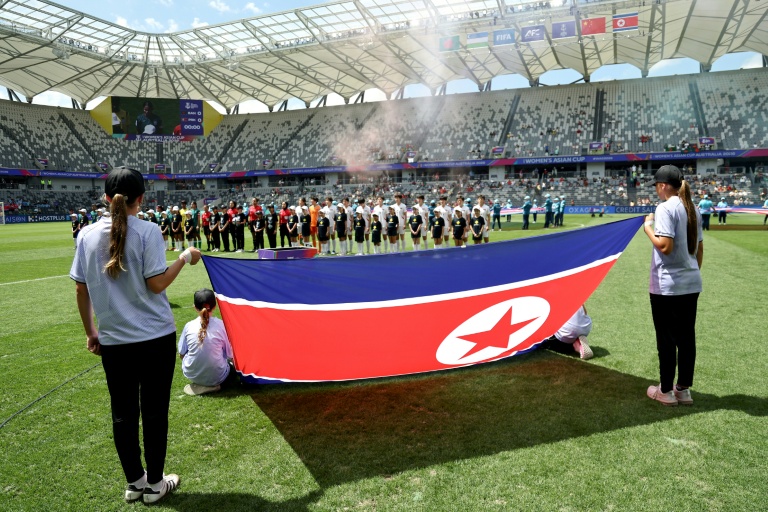
Breaking the DMZ Barrier: North Korean Club Set for Historic Football Match in South Korea
In a development that resonates far beyond the pitch, a North Korean women’s football club is poised to make history this month. Seoul’s unification ministry confirmed Monday that Naegohyang Women’s FC will become the first sports team from the Democratic People’s Republic of Korea (DPRK) to compete in South Korea since 2018. This rare sporting exchange, set against the backdrop of the Korean Peninsula’s ongoing technical state of war, represents a fragile but powerful bridge between two nations divided by the 1950–53 Korean War.
The match, scheduled for May 20, will see Naegohyang face South Korea’s Suwon FC Women in the semi-finals of the Asian Football Confederation (AFC) Women’s Champions League. The 39-member delegation—comprising 27 players and 12 staff—is expected to arrive on May 17, according to the Korea Football Association (KFA). The winner will advance to the final on May 23, facing either Australia’s Melbourne City or Japan’s Tokyo Verdy Beleza.
For a region where sporting and cultural exchanges have been virtually frozen since the collapse of the 2018 inter-Korean dialogue, this match is more than just a game. It is a diplomatic tightrope walk, a test of logistics, and a powerful symbol of sport’s ability to transcend political boundaries.
Why This Match Matters: From Panmunjom to the Pitch
The significance of this fixture cannot be overstated. Since the Korean War ended in an armistice—not a peace treaty—the two Koreas have remained in a state of suspended conflict. The Demilitarized Zone (DMZ) is one of the world’s most heavily fortified borders. In this context, any cross-border movement is laden with political weight.
The last time a North Korean sports team set foot in the South for competition was in 2018, during the PyeongChang Winter Olympics. That event saw a unified Korean women’s ice hockey team and a joint march under the Korean Unification Flag. However, diplomatic progress stalled sharply after the breakdown of the 2019 Hanoi summit between Kim Jong Un and then-U.S. President Donald Trump. Since then, North Korea has ramped up missile tests and rhetoric, while South Korea’s conservative government under President Yoon Suk Yeol has taken a harder line on engagement.
This match, therefore, is a rare flicker of people-to-people contact. The unification ministry in Seoul stated that the North Korean authorities submitted a “notification of a 39-member delegation” for the trip. While the South Korean government has approved the visit, it has also emphasized that all standard security and protocol measures will be in place. The match will be played at a neutral venue—likely in the greater Seoul area—with heightened security to ensure the safety of both teams.
Expert Analysis: What This Means for Inter-Korean Relations
As a sports journalist who has covered Asian football for over a decade, I see this as a carefully calibrated move by Pyongyang. The regime rarely permits its athletes to travel abroad without explicit political oversight. The choice of a women’s club is also telling. Women’s football in North Korea is a source of national pride—the national team has won the AFC Women’s Asian Cup twice and is a perennial powerhouse at the youth level. By sending Naegohyang, North Korea is showcasing a high-performing, disciplined team while keeping the diplomatic stakes relatively low.
“This is not a mass opening, but it is a significant crack in the door,” says Dr. Kim Hyun-woo, a professor of Korean studies at Seoul National University who specializes in sports diplomacy. “Both sides have something to gain. For the South, it demonstrates soft power and a willingness to engage. For the North, it’s a chance to project a normal, competitive image on a regional stage without making major political concessions.”
However, experts warn against over-optimism. The match is a one-off, not the start of a regular exchange. The North Korean delegation will be under strict supervision, and any political messaging—such as the use of flags or anthems—will be closely monitored. The South Korean government has already stated that no official political ceremonies will be held during the match.
The Teams: Naegohyang Women’s FC vs. Suwon FC Women
On paper, this semi-final is a clash of two very different footballing cultures. Let’s break down the key details:
- Naegohyang Women’s FC: Based in the city of Sinuiju, near the Chinese border, Naegohyang is a relatively new but ambitious club. They are known for their rigorous training regimen, tactical discipline, and physical fitness. In North Korea’s domestic league, they are a top-tier side, but their international exposure is extremely limited. The club’s name translates to “Inner Fragrance,” a poetic reference to the scenic mountains of their home region. Their style is typically direct and counter-attacking, relying on speed and set-pieces.
- Suwon FC Women: A well-established club in the South Korean WK League, Suwon FC Women have a more modern, possession-based approach. They have access to better facilities, foreign coaching influences, and consistent league competition. Their squad includes several South Korean national team players, such as midfielder Jang Sel-gi and forward Son Hwa-yeon. Suwon finished third in the WK League last season and have been in strong form in the current campaign.
The AFC Women’s Champions League is a relatively new competition, designed to mirror the men’s tournament and elevate women’s club football in Asia. The winner of this semi-final will face a formidable opponent in the final—either the high-pressing Melbourne City or the technically gifted Tokyo Verdy Beleza.
Predictions: Tactical Breakdown and Key Factors
Predicting the outcome of this match is uniquely challenging because of the unknowns. North Korean women’s teams are notoriously difficult to scout. They rarely play international friendlies, and their domestic league footage is almost non-existent. What we do know is that North Korean women’s football prioritizes collective discipline and physical endurance. They are trained to run relentlessly for 90 minutes and to execute tactical plans with military precision.
Key factors that will decide the match:
- Psychological pressure: This is the biggest game of most Naegohyang players’ lives. Playing in the rival South, under global media scrutiny, with political implications—this could either inspire them or paralyze them. Suwon, by contrast, will be playing in a familiar environment.
- Adaptability: Suwon FC Women are used to different formations and styles. They can shift from a 4-3-3 to a 3-5-2 mid-game. Naegohyang’s tactics are likely more rigid. If Suwon can disrupt their shape early, they could exploit gaps.
- Set pieces: In high-stakes matches with limited information, dead-ball situations often decide the result. Both teams will have prepared extensively for corners and free kicks. Watch for Naegohyang’s tall defenders, who may pose a threat from headers.
- Fatigue: The North Korean team will have traveled to Seoul and will have only a few days to acclimatize. Suwon has home advantage and a regular schedule. However, North Korean players are known for their extraordinary fitness levels, often running 10-12 kilometers per game.
My prediction: This will be a tense, low-scoring affair. Suwon FC Women have the edge in experience and tactical flexibility, but Naegohyang’s sheer unpredictability and physicality could produce an upset. I expect a 1-1 draw after 90 minutes, with Suwon advancing on penalties. However, if Naegohyang scores first, the psychological lift could carry them to a 2-1 victory.
Conclusion: A Small Step for Football, a Giant Leap for Dialogue?
When the whistle blows on May 20, the world will be watching not just a football match, but a rare moment of inter-Korean contact. The last time a North Korean team played in the South, it was 2018—a year of Olympic handshakes and diplomatic breakthroughs. Since then, the peninsula has witnessed missile launches, border tensions, and a chilling of relations.
This match will not solve the Korean conflict. It will not reopen the Kaesong Industrial Complex or restart family reunions. But it is a reminder that sport can create spaces where politics cannot. For 90 minutes, 27 North Korean athletes and their South Korean counterparts will share a pitch, a ball, and a common language of football. That is not nothing.
For the players of Naegohyang Women’s FC, this journey is likely the trip of a lifetime. For Suwon FC Women, it is a chance to prove their mettle against a mysterious and formidable opponent. And for the fans—both in the stadium and watching from afar—it is a glimpse of a different kind of future, one where the DMZ is crossed not by soldiers, but by footballers.
The winner will go on to chase continental glory on May 23. But regardless of the scoreline, this match has already made history. In a divided land, sometimes just showing up is the most powerful victory of all.
Source: Based on news from Yahoo Sports.