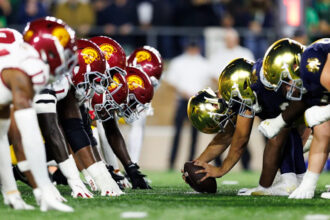
Notre Dame’s Stunning Bowl Boycott: A Program Draws a Line in the Sand After Playoff Snub
The tectonic plates of college football shifted on Sunday, not with the announcement of the four-team College Football Playoff field, but with the seismic reaction from the one left standing at the door. The Notre Dame Fighting Irish, deemed the first team out by the selection committee, did not simply express disappointment. They made an unprecedented, program-defining statement: if it’s not the Playoff, we’re not playing. In opting out of the bowl season entirely, Notre Dame has ignited a fierce debate about prestige, player safety, and the very meaning of the postseason in the modern era.
The Snub That Sparked a Revolution
The College Football Playoff committee’s final bracket delivered a gut punch to South Bend. The Irish, with a strong resume, watched as the Miami Hurricanes claimed the final spot. More galling to the Notre Dame faithful was seeing the James Madison Dukes and Tulane Green Wave—Group of Five champions with compelling stories but weaker overall schedules—also selected ahead of them. The message from the committee was interpreted clearly at Notre Dame: even a stellar season as an independent wasn’t enough to crack the new, more inclusive field if the wrong dominoes fell.
This decision transcends a simple protest of rankings. It is a calculated, radical assessment of the current bowl landscape. For a program of Notre Dame’s stature, non-Playoff bowls are increasingly viewed as high-risk, low-reward exhibitions. The potential for key player injuries, the transfer portal distractions, and the logistical burden are now being weighed against diminishing prestige and financial payouts that, while significant, are not essential to Notre Dame’s athletic budget.
- Playoff or Bust Mentality: The move codifies what has been whispered for years: for elite programs, the season is binary. You either compete for a national championship or you don’t.
- Player Safety & Future Focus: By skipping, Notre Dame immediately protects its draft-eligible stars from injury and allows its entire roster, including young players like quarterback CJ Carr, to begin offseason development programs earlier.
- Transfer Portal Strategy: The coaching staff, led by Marcus Freeman, can now dedicate 100% of its energy to retaining current talent and attacking the portal, while other programs are still preparing for bowl games.
A Contrast in Conversations: Texas’ Hope vs. Notre Dame’s Hard Line
The fallout from Selection Sunday created starkly different narratives across the country. While Notre Dame stewed, University of Texas head coach Steve Sarkisian joined commentator Colin Cowherd to discuss his team’s playoff inclusion and, notably, the development of backup quarterback Arch Manning. The conversation was forward-looking, centered on championship preparation and future potential.
This contrast is illuminating. Texas, securely in the field, operates within the system’s accepted framework. Notre Dame, on the outside looking in, has chosen to challenge the framework itself. The Longhorns’ discussion of Manning’s progress is a classic example of a program managing its present and future within the established cycle. Notre Dame’s bowl boycott shatters that cycle, questioning whether the traditional “consolation prize” bowl model still holds value for the sport’s upper echelon.
Marcus Freeman’s leadership is now under a new microscope. This is not a decision made by disgruntled players; this is an institutional stance, likely endorsed at the highest levels of the university administration. It signals a unified front and a willingness to absorb short-term criticism for a perceived long-term principle: that Notre Dame football should be judged and engaged at the highest level, or not at all.
The Ripple Effect: What Notre Dame’s Decision Means for College Football
Notre Dame has thrown a stone into the stagnant pond of the postseason, and the ripples will be felt far and wide. This decision sets a powerful, and potentially dangerous, precedent.
For other elite programs: Will Alabama, Ohio State, or Georgia follow suit in future years if they suffer a similar snub? The pressure to conform to a “Playoff or Nothing” ethos just increased exponentially.
For the bowl system: This is an existential threat. The prestige and television ratings of non-New Year’s Six bowls are built on the participation of brand-name schools. If other blue-bloods emulate Notre Dame, the entire ecosystem could collapse.
For the expanded 12-team playoff: Ironically, Notre Dame’s move is the strongest possible advertisement for the new format arriving next season. The 12-team model is designed specifically to include teams in Notre Dame’s position, making such a drastic boycott unlikely in the future. This act can be seen as the final, furious gasp of protest against the restrictive four-team era.
Predictions and the Road Ahead for the Fighting Irish
The immediate consequences for Notre Dame will be a whirlwind of hot-take criticism. They will be labeled as sore losers, quitters, and arrogant. Their draft-eligible players who supported the decision will face questions about their competitiveness. The program will also forfeit millions in bowl revenue, though its independent TV contract with NBC cushions that blow.
However, the long-term strategic play is fascinating. Prediction: This will become a powerful recruiting tool. Notre Dame can sell a vision of singular focus: every season is a direct, uncluttered path to competing for a national championship. There is no “Plan B” bowl trip to Orlando. It’s a ruthless, professionalized approach that may resonate with top-tier high school talent.
Furthermore, the extra weeks of practice and development for players like CJ Carr and defensive leader Donovan Hinish cannot be understated. While opponents manage bowl practices, Notre Dame’s staff will be conducting a full-scale spring evaluation, potentially giving them a critical head start on 2026.
Conclusion: A Line in the Turf
Notre Dame’s bowl boycott is more than a tantrum; it is a declaration of independence from a postseason structure it views as broken. In the final year of the four-team playoff, the Fighting Irish have chosen not to go quietly. They have staged a walk-out, leveraging their unique national brand to make a point that will echo through conference rooms and living rooms alike.
This decision recalibrates the value proposition of college football’s regular season for the elite. It places immense pressure on the coming 12-team playoff to deliver on its promise of inclusivity and meaning. And it establishes Marcus Freeman not just as a coach, but as the steward of a program confident enough to define its own standards for success. Whether viewed as principled or petulant, Notre Dame has drawn a line in the turf. The rest of college football must now decide which side of it they stand on.
Source: Based on news from Fox Sports.
Image: CC licensed via www.rawpixel.com