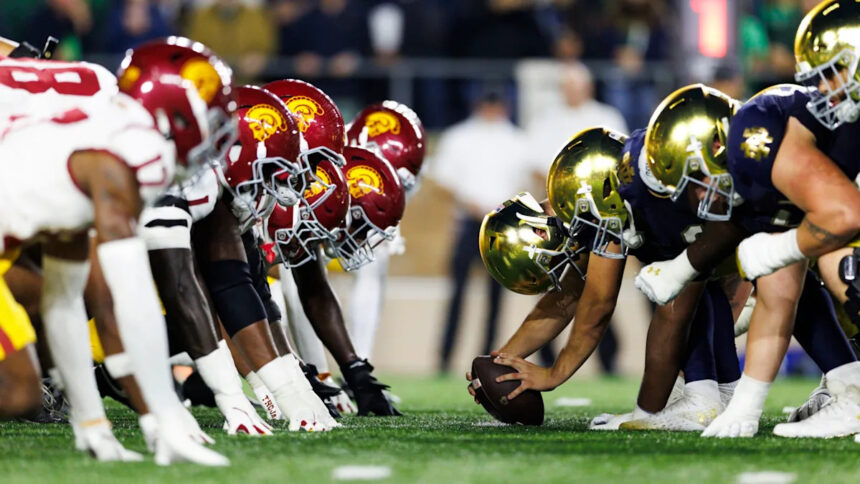
The End of an Era: Notre Dame and USC Pause a Century-Old College Football Rivalry
In the cathedral of college football, where tradition is the sacred text, the pews are being rearranged. The sport is undergoing a seismic, money-driven realignment that is severing historic ties and rewriting geographic logic. The latest, and perhaps most poignant, casualty is one of the game’s most storied chapters: the annual clash between the Notre Dame Fighting Irish and the USC Trojans. After nearly a century of defining autumns, this iconic rivalry is being placed on indefinite hiatus, a stark symbol that in today’s game, the only constant is change.
A Legacy Forged in Steel and Rose Petals: The History of the Jeweled Shillelagh
To understand the weight of this pause, one must understand the legacy. The Notre Dame-USC series began in 1926, a matchup engineered by the wives of the schools’ respective coaches who were friends from their days at the University of Nebraska. What started as a convenient intersection quickly evolved into a national spectacle. It became a cross-country battle of identities: the disciplined, midwestern Catholics versus the sun-kissed, Hollywood-adjacent showmen. The rivalry gave us the Jeweled Shillelagh, a unique trophy adorned with emerald-studded medallions for Irish wins and ruby-studded ones for Trojan victories.
This series didn’t just have history; it was history. It featured Heisman Trophy moments, national championship implications, and legendary figures from Frank Leahy and John McKay to Reggie Bush and Brady Quinn. The games in the Los Angeles Coliseum and Notre Dame Stadium became annual pilgrimages for fans and national television events that captivated the country. The late-November meeting in LA, often with Pacific sunsets and Rose Bowl hopes in the balance, was a cherished closing act to the regular season.
- 1926: Series begins with a 13-12 Notre Dame victory.
- The 1970s: A golden era featuring epic clashes between national powers.
- 2005: The “Bush Push” game, one of the most dramatic finishes in rivalry history.
- 95 Meetings: Notre Dame leads the series 50-37-5.
The Inevitable Collision: Conference Realignment vs. Tradition
The direct cause of the hiatus is the ever-shifting landscape of college football, specifically USC’s impending move to the Big Ten Conference in 2024. This seismic shift, driven by billion-dollar media rights deals, fundamentally alters the Trojans’ scheduling calculus. The Big Ten will feature a grueling nine-game conference schedule, plus a mandated annual matchup with fellow new member and historic rival UCLA. This leaves minimal room for non-conference flexibility.
USC’s request, as reported, was to move the Notre Dame game from its traditional late-season slot to earlier in the fall, during the standard non-conference window. For Notre Dame, an independent whose schedule is its lifeblood, this presented a problem. The Irish have built their unique identity on a national, intersectional schedule where every game is an event. Moving the USC game would disrupt a carefully balanced calendar and, more importantly, dilute the profound significance of the rivalry’s season-ending spot. With no agreement reached, the series hits the pause button.
Notre Dame will replace USC with BYU for at least the 2024 and 2025 seasons, a pragmatic but less glamorous substitute that underscores the new reality. The joint statement from the schools, while affirming the rivalry’s special status, is the diplomatic language of a breakup, promising to “continue working towards bringing back The Battle for the Jeweled Shillelagh” at an unspecified future date.
Expert Analysis: What This Means for the Soul of the Sport
This decision is more than a scheduling note; it’s a cultural inflection point. For decades, the Notre Dame-USC rivalry stood outside the conference fray, a testament to the idea that some competitions transcend leagues and television contracts. Its pause confirms the total victory of the conference super-structure over the sport’s traditional, regional, and independent pillars.
“This is the ultimate example of tradition being sacrificed at the altar of consolidation and revenue,” says Dr. Alicia Miller, a sports historian. “Notre Dame-USC was a national holiday on the college football calendar. It was a thread that connected different parts of the country and different eras of the sport. When you cut that thread, you’re not just changing a schedule; you’re eroding the narrative continuity that makes college football unique.”
The move also highlights the precarious position of Notre Dame independence. As the Power 4 conferences (Big Ten, SEC, Big 12, ACC) become more insular with larger league schedules, finding premium opponents for the 7-8 non-conference slots becomes harder. The loss of an annual barometer like USC weakens the Irish’s schedule and removes a key emotional touchstone for its national fanbase.
Predictions and the Uncertain Road Ahead
So, what comes next? The “foreseeable future” is deliberately vague, but the path to revival is fraught with obstacles.
- Limited Windows: With a 12-team College Football Playoff beginning in 2024, the emphasis on strength of schedule will be paramount. This could incentivize both schools to resume the series, but finding an open, mutually agreeable date in crowded slates will be a massive logistical hurdle.
- Intermittent Meetings: The most likely outcome is not an annual resumption, but a shift to an occasional, home-and-home series every 5-10 years, similar to how Notre Dame schedules other historic rivals like Georgia or Ohio State. This preserves the “event” status but destroys the rhythm and narrative of the annual feud.
- Fan Backlash: The outcry from both fanbases is significant and will maintain pressure on the athletic departments. This grassroots sentiment could accelerate the timeline for a return, perhaps by the late 2020s, but it will not override the financial imperatives of conference obligations.
The grim prediction is that the annual tradition is gone for good. The new economics of the sport, where every game must maximize television value within a conference package, disincentivizes such a permanent non-conference commitment.
Conclusion: A Trophy in Storage, A Lesson in Loss
The pause of the Notre Dame-USC rivalry is a funeral for a certain kind of college football. It marks the end of an era where pageantry, regional pride, and historic animosity could exist outside the monolithic structures of modern conferences. The Jeweled Shillelagh will go into storage, its emeralds and rubies awaiting a future that is uncertain.
While administrators promise a future revival, the cold truth of realignment suggests otherwise. The sport is moving toward a future of consolidated power, where conference logos matter more than unique trophies, and television windows are sacred while traditions are negotiable. The loss of this annual classic is a warning: in the new religion of college football, the gods of revenue and consolidation demand their sacrifices. And as fans of the Irish and Trojans now know all too well, even the most sacred relics are not safe from the altar.
Source: Based on news from Yahoo Sports.