Patriots’ Kyle Williams Nearly Makes Game-Saving Tackle on Super Bowl Field Invader
In the high-stakes crucible of the Super Bowl, where every play is immortalized and every mistake magnified, the most unexpected moments can steal the spotlight. During the tense fourth quarter of Super Bowl LX between the New England Patriots and the Seattle Seahawks, the drama briefly shifted from a battle of football titans to an impromptu game of cat and mouse. As a shirtless fan evaded stadium security on the hallowed turf, an unlikely pursuer emerged from the Patriots’ sideline: wide receiver Kyle Williams. In a heartbeat, the game’s perimeter vanished, and Williams’ instinctual chase created an iconic “what if” moment that will be debated in Boston bars for years to come.
- The Fourth Quarter Frenzy: A Security Breach Meets Football Instinct
- Beyond the Blitz: Analyzing Williams’ Split-Second Decision
- Historical Context: Field Invasions and Player Reactions
- The Ripple Effect: Predictions for Security and Player Protocol
- Conclusion: The Tackle That Wasn’t and the Statement It Made
The Fourth Quarter Frenzy: A Security Breach Meets Football Instinct
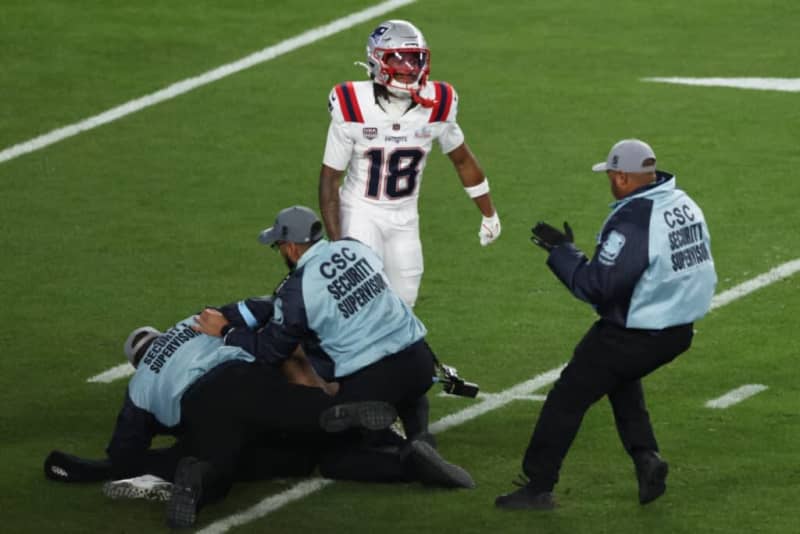
The incident occurred during a critical stoppage in play late in the fourth quarter. With the championship hanging in the balance, the focused silence of strategic calculation was shattered by a commotion near the sideline. A fan, stripped to the waist, had breached security and was now sprinting across the field, a blur of misguided exuberance against the green backdrop. Stadium security personnel immediately gave chase, but their angles were poor, and the invader displayed surprising agility.
From the New England sideline, Kyle Williams, a key special teams contributor and reserve receiver, saw the intrusion unfold. Without a moment’s hesitation, Williams exploded into a full sprint, cutting across the field with the precision of a well-run route. His reaction time was instantaneous, showcasing the elite athleticism that defines an NFL player. For a few thrilling seconds, it was no longer a fan versus security; it was an NFL athlete, trained for pursuit and tackle, closing in on an unpredictable target. Williams nearly collared the fan before security finally converged and wrestled the individual to the ground, just yards from where Williams had arrived.
Beyond the Blitz: Analyzing Williams’ Split-Second Decision
Kyle Williams’ near-tackle was more than a viral moment; it was a fascinating case study in athlete psychology and situational awareness. Let’s break down the layers of this unprecedented event:
- Protective Instinct: The field is a team’s sanctuary. An unauthorized intruder represents a literal wild card—an unknown variable that could pose a threat to players, coaches, or officials. Williams’ move can be seen as a protective, almost territorial, response to secure his team’s environment.
- Competitive Fire Channeled: Super Bowl intensity doesn’t have an off switch. Williams, likely amped with adrenaline from the game’s climax, translated that competitive energy directly into the chase. It was a pure, unscripted display of the competitive instinct that defines champions.
- The Unwritten Rule of the Sideline: While security’s job is clear, players often view the field as their domain. Historically, players have intervened in altercations or to protect teammates. Williams’ action, though against a non-player, extended this ethos to a unique security breach.
- Risk vs. Reward: Had Williams made the tackle, he would have been hailed a hero. However, the risks were significant: a potential injury from a collision, a penalty for unsportsmanlike conduct if misconstrued, or even escalating the situation. His decision to pull back at the last second, allowing security to finish the job, showed remarkable in-the-moment judgment.
Historical Context: Field Invasions and Player Reactions
Field invasions, while less common in the modern security era, have a storied history in sports. What sets the Kyle Williams chase apart is the direct, proactive involvement of an active player during the championship’s most critical juncture. Unlike the famous “Pine Tar Game” incident or various streaking episodes, this was not a delayed reaction or a comedic interlude.
This event draws a more direct line to the few instances where athletes have taken security into their own hands, such as baseball players confronting fans who ran onto the diamond. In the NFL, with its militarized sideline security, such a direct intervention by a player is exceptionally rare, especially in the Super Bowl. It underscores a shifting perspective where players may feel a heightened sense of responsibility for their workspace, particularly in an era where safety is paramount. The incident will undoubtedly become a top-tier Super Bowl anecdote, remembered not for the play it interrupted, but for the sheer audacity of the response it provoked from a Patriot.
The Ripple Effect: Predictions for Security and Player Protocol
The image of Kyle Williams bearing down on a field invader will have lasting implications beyond the highlight reel. We can expect several developments in the wake of this unprecedented event:
- Enhanced Sideline Security Protocols: Stadiums and the NFL will re-evaluate sideline barrier designs and security personnel placement. The league may implement more frequent, randomized security drills to ensure faster response times, ensuring players never feel the need to intervene.
- A League Mandate on Player Conduct: The NFL will likely issue a formal clarification or rule regarding player interaction with field invaders. While they may praise Williams’ intent, the league’s primary concern will be liability and player safety. A new league policy on field invasions may explicitly instruct players to clear the area and let security handle the situation.
- Cultural Impact on Fan Behavior: This event serves as a powerful deterrent. The message is clear: if you run onto an NFL field, you’re not just outrunning security guards; you’re potentially lining up against a 4.4-speed wide receiver in peak physical condition. The risk calculus for would-be invaders just changed dramatically.
- Kyle Williams’ Legacy Cemented: Regardless of his statistical output in the game, Kyle Williams’ name is now forever attached to one of the Super Bowl’s most memorable moments. It exemplifies a team-first, all-in mentality that coaches love and teammates respect.
Conclusion: The Tackle That Wasn’t and the Statement It Made
Kyle Williams did not ultimately bring down the fan who disrupted Super Bowl LX. Yet, his explosive, instinctive reaction created a moment more telling than any scripted touchdown celebration. It revealed the razor-sharp focus and protective drive that exists even outside the confines of a play call. In the grand narrative of the Patriots’ season, this chase may be a footnote, but in the broader lore of the sport, it stands as a powerful symbol. It signifies that for true competitors, the switch is never flipped to “off,” and the desire to defend their territory—be it from an opposing cornerback or an invading fan—is absolute. The next time a fan contemplates a dash onto the field, they might just remember the sight of a Patriots receiver closing in, a reminder that on the gridiron, even the spectators in pads are always ready to play.
Source: Based on news from Yahoo Sports.