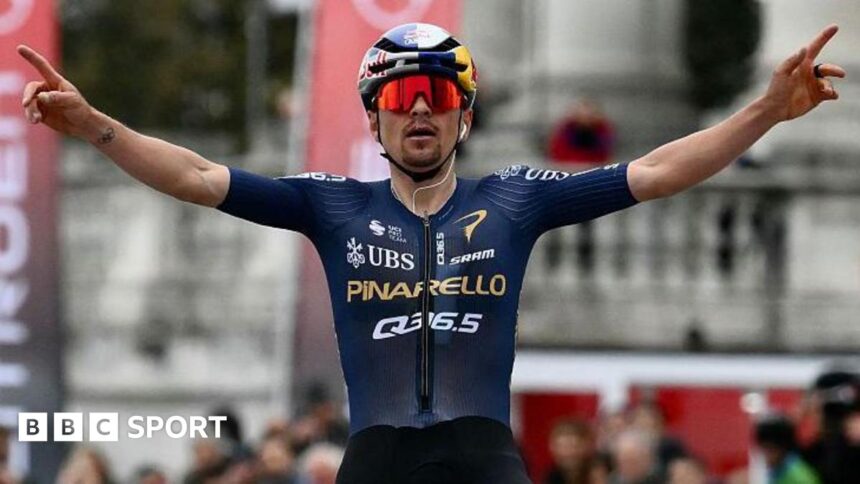
Tom Pidcock Stuns on Debut, Conquers History at Milano-Torino
On the hallowed roads of Italy’s oldest classic, a new chapter was written with a signature burst of explosive power. Tom Pidcock, in his very first attempt and wearing the colors of his new Pinarello-Q36.5 team, authored a stunning victory at the 106th Milano-Torino. On the race’s monumental 150th anniversary, the British phenom launched a devastating late attack on the final slopes of the Superga climb, soloing to a win that reverberated through the peloton. This wasn’t just a season opener; it was a definitive statement from one of cycling’s most versatile talents, announcing his arrival in a new era with breathtaking authority.
A Calculated Move: Pidcock’s New Home Delivers Immediate Payoff
All eyes were on Tom Pidcock at the start line in Magenta, but not just because of his palmarès. The winter saw one of the sport’s most significant transfers as the 26-year-old left the Ineos Grenadiers super-team to join the ambitious, growing Pinarello-Q36.5 Pro Cycling Squad. This victory, in his very first race for the team, validates that bold career move in the most dramatic way possible.
The strategic shift for Pidcock was clear. At Pinarello-Q36.5, he transitions from being one star among many to the undisputed leader for the classics and one-day races. The team’s entire apparatus was deployed in his service today, a focused support system that allowed his unique talent to flourish at the decisive moment. The win provides immense justification for the move, delivering immediate ROI for both rider and sponsor. It proves the environment is right for Pidcock to chase his own ambitions, blending his mountain bike-honed skills with road racing’s toughest tests.
Anatomy of a Winning Attack: Mastering the Superga Showdown
The 174km race followed its traditional script, with the day’s early breakaway reeled in ahead of the iconic, double-ascent of the Superga climb. The first pass served to shred the peloton, but it was on the final, decisive 4.5km climb that the race was truly forged. Pidcock, showing preternatural calm, positioned himself perfectly within a select lead group of twelve riders.
As the gradient bit and the group whittled down to five elite contenders, the anticipation built. Then, with just 600 meters remaining on the steepest section, Pidcock ignited. His acceleration was not a gradual increase in tempo but a violent, bike-throwing surge that instantly created a gap.
- Unmatched Power-to-Weight: His background as a double Olympic mountain bike champion was evident, producing a burst that pure climbers couldn’t match.
- Tactical Patience: He waited until the absolute moment of maximum fatigue, when his rivals were on the limit and dreaming of the sprint.
- Psychological Blow: The suddenness of the attack left no time for organization or response. It was a race-winning move in under 15 seconds.
He crossed the line alone, arms aloft, adding his name to a storied winners’ list that includes legends like Merckx, Coppi, and Girardengo.
Historical Context: Joining an Elite Pantheon
The significance of this victory is magnified by the occasion. The 150th anniversary of Milano-Torino—the world’s oldest classic—lent a historic weight to the event. Pidcock’s debut win places him in a unique niche in the annals of the sport. He becomes only the second British rider ever to win the race, following Mark Cavendish’s sprint victory in 2022. However, their methods could not be more different, highlighting Pidcock’s all-terrain prowess.
This victory also underscores a key trend in modern cycling: the rise of the hyper-versatile cyclist. Pidcock is not a pure climber, sprinter, or time trialist. He is a consummate competitor who can win on mountain bike dirt, in cyclocross mud, and now on the punishing asphalt of Italian classics. His Milano-Torino win is a testament to a complete, aggressive racing style that is redefining what it means to be a champion in the current era.
Expert Analysis & Predictions: What This Means for 2025
Pidcock’s Milano-Torino triumph is far more than a one-off result. It is a critical data point for the entire 2025 season. Analysts see several key takeaways:
Form and Focus: Entering a new team with such dominant form signals Pidcock’s winter preparation was flawless. His focus appears razor-sharp, likely targeting a spring campaign that could include monuments like Liège–Bastogne–Liège, where his climbing punch is perfectly suited.
Team Morale and Cohesion: For Pinarello-Q36.5, this win is transformative. It galvanizes the entire organization, from mechanics to directors, proving they can support a rider to the highest victory. This confidence will be a powerful asset in the grueling months ahead.
The Pidcock Effect on the Peloton: Rivals now have a confirmed warning. Pidcock, unshackled and clearly the leader, is more dangerous than ever. His win adds a thrilling new variable to every hilly classic. Teams will have to mark him specifically, altering the dynamic of races and potentially creating opportunities for others on his squad.
Looking ahead, the predictions for Tom Pidcock are now soaring. He has immediately answered every question about his transfer and his condition. The cycling world will now expect a serious challenge at the Ardennes classics and potentially even a targeted run at the Tour de France polka-dot jersey, where his climbing and descending skills could shine.
Conclusion: A Star Reborn on Historic Ground
Tom Pidcock’s debut victory at the 106th Milano-Torino was a masterclass in timing, power, and symbolic resonance. On a day celebrating 150 years of cycling history, he carved out his own piece of it. The win serves as a perfect launchpad for his tenure with Pinarello-Q36.5, silencing doubters and energizing his new team. It was a performance that announced not just a change of jersey, but the arrival of a more focused, determined, and liberated Pidcock. As the dust settles on the road to the Basilica di Superga, one message is clear: Tom Pidcock’s new era has begun with a historic bang, and the rest of the peloton is now on full alert.
Source: Based on news from BBC Sport.