Pilates, Pain, and Precision: How George Ford Defies Time at Fly-Half
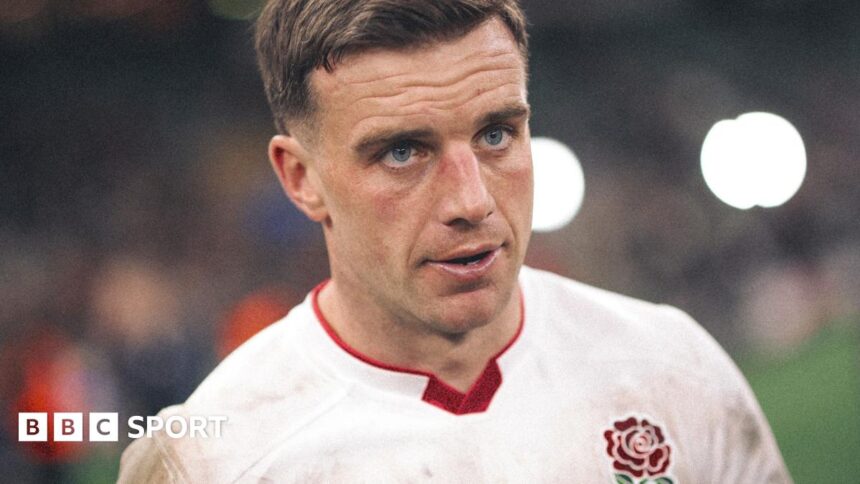
The roar at Twickenham had barely subsided, the man-of-the-match champagne still chilled, when George Ford allowed himself a moment of stark honesty. At 32, with 106 England caps and a legacy already secured, the fly-half’s greatest victory wasn’t over Wales in the 2025 Six Nations opener. It was a quieter, more brutal triumph fought in the sterile silence of a rehab room, on a Pilates mat, and in the deepest recesses of his own mind. For a player whose career is built on the power of his boot and the sharpness of his mind, Ford had been forced to confront a terrifying vulnerability: his own body’s weakness.
The Saracens Setback: A Career at a Crossroads
Five minutes. That’s all it took. In October 2024, during Sale Sharks’ bruising encounter with Saracens, a seemingly innocuous movement resulted in a torn right quadriceps. For a fly-half, the quad is the engine room; it’s the piston that drives those long, spiraling clearances, the source of the explosive power for goal-kicking from inside his own half. The diagnosis from the specialist was a double-edged sword.
No surgery was required, but the warning was explicit and chilling: get the rehabilitation wrong, and the legendary distance on his kicking would evaporate. He would lose precious metres off the tee and out of hand—the very metres that define territorial battles at Test level. For a perfectionist like Ford, it wasn’t just an injury; it was an existential threat to the core of his game.
- The Injury: Torn right quad muscle, October 2024.
- The Stakes: Potential permanent loss of kicking power.
- The Mandate: A rehabilitation process requiring absolute precision.
Beyond the Barbell: The Pilates Protocol
George Ford’s career has been forged in the teeth of opposition defences and honed by countless gym reps. Yet, to overcome this challenge, he had to look beyond traditional strength training. The solution was not to simply lift heavier, but to train smarter. Enter an intensive, bespoke Pilates and prehab regimen, a radical shift for a player of his vintage.
This wasn’t about flexibility for its own sake. This was targeted, neurological recalibration. Ford’s rehab focused on isolating and strengthening the supporting musculature—the glutes, the hip stabilizers, the core—to create an efficient kinetic chain. The goal was to offload strain from the vulnerable quad and ensure power was generated and transferred flawlessly from the ground up through his kicking leg. Every exercise on the reformer bed, every controlled movement, was about re-engineering his body’s firing patterns for one purpose: preserving the cannon in his right boot.
“It’s about finding space where there isn’t any,” Ford has often said of playing fly-half. Now, he was applying that same philosophy to his physiology, finding strength in previously untapped, smaller muscles to protect the whole system.
The Mental Metronome: Perfectionism as a Tool
Physical rehab is only half the battle. For an athlete, the mind can be the biggest barrier to return. Doubt is a more insidious opponent than any openside flanker. Here, Ford’s famed perfectionism and analytical mind, traits that sometimes see him scrutinized for over-playing, became his superpowers.
He approached his recovery with the same meticulous detail he applies to dissecting an opponent’s defensive line. Each session was a data point, each slight improvement in range of motion or pain-free contraction a minor victory. The relentless focus on process over outcome shielded him from the anxiety of the larger question: “Will I ever kick the same again?” By trusting the granular, daily work—the Pilates, the spotting, the controlled loading—he maintained a champion’s mindset. The mental fortitude required to stand in the pocket as 120kg of forward bears down on you was now channeled into the patience needed for a slow, often frustrating, physical rebuild.
The Twickenham Testament: Proof of Concept
The performance against Wales was more than just a masterclass in game management. It was a living, breathing proof of concept for Ford’s new physical paradigm. Every time he stepped into the ball for a clearance kick, the evidence was there. The distance was intact. The trajectory was true. The explosive power from the tee, notably a crucial long-range penalty, remained a potent weapon.
But the evolution was visible beyond his kicking. His movement in the pocket seemed more economical, his passing snappier from a stable base. The work on his core stability and kinetic linking translated to a seemingly calmer, more robust presence under pressure. He wasn’t just the old George Ford patched up; he was a subtly upgraded model, engineered for durability without sacrificing performance. The man-of-the-match award was validation that the pain, the Pilates, and the profound patience had paid off.
The Road Ahead: Ford’s Blueprint for Longevity
So what does this mean for Ford and England moving forward? His journey offers a compelling blueprint for the modern elite athlete’s longevity, particularly in the sport’s most pressurized position.
- He has redefined his physical ceiling: By embracing prehab and alternative training, he has potentially added years to his career at the highest level.
- He is a tactical fulcrum: With his kicking game preserved, he remains the undisputed conductor of England’s orchestra, able to pin teams back and control field position.
- He is a mentor in resilience: For the next generation of English 10s, Ford’s path is a masterclass in adapting to survive and thrive.
The fly-half fight in England is perpetually fierce, with young talents perpetually on the horizon. Yet, at 32, George Ford has done more than just stay in the fight. He has changed the terms of engagement. He has shown that vulnerability, once acknowledged and addressed, can become the foundation for renewed strength. His career is no longer just defined by the trophies and caps, but by this profound mid-career pivot. The power behind his boot was never just about muscle; it was always about mind. And as he proved against Wales, a mind that can conquer rehab room fears is more than equipped to spot the space and win the fight on rugby’s grandest stages.
Source: Based on news from BBC Sport.