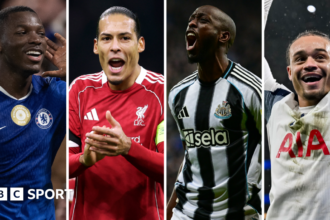
Premier League Power on Display, But the Champions League Knockouts Are a Different Beast
The dust has settled on the most chaotic, goal-laden finale to a Champions League group stage in recent memory. Eighteen games played simultaneously produced a staggering 61 goals, a spectacle capped by the surreal sight of Benfica’s goalkeeper, Anatoliy Trubin, thumping home a last-gasp header that ultimately meant nothing for his team’s fate. Yet, beneath the glorious bedlam, a familiar, powerful narrative emerged: the sheer, overwhelming dominance of the Premier League. All four English entrants—Manchester City, Arsenal, Real Madrid, and Barcelona—marched into the last 16, with several topping their groups. This statistical superiority is undeniable, but as any European veteran will whisper, the knockout phase is a tournament reborn. What looks like a procession in December can become a perilous puzzle by March.
The English Juggernaut: Depth, Talent, and a Point to Prove
The Premier League’s collective strength is not a fluke; it’s a financial and tactical reality. The league’s economic might allows its top clubs to build squads of staggering depth, a critical asset for navigating the dual demands of a domestic grind and a European campaign. Unlike leagues where one or two teams dominate, the Premier League’s competitive intensity week-in, week-out arguably creates a resilience that translates well to high-stakes Champions League nights.
Manchester City, the reigning champions, remain the gold standard. With Pep Guardiola at the helm and a squad that seems to absorb injuries without losing rhythm, they are the unambiguous favorites. Arsenal, back in the knockouts after a long hiatus, have evolved from excited participants to seasoned contenders, boasting a blend of youthful exuberance and hard-earned maturity. Their seeding as group winners is a significant advantage. Meanwhile, clubs like Barcelona and Real Madrid, while navigating transitions, possess the individual genius and continental pedigree that can never be discounted in a two-legged tie.
However, this dominance brings its own pressure. The expectation is now squarely on English shoulders. The narrative has shifted from “can they compete?” to “they must win it.” This psychological burden, coupled with the relentless physical toll of the Premier League, will be tested in the unforgiving format of the knockout rounds.
The Knockout Phase: Where Legends Are Made and Giants Fall
The league phase is a marathon of consistency. The knockouts are a sprint of nerve, tactical cunning, and momentous individual brilliance. Everything changes. The margin for error evaporates. A single defensive lapse, a moment of refereeing controversy, or an inspired opposing goalkeeper can undo six months of exemplary work. The format itself is a great equalizer.
Key factors that define the knockout stage include:
- The Tactical Duel: Managers have two legs to outthink each other. Adjustments from the first leg to the second are crucial. We move from broad group strategies to hyper-specific game plans designed to exploit a single opponent’s weakness.
- The Away Goal (Mentality): While the away goals rule is gone, the mentality remains. A draw, especially with goals, away from home is still a powerful psychological result. Managing the two legs as a cohesive 180-minute battle is a unique skill.
- Experience & Pedigree: Clubs with history in the latter stages—Bayern Munich, Real Madrid, etc.—carry an aura. They know how to manage these games, how to suffer, and how to pounce. For younger squads, this can be an intimidating hurdle.
- The Injury Lottery: A key injury to a star player in February or March can derail a campaign instantly. Squad depth, as mentioned, becomes paramount.
Landmines and Dark Horses: The Threat Beyond England
To assume a Premier League coronation is to profoundly disrespect a cast of European royalty and ambitious insurgents lying in wait. The draw will be pivotal, as the group winners will face runners-up. The English clubs will be desperate to avoid certain nightmares.
Real Madrid needs no introduction. In this competition, they are a living myth. Carlo Ancelotti’s calm expertise and a midfield featuring Jude Bellingham make them a threat to anyone. Bayern Munich, despite domestic struggles, are a Champions League machine, built for this competition with deadly wingers and a fearsome mentality.
Then come the potential banana skins. Paris Saint-Germain, now with a more cohesive team under Luis Enrique and the ever-present threat of Kylian Mbappé, could be devastating over two legs. Inter Milan, last season’s finalists, are a tactically disciplined and physically robust unit under Simone Inzaghi. Diego Simeone’s Atletico Madrid specialize in the kind of gritty, disruptive football that can frustrate and eliminate more fancied opponents. And one must never discount the Italian champions, Napoli, who possess the individual talent in Victor Osimhen and Khvicha Kvaratskhelia to blow any defense away on their day.
Predictions and the Road to Wembley
Forecasting the winner of this season’s Champions League is a fool’s errand, which is precisely what makes it so compelling. However, based on the group evidence and historical trends, we can outline the likely contours of the battle ahead.
Manchester City will be in every conversation until they are eliminated. Their combination of control, creativity, and big-game experience makes them the team to beat. Real Madrid and Bayern Munich remain their most credible challengers on paper, clubs equally steeped in the competition’s lore.
The wildcard is Arsenal. If they get a favorable draw and maintain their current form and health, they have the tools to make a deep run. Their learning curve, however, will be steepest in the quarter-finals or beyond. The intrigue lies in whether the other European giants see the Premier League’s collective strength as a motivator. Bayern, Madrid, and PSG will relish the role of hunter, not hunted, aiming to slay the English giants.
The draw will create instant classic narratives. Could we see an all-English clash in the last 16? A Guardiola vs. Ancelotti masterclass in the quarters? A Mbappé audition against Real Madrid? These subplots will fuel the winter months.
Conclusion: Dominance Meets Destiny
The Premier League’s commanding performance in the league phase is a testament to its quality and power. It has set the stage for a potentially historic campaign. But the Champions League trophy is not awarded for group-stage supremacy. It is earned in the white-hot crucible of the knockout rounds, where history, pressure, and a single moment of magic converge.
The English clubs have proven they are the collective force in European football. Now, they must prove they can navigate the minefield of the knockouts, where the rules of engagement change and the ghosts of European pasts rise. The story is no longer about numerical dominance; it is about which club can marry that strength with the cold-blooded precision, tactical flexibility, and slice of fortune required to conquer Europe. The league phase was a statement. The real conversation begins now.
Source: Based on news from Sky Sports.
Image: CC licensed via www.piqsels.com