Yulia Putintseva’s Rabbit Song: The Unlikely Anthem That Silenced the Australian Open Crowd
In the gladiatorial arena of a Grand Slam third round, where history and pressure converge, athletes arm themselves with the finest tools: cutting-edge rackets, meticulous tactics, and sports psychologists. Yulia Putintseva arrived with a song about rabbits. Facing a wall of sound supporting her opponent and the weight of four previous third-round losses at the Australian Open, the Kazakh star performed a masterclass in mental fortitude, conjuring an absurdist lullaby from a Soviet-era film to carve her path into the second week. Her 6-3, 6-7 (3-7), 6-3 victory over Turkish qualifier Zeynep Sonmez was a triumph of tactical resilience, but it was her psychological maneuver—drowning out a “disrespectful” crowd with whimsy—that will be remembered as one of the tournament’s defining moments.
The Crucible of Kia Arena: A Crowd Turned Adversary
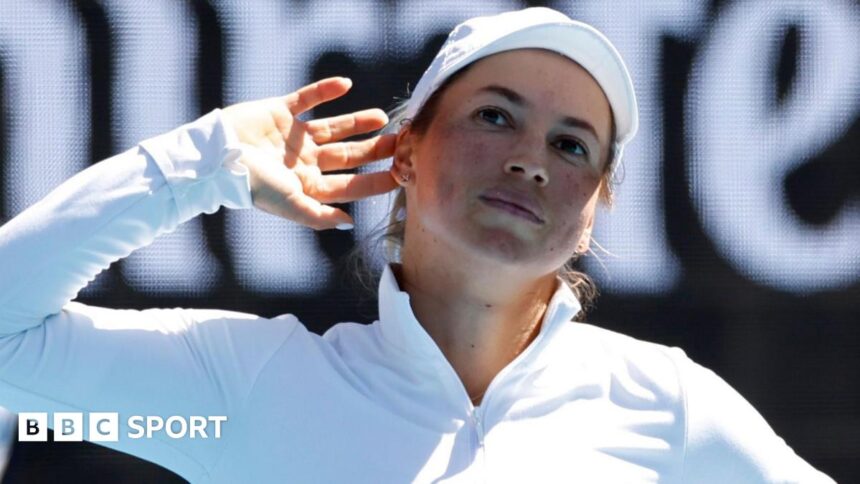
The scene on Kia Arena was a classic Australian Open tableau, but with a twist. Zeynep Sonmez, the world No. 254 qualifier on a dream run, had become an instant darling. Her every winning point was met with rapturous applause, while Putintseva, the higher-ranked and more experienced player, found herself cast in the unfamiliar role of the villain. This wasn’t just support for the underdog; to Putintseva, it crossed a line. The energy became a tangible force, threatening to sweep her out of the tournament as it had in years past.
After surrendering a second-set tiebreaker, the match was at a precipice. The crowd, smelling an upset, amplified their support. For many players, this is the moment the mind narrows, pressure mounts, and old ghosts whisper. Putintseva’s usual sanctuary—the music of Taylor Swift—wasn’t cutting through the noise. She needed something more potent, more personal, and utterly disconnected from the battle on court. She reached into her childhood and found a rabbit.
The Rabbit’s Burrow: A Psychological Masterstroke
Putintseva’s chosen mantra was not a pump-up hip-hop track or a serene classical piece. It was a simple, repetitive song about rabbits from the 1978 Soviet film “The Adventures of Buratino.” The lyrics, translating roughly to “A rabbit has a warm fur coat, a rabbit sleeps and sees dreams,” became her mental shield. This was a deliberate and brilliant cognitive intervention.
Sports psychologists emphasize the need for cognitive refocusing under extreme stress. By forcing her brain to dedicate active memory and auditory imagination to these silly, innocent lyrics, Putintseva effectively built a wall between her competitive focus and the distracting, emotionally charged environment. The song served a dual purpose:
- It blocked external noise: The repetitive nature of the song left little mental bandwidth to process the crowd’s cheers for her opponent.
- It induced emotional regulation: The childish, peaceful imagery of a sleeping rabbit countered the high-adrenaline, fight-or-flight state the match was trying to trigger.
“It was not respectful at all,” Putintseva stated bluntly about the crowd’s partiality post-match. Her solution, however, wasn’t confrontation but insulation. She didn’t try to fight the crowd; she made them irrelevant. This shift from frustration to focused indifference is a hallmark of elite mental conditioning. Where others might have engaged in heated exchanges or let their frustration boil over, Putintseva built a rabbit warren in her mind and hunkered down to work.
Breaking the Barrier: A Victory of Experience and Nerve
While the rabbit song managed the atmosphere, the victory was secured through a clutch display of veteran tennis. Putintseva’s game is built on variety, touch, and disruptive power. Against the fearless baseline aggression of Sonmez, she had to constantly problem-solve.
The key strategic battlegrounds were clear:
- Controlling the Forehand: Putintseva repeatedly targeted the Sonmez forehand in pressure moments, drawing errors.
- Using the Drop Shot: Her exquisite feel brought the qualifier forward, disrupting her rhythm and exposing her less comfortable net game.
- Stealing Momentum Early in the Third: After the emotional drain of losing the second set, Putintseva broke immediately in the decider, a critical psychological reset that silenced the crowd and asserted her intent.
This was not a flawless performance, but it was a winning one. It showcased the hard-earned maturity of a player who has spent years in the top 50, learning how to win ugly. The ghost of her four previous third-round exits in Melbourne was not just confronted; it was exorcised with a nursery rhyme.
What This Means for Putintseva’s Open Campaign
Surviving a match of this psychological intensity often serves as a catalyst. Putintseva has not only reached her first Australian Open fourth round but has proven she can win a street fight in a hostile environment. This forges a different kind of confidence—one that is self-contained and immune to external circumstances.
Moving forward, her path becomes both more difficult and more freeing. The expectations change. She will no longer be battling the narrative of her third-round curse. However, the physical and emotional toll of this three-set war cannot be ignored. Her immediate challenge shifts from crowd noise to the sheer power and consistency of the tour’s elite. The question becomes: can the rabbit song mentality—that ability to create a bubble of calm focus—hold up against a top-10 opponent who brings relentless pressure with every stroke?
Based on this performance, Putintseva has armed herself with a unique weapon. She has demonstrated that her mental game is as varied and creative as her tennis. She can switch from Taylor Swift to Soviet cartoon soundtracks if the situation demands it. This adaptability is a nightmare for opponents. She is a known disruptor on court, and now she has shown she can be a disruptor of her own mental state, which is far more valuable.
Conclusion: More Than a Quirky Anecdote
Yulia Putintseva’s rabbit song will be filed as a charming, quirky sports anecdote. But to dismiss it as such is to miss its profound significance. In the hyper-professionalized world of modern tennis, her victory was a raw, human testament to the art of mental survival. It was a reminder that beneath the analytics and the endorsements, athletes are individuals searching for any port in a storm.
She didn’t just beat Zeynep Sonmez; she outmaneuvered the entire emotional ecosystem of the match. By choosing a lullaby over a war cry, she demonstrated that psychological resilience isn’t always about being harder or louder. Sometimes, it’s about being softer, quieter, and whimsically detached. As she hops into the second week of the Australian Open, her opponents are now warned: Yulia Putintseva is not just playing against you. She might be in her own world, humming a tune about a sleeping rabbit, and that makes her more dangerous than ever.
Source: Based on news from BBC Sport.