Florida State’s Transfer Portal Exodus Continues: OL Josh Raymond Departs
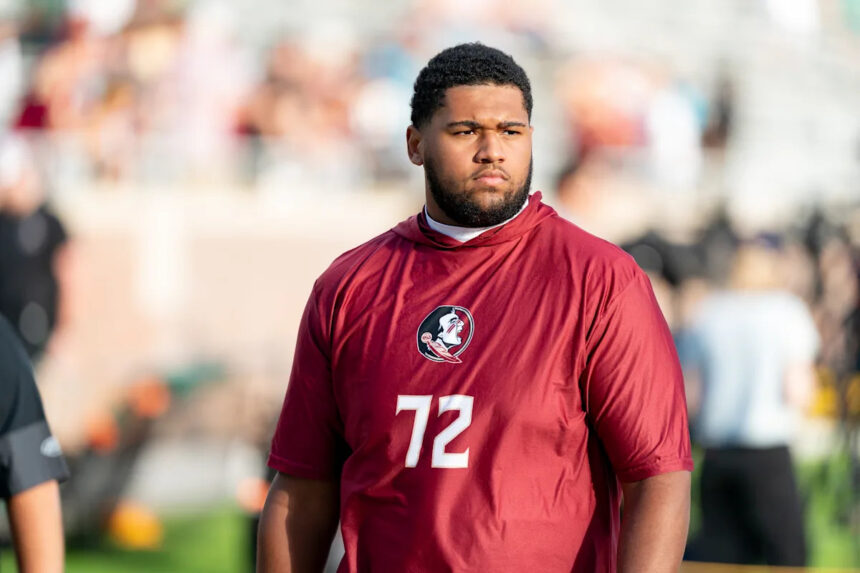
The revolving door at Florida State University’s football facility shows no sign of slowing. In an offseason defined by staggering roster turnover, the Seminoles have lost another player to the NCAA transfer portal. This time, it’s offensive lineman Josh Raymond, a player who arrived with considerable fanfare just a year ago. His departure, first reported by 247Sports, is more than a simple line item; it is a symbolic chapter in a broader, more concerning narrative for head coach Mike Norvell and his staff. With over 30 players exiting since the season ended, the question in Tallahassee has shifted from “who’s next?” to “how do we build a cohesive team?”
The Brief Seminole Career of Josh Raymond
Josh Raymond’s journey to Florida State was one of homecoming promise. A Consensus three-star recruit from Lake Mary High School in Orlando, Raymond was a decorated prospect. He earned Under Armour All-American status and was a key leader for a powerful Rams program. After initially committing and spending a redshirt year at Vanderbilt in 2023, he transferred to FSU, a move celebrated by a fanbase eager to bolster its offensive line depth.
However, his on-field impact never materialized. Raymond’s entire Florida State career stat line is stark: six total snaps, all coming in the season-opening blowout against East Texas A&M. For the remainder of the season, he was a spectator, buried on a depth chart that itself underwent significant turmoil. His exit underscores a harsh reality of the modern portal: for every high-profile success story, there are dozens of players like Raymond—talented individuals seeking the right fit who, for various reasons, don’t find it on their first or second try.
Anatomy of an Exodus: Why FSU is Hemorrhaging Talent
The loss of Josh Raymond is not an isolated event. It is part of a massive roster overhaul that has seen the Seminoles lose more than 30 scholarship players this offseason. This “great exodus” can be attributed to a confluence of powerful factors reshaping college football:
- NIL and Portal Interplay: The combination of Name, Image, and Likeness earnings and the transfer portal has created a free-agency-like environment. Players buried on depth charts, especially at high-profile programs, are incentivized to seek playing time and financial opportunities elsewhere.
- Post-ACC Snub Ripple Effect: The committee’s controversial exclusion of an undefeated FSU from the College Football Playoff created immediate roster instability. Key veterans declared for the NFL Draft, while others, seeing a potential reset, entered the portal.
- Scholarship Number Crunch: FSU brought in a large, highly-ranked recruiting class alongside several portal additions. To comply with the 85-scholarship limit, staffs often encourage lower-depth-chart players to seek opportunities, a process known as “roster management.”
- The Quest for Playing Time: At its core, most transfers are about snaps. For a player like Raymond, who saw only six in a season, the calculation is simple: with three years of eligibility remaining, a fresh start is his most valuable asset.
Expert Analysis: The Impact on FSU’s Offensive Line
While Raymond was not a contributor in 2023, his departure is a canary in the coal mine for the offensive line room. This unit was already a primary focus after inconsistent play last season. The analysis here is two-fold:
Short-Term Depth Erosion: Every offensive lineman on a roster is a potential starter due to the inevitability of injuries. Losing a player with Raymond’s physical profile and multiple years of development remaining thins the margin for error. It increases the pressure on incoming transfers and freshmen to be immediately ready, a risky proposition in the trenches of the ACC.
Long-Term Development Pipeline: College offensive lines are built through years of development. Players often need a season or two in a strength program before they are game-ready. Raymond represented a developmental piece for 2025 and beyond. His exit means the coaching staff must restart that developmental clock with another player, delaying the overall maturation of the unit.
The counter-argument, of course, is that Norvell and offensive line coach Alex Atkins have aggressively used the portal to *replace* departing talent with experienced or high-ceiling players. The focus will be on whether the incoming talent can gel faster than the outgoing players departed.
Predictions: What’s Next for Raymond and Florida State?
For Josh Raymond, the path forward is one of opportunity. His recruiting pedigree and physical tools will attract interest. Look for him to target programs where the offensive line depth chart is less crowded, potentially at the Group of Five level or at an FBS program undergoing its own rebuild. A successful reset could see him compete for a starting job by 2025, finally unlocking the potential that made him a first-team all-district standout in Florida.
For Florida State, the predictions are more complex. The immediate future is one of unprecedented roster churn. The 2024 Seminoles will be a fascinating case study in modern team-building—a patchwork of holdover stars, blue-chip freshmen, and mercenary portal veterans. The potential for high-ceiling play exists, but so does the risk of a team lacking chemistry and depth.
- Prediction 1: FSU will remain active in the portal, even after spring practice, seeking to backfill positions of need created by departures like Raymond’s.
- Prediction 2: Team cohesion will be the defining storyline of Fall camp. How Norvell molds this new group will determine their ceiling more than any individual talent.
- Prediction 3: The “exodus” narrative will only quiet with on-field success. A strong start in 2024 will stabilize the program; early struggles could trigger another wave of portal activity next cycle.
Conclusion: A New Era Demands a New Blueprint
The departure of offensive lineman Josh Raymond is a minor transaction in the grand ledger of college football. Yet, it perfectly encapsulates the volatile state of the Florida State program and the sport at large. We have moved past the era of four-year developmental projects at most major schools. The roster is now a fluid, ever-changing entity.
For Florida State, the challenge is no longer simply recruiting high school stars. It is about managing a year-round roster, balancing NIL collectives, acing the portal evaluation process, and fostering a culture strong enough to withstand constant turnover. The loss of 30+ players is a storm surge reshaping the coastline of the program. Whether it leaves behind fertile ground for a new contender or a barren landscape will depend on Mike Norvell’s ability to master this chaotic new game. The exodus may continue, but in today’s college football, the only constant is change itself.
Source: Based on news from Yahoo Sports.