Saints Rebuild: How the 2026 NFL Draft Made New Orleans One of the League’s Youngest Teams
For the better part of the last half-decade, the New Orleans Saints carried a reputation that was impossible to shake: they were old. Not just “veteran savvy” old, but visibly, mechanically slow. When you watched the Saints take the field in 2023 and 2024, it was often a study in contrast. While the rest of the NFL was getting faster, more explosive, and more athletic at the skill positions, New Orleans was trotting out a roster that featured a 35-year-old quarterback in Derek Carr, a 34-year-old defensive end in Cameron Jordan, and a 33-year-old linebacker in Demario Davis. The result was a team that often looked a step behind, struggling to keep pace with the league’s rising tide of speed.
That narrative is officially dead. Following the conclusion of the 2026 NFL Draft, the Saints have undergone a dramatic demographic shift. According to the most recent roster age analysis, New Orleans now ranks as the ninth-youngest team in the NFL with an average age of just 25.78 years. More impressively, their offense is the fifth-youngest in the league at 25.46 years old. This isn’t just a minor bump; it’s a systemic overhaul. The days of the Saints being a “slow” team are over. Here is the breakdown of how Mickey Loomis and the front office pulled it off, and what it means for the 2026 season.
The Offensive Youth Movement: Kamara Stands Alone
The most staggering statistic regarding the 2026 Saints offense is this: Alvin Kamara is the only player on that side of the ball over the age of 30. Kamara, who will turn 31 in July, is now the elder statesman of a unit that is bursting with young talent. This is a radical departure from just two years ago, when the offensive line alone featured multiple starters in their 30s.
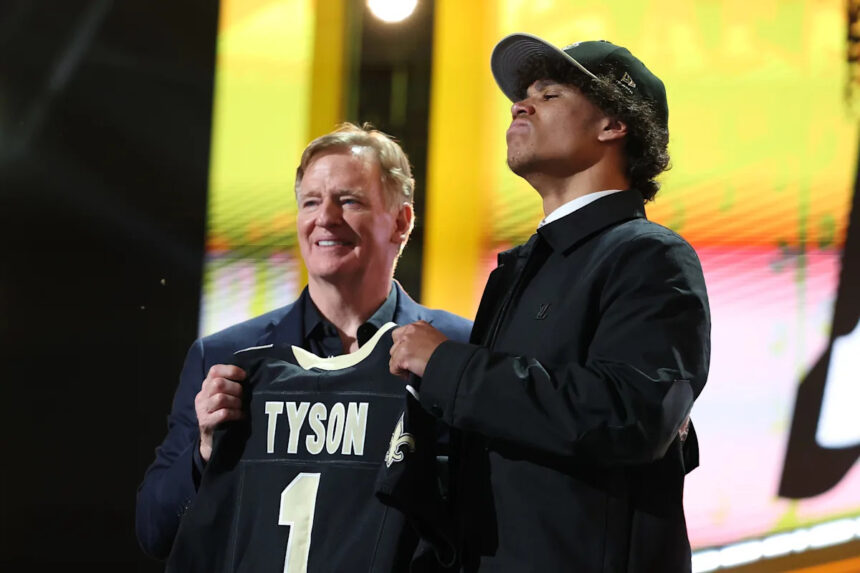
How did this happen? It started with the 2025 and 2026 draft classes. The Saints have aggressively prioritized youth and athleticism at wide receiver, offensive line, and tight end. Their 2026 first-round pick, wide receiver Jordyn Tyson, is the youngest player on the entire roster. Born on August 12, 2005, Tyson is a dynamic, explosive threat who immediately injects a vertical element that the Saints have lacked since the prime of Michael Thomas. He is a sub-4.4 speedster who can take the top off a defense, forcing safeties to respect the deep ball.
Beyond Tyson, the Saints have invested heavily in the offensive line. They used premium draft capital in 2025 to select a new left tackle, and their 2026 mid-round picks added depth at guard and center. The result is an offensive line that is no longer a group of aging, heavy-footed veterans. Instead, it is a young, mobile, and agile unit that fits perfectly with offensive coordinator Klint Kubiak’s zone-blocking scheme. The average age of the starting offensive line is now under 27, a massive drop from the 30-plus average of the 2022-2023 seasons.
- Key Stat: The Saints offense is the 5th youngest in the NFL at 25.46 years old.
- Key Player: First-round pick Jordyn Tyson (21 years old) is the fastest player on the roster.
- Key Takeaway: Alvin Kamara is the only offensive starter over 30, making him a unique veteran presence.
This youth movement also extends to the quarterback room. While Derek Carr is gone, the Saints have turned the page to a young, mobile signal-caller drafted in 2025. This new quarterback, combined with a young offensive line and a fast receiving corps, means the Saints can now run the wide-zone, play-action, and RPO concepts that require speed and athleticism. They are no longer a “drop-back, power-run” offense. They are a modern, dynamic attack designed to stress defenses horizontally and vertically.
Defense: Still a Work in Progress, But the Foundation is Set
While the offense has undergone a complete youth revolution, the defense is in a slightly more transitional phase. The Saints currently have an average age of 26.1 on defense, ranking 21st in the NFL. This is an improvement from the “old and slow” days, but it also reveals that the defense still carries some veteran dead weight.
As it stands, the projected Week 1 defense features only two starters over 30: defensive tackle Nathan Shepherd and linebacker Kaden Elliss. However, the depth chart is where the age problem lingers. Backups like Davon Godchaux (31) and cornerback Isaac Yiadom (30) are raising the overall average. These are players who, while experienced, lack the explosive burst of their younger counterparts.
The good news is that this is a temporary problem. The Saints used their second-round pick in the 2026 draft on defensive tackle Christen Miller, who is just 21 years old. Miller, born on August 5, 2005, is a massive, disruptive interior force. He is already being projected to take Godchaux’s spot in the rotation by mid-season. Miller is a powerful, explosive athlete who can push the pocket and stop the run. His insertion into the lineup will immediately lower the defense’s average age and increase its athletic ceiling.
The secondary is also getting younger. While Yiadom remains as a veteran insurance policy, the Saints have drafted two cornerbacks in the last two drafts. These young corners are faster, more fluid, and better suited to cover the modern NFL receiver than the aging veterans they are replacing. The linebacker corps, anchored by Elliss (who is still productive at 30), also features a 2025 third-round pick who is a sideline-to-sideline athlete.
- Defensive Age: Ranked 21st at 26.1 years old, but trending younger.
- Rookie Impact: 2nd-round DT Christen Miller (21) will replace Godchaux in the rotation.
- Veteran Overhang: Shepherd, Elliss, Godchaux, and Yiadom are the only players over 30.
The defense is not yet “young,” but it is getting younger. By the end of the 2026 season, with Miller starting and the young corners playing more snaps, this unit could easily rank in the top 15 in terms of youth. The Saints are deliberately choosing to absorb the growing pains of young players now, rather than relying on aging veterans who can no longer make the plays required to win in the NFC South.
What the Numbers Actually Mean: The Thin Margin for Success
It is easy to look at roster age and assume it is a magic bullet, but the reality is more nuanced. The difference between the youngest team in the NFL (the Miami Dolphins at 25.18 years old) and the oldest team (the Washington Commanders at 26.79 years old) is less than a year and a half. That is a remarkably thin margin. In the NFL, one year of experience can be the difference between a blown assignment and a game-winning play.
So, what does this youth actually buy the Saints? It buys explosiveness, recovery speed, and financial flexibility.
Explosiveness: Younger players, especially at the skill positions, are simply faster. They have fresher legs and quicker twitch. The Saints offense now has the ability to create big plays on any given snap. A 21-year-old wide receiver like Jordyn Tyson can turn a 5-yard slant into a 75-yard touchdown. A 24-year-old offensive tackle can get to the second level and block a safety. This is the kind of athleticism that the 2023 Saints simply did not have.
Recovery Speed: Defensively, youth matters most in the fourth quarter. An older defensive line gets tired. A younger one can still rush the passer. The Saints’ defense, while still having some older players, now has the depth of young, hungry players who can rotate in and keep the pressure on. Christen Miller and the young edge rushers will be critical in the final 15 minutes of games.
Financial Flexibility: The most important long-term benefit is cap health. Rookie contracts are cheap. By replacing expensive, aging veterans with drafted rookies, the Saints have finally escaped the salary cap hell that plagued them for a decade. They can now afford to pay their stars (like Kamara and a few defensive studs) while surrounding them with cost-controlled talent. This is the sustainable model that winning franchises like the San Francisco 49ers and Kansas City Chiefs have used.
Prediction: A Playoff Push in 2026?
So, does this youth movement mean the Saints are ready to contend for a Super Bowl in 2026? Not quite. The roster is still a work in progress, particularly on defense. However, the trajectory is undeniably upward. The Saints are no longer a team that is “one year away” from a rebuild. They are in the middle of it, and the results are tangible.
My prediction: The Saints will be a 9-8 or 10-7 football team in 2026. They will be competitive in every game because of their speed. The offense will be exciting, if inconsistent, due to the young quarterback and receivers. The defense will struggle early but improve significantly as the season progresses and the young players like Miller get more snaps. They will be in the wild card race until the final week.
More importantly, the foundation is set. The Saints have successfully transitioned from one of the NFL’s oldest, slowest teams to one of its youngest and fastest. The 2026 draft was the final piece of that puzzle. The “aging” narrative is gone. The “slow” label is gone. The New Orleans Saints are finally running with the young guns. And that, for a franchise that has been stuck in neutral for three years, is the most exciting development of all.
The future is young in New Orleans. And for the first time in a long time, it looks fast.
Source: Based on news from Yahoo Sports.