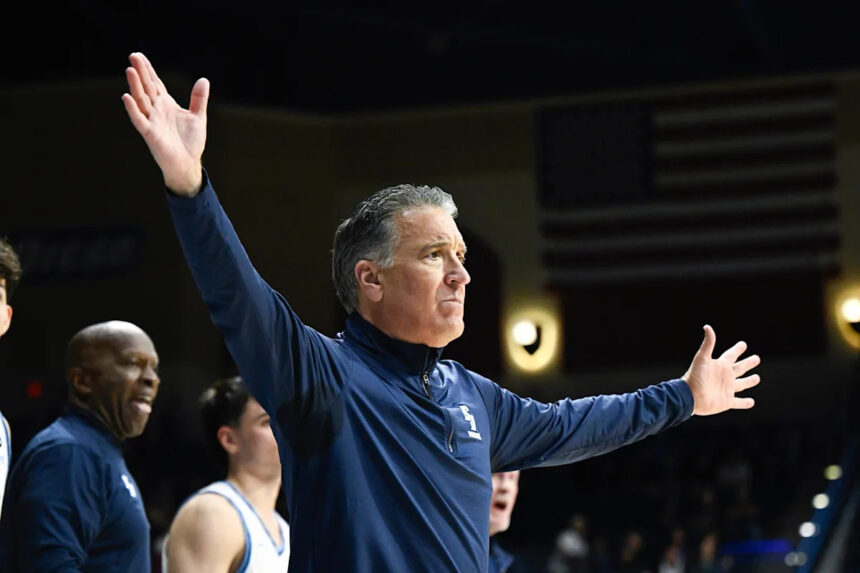
San Diego Parts Ways with Head Coach Steve Lavin
The University of San Diego is set to embark on a new chapter in its men’s basketball program. The school announced Wednesday that head coach Steve Lavin will not return next season, concluding a four-year tenure marked by struggle and a single, fleeting glimpse of success. The decision, coming with three regular-season games remaining, allows Lavin to finish the 2024-25 campaign but signals a clear desire for change atop the Toreros basketball program.
A Tenure Defined by Persistent Struggle
Steve Lavin arrived at San Diego in 2021 with a recognizable name and a pedigree built from his time at UCLA and St. John’s. The hope was that his experience and recruiting connections could elevate a WCC program often living in the shadow of conference giants Gonzaga and Saint Mary’s. That elevation, however, never materialized in a sustained way.
The numbers paint a stark picture of the Lavin era at the Jenny Craig Pavilion:
- Overall Record: 46-79 (.368 winning percentage)
- WCC Conference Record: 18-47 (.277 winning percentage)
- Winning Seasons: 1 (2023-24: 18-15)
- NCAA Tournament Appearances: 0
- WCC Tournament Success: No championship game appearances
The lone bright spot was last season’s 18-15 finish, a campaign that offered a semblance of progress. Yet, that momentum proved illusory. This season’s regression to an 11-17 record (as of the announcement) and another bottom-half West Coast Conference standing ultimately sealed Lavin’s fate. The inability to build a consistent winner or crack the upper echelon of the league proved insurmountable.
Analyzing the Missed Connection in Mission Valley
From an analytical standpoint, Lavin’s tenure at San Diego represents a curious case of a coach whose second act never found its rhythm. Several key factors contributed to the disappointing outcome.
Defensive Deficiencies: Throughout his four seasons, Lavin’s teams were consistently porous on defense. They often ranked near the bottom of the WCC in defensive efficiency and points allowed. In a league with disciplined, systematic offenses, this was a fatal flaw.
Recruiting Inconsistency: While Lavin brought in some talented transfers and a few promising high school players, the roster never achieved the balance or depth needed to weather injuries or sustain performance. The teams often lacked a clear identity, oscillating between styles that didn’t always suit the personnel.
The Gonzaga Gauntlet: Coaching in the WCC means navigating the juggernaut that is Gonzaga, but also rising programs like Saint Mary’s, San Francisco, and Santa Clara. Lavin’s Toreros failed to become competitive in this tier, going a combined 2-14 against those four programs during his tenure. To be a contender, you must win some of these games; USD was routinely non-competitive.
Lavin’s gracious statement reflected his appreciation for the opportunity and the relationships built, saying, “Teaching and coaching at the University of San Diego has been an experience of unparalleled pride and joy.” However, the administration’s decision underscores the cold, hard reality of college athletics: results are the ultimate metric.
What’s Next for the Toreros Basketball Program?
San Diego’s decision to make this announcement before the season concludes is strategic. It provides immediate clarity and allows the athletic department, led by Director of Athletics Bill McGillis, to begin a critical coaching search in earnest. The upcoming WCC Tournament in Las Vegas will now serve as an audition for the current players and a backdrop for the program’s future.
The search will likely focus on a candidate profile distinct from Lavin. Expect San Diego to target:
- A Proven Program Builder: Someone with experience constructing a winner, likely at the mid-major level, with an emphasis on player development and defensive identity.
- A Dynamic Recruiter: The new coach must be able to tap into the fertile Southern California recruiting grounds and the transfer portal to quickly upgrade talent.
- A Coach with WCC or West Coast DNA: Understanding the unique challenges and landscape of the West Coast Conference is a significant advantage.
Potential names could include successful head coaches from the Big West, Big Sky, or Mountain West conferences, or top assistants from established Pac-12 or WCC programs who are ready for a head coaching role. The appeal of San Diego—a beautiful campus, a solid facility, and a conference with national exposure—remains strong.
Predictions for a Pivotal Offseason
The coming months are the most important for Toreros basketball in nearly a decade. This coaching hire will define the trajectory of the program for the next five years.
Prediction 1: Portal Activity Will Be Fierce. The current USD roster will see significant turnover. Players will wait to see who the new coach is, but expect several to enter the transfer portal. Conversely, the new coach’s first major task will be to use the portal to inject immediate competitiveness into the lineup.
Prediction 2: The Search Will Move Quickly. With the coaching carousel set to spin furiously in March, San Diego will aim to secure its target early. A hire by early April is likely to allow maximum time for roster reconstruction.
Prediction 3: Pressure for Immediate Progress. The patience afforded to Lavin will not be extended to his successor. While a year-one tournament bid may not be expected, showing clear tactical improvement, a stronger defensive foundation, and competitiveness in the WCC will be the minimum benchmarks for 2025-26.
Conclusion: A Necessary End and a Hopeful Beginning
The Steve Lavin era at the University of San Diego ends not with acrimony, but with a shared acknowledgment that the fit simply didn’t produce the desired results. For Lavin, it was a final head coaching opportunity that highlighted the increasing difficulty of turning around a mid-major program in today’s volatile college basketball landscape. For the Toreros, it was a costly experiment that yielded little return on investment.
Yet, within this conclusion lies genuine opportunity. San Diego is not a barren basketball outpost. It possesses the tools—location, conference, facilities—to be a consistent top-half WCC team and an occasional NCAA Tournament contender. The school’s leadership now has a mandate to find the right architect to build that reality.
The announcement closes the book on a disappointing chapter, but it also turns the page. The focus in Mission Valley now shifts from a past of unmet expectations to a future filled with the promise of a fresh start. The search for the next leader of Toreros basketball is officially on, and its outcome will determine whether this program can finally climb the mountain it has been staring at for far too long.
Source: Based on news from Yahoo Sports.