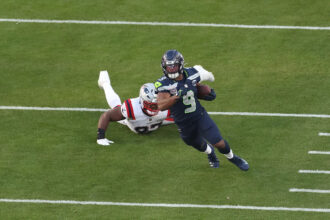
Seahawks’ Rashid Shaheed Etches Name in Super Bowl Lore with Unprecedented Fair Catch Feat
In the grand, highlight-chasing spectacle of the Super Bowl, where legends are born from impossible catches and game-breaking returns, a new kind of record was authored in Super Bowl 60. It was not written in yards or touchdowns, but in a series of prudent, understated waves of the right hand. Seattle Seahawks return specialist Rashid Shaheed, in a performance that perfectly encapsulated a defensive masterclass, secured his place in the annals of the game by fielding a record-setting six fair catches in Seattle’s 29-13 victory over the New England Patriots. In a game defined by field position and punts, Shaheed’s historic discretion became a defining, if unconventional, storyline.
- The Art of the Inaction: How Fair Catches Won the Field Position Battle
- Contextualizing the Record: A Defensive Slugfest for the Ages
- Patriots’ History-Making Night for the Wrong Reasons
- The Legacy of Prudence: What Shaheed’s Record Tells Us About Football’s Future
- Conclusion: A Record of Intelligence in a Game of Force
The Art of the Inaction: How Fair Catches Won the Field Position Battle
To the casual observer, a fair catch is a non-event—a procedural blip before the commercial break. For strategists and football purists, it is a critical, high-stakes decision. In the pressurized environment of Super Bowl 60, with the Patriots’ elite coverage units bearing down, Shaheed’s judgment was flawless. Each raised arm was a calculation: risk a fumble or a devastating hit for minimal gain, or guarantee possession and trust a suffocating Seahawks defense and an efficient, if not explosive, offense.
Seattle’s game plan, orchestrated by Head Coach Mike Macdonald in his first year, was a thing of pragmatic beauty. It recognized that against a Bill Belichick defense, winning the war of attrition was key. The Seahawks’ offense, led by a patient Geno Smith, consistently moved the ball just enough to get into Jason Myers’ range—the kicker himself setting a Super Bowl record with five field goals. The defense, meanwhile, forced the Patriots into a cascade of punts. Shaheed, stationed deep, became the reliable terminus for those kicks. His six fair catches were not a sign of timidity, but of supreme discipline, directly contributing to Seattle’s consistently advantageous starting field position and keeping the Patriots’ offense pinned deep.
Contextualizing the Record: A Defensive Slugfest for the Ages
Shaheed’s record cannot be understood in a vacuum. It is a direct product of the type of game Super Bowl 60 became—a throwback, grind-it-out affair that was the antithesis of the shootouts that have recently defined the league. The statistical landscape tells the story:
- Combined Punts: The two teams combined for 14 punts, a number reminiscent of a 1970s NFC Central clash.
- Third Down Efficiency: Both teams struggled mightily on third down, converting under 35% of their attempts, leading to frequent special teams swaps.
- Turnovers and Sacks: The game featured four total turnovers and five sacks, underscoring the defensive dominance on both sides.
In this environment, Rashid Shaheed’s role transformed. The dynamic speedster, known for his punt return touchdowns during the season, was asked to be a safety valve. His record is less about individual athleticism and more about executing a game plan to perfection. It highlights a often-overlooked facet of championship football: the mental fortitude to prioritize the team’s needs over personal glory. On the biggest stage, where players are often tempted to force a play, Shaheed exercised legendary restraint.
Patriots’ History-Making Night for the Wrong Reasons
While the Seahawks celebrated their third Lombardi Trophy, the New England Patriots found themselves on the wrong side of history once more. Their record 12th Super Bowl appearance, a testament to the sustained excellence of the Belichick-Brady era and beyond, concluded with a sobering milestone. The loss marked the franchise’s sixth defeat in the Super Bowl, breaking their tie with the Denver Broncos for the most by any NFL franchise.
The game itself was a microcosm of the Patriots’ post-Brady struggles. The defense performed admirably for long stretches, but the offense, led by Drake Maye in his sophomore season, could not solve Seattle’s complex defensive schemes. The Patriots’ own punt return unit never got a chance to make a impact, as Seattle’s Michael Dickson boomed kicks with hangtime that forced their own fair catches. For New England, the quest for a seventh title continues, now shadowed by the unwanted distinction of being the franchise that has felt the sting of Super Bowl defeat most often.
The Legacy of Prudence: What Shaheed’s Record Tells Us About Football’s Future
In the immediate aftermath, pundits are already debating the place of Rashid Shaheed’s fair catch record in football lore. Is it a quirky footnote, or a sign of a strategic shift? The analysis suggests the latter. As NFL defenses grow more sophisticated and athletic, and as the value of every single possession is magnified, the risk-reward calculus of the return game is being fundamentally re-evaluated.
We predict that Shaheed’s record will stand as a symbol of this new pragmatism. Teams are increasingly willing to trade the potential for a explosive return for the certainty of possession. This record may one day be broken, but only in a game with similar defensive ferocity. Furthermore, Shaheed’s performance elevates the often-unsung special teams ace. It proves that impact plays are not solely about gaining yards; sometimes, the most impactful play is the one that avoids catastrophe and resets the battle for field position.
Conclusion: A Record of Intelligence in a Game of Force
Super Bowl 60 will be remembered for the Seattle Seahawks’ coronation under Mike Macdonald, for Jason Myers’ reliable right leg, and for a defense that stifled a legendary franchise. But woven into the fabric of that victory is the unique, historic contribution of Rashid Shaheed. His record six fair catches are a testament to a different kind of football brilliance—the brilliance of judgment, patience, and selflessness.
In an era obsessed with “making a play,” Shaheed’s legacy from this game is the power of *not* making a play. It is a record born not from physical dominance, but from football intelligence. It reminds us that championships are won in a multitude of ways, and sometimes, the surest path to glory is a simple, repeated wave of the hand, securing the ball and, ultimately, securing a place in history.
Source: Based on news from Yahoo Sports.