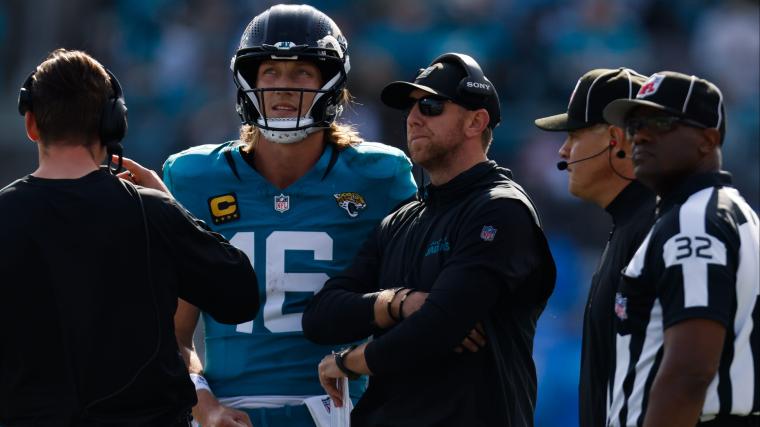
Sports World Divided: A Reporter’s Unusual Praise for Jaguars’ Liam Coen Sparks Heated Debate
In the immediate, raw aftermath of a playoff loss, the postgame press conference is a theater of predictable rhythms. Questions about critical turnovers, defensive breakdowns, and offseason plans are lobbed at a coach navigating the fresh sting of elimination. What it is not typically known for is heartfelt, public consolation. Yet, that is precisely what unfolded following the Jacksonville Jaguars’ season-ending defeat to the Buffalo Bills, sparking a surprising and divisive national conversation that has the sports world examining the very protocols of sports journalism.
An Unscripted Moment of Humanity in a Scripted Setting
The scene was the Jaguars’ media room. First-year head coach Liam Coen, having just seen a promising season conclude, prepared for the standard postmortem. Then, Lynn Jones of the Jacksonville Free Press News, a weekly serving the city’s Black community, took her turn. What followed was not a question, but a soliloquy of support.
“How you doing today, Lynn Jones, Jacksonville Free Press News. I just want to tell you, congratulations on your success young man. You hold your head up, alright? You guys have had a most magnificent season. You did a great job out there today. You just hold your head up, okay? Ladies and gentlemen, Duval, you the one. Keep it going, we got another season, okay? Take care, and much continued success to you and the entire team.”
Coen, visibly moved, offered a quiet “Thank you, Lynn,” and a nod. The moment was brief, but its impact was immediate and far-reaching, splintering opinions across social media, talk radio, and industry circles.
The Great Divide: Compassion vs. Objectivity
The reaction to Lynn Jones’s press conference comments revealed a fundamental clash in perspectives on the role of a sports reporter.
Side A: A Necessary Dose of Compassion
This camp views Jones’s words as a refreshing, humanizing break from a often cynical and repetitive media cycle. Proponents argue:
- Context matters: Coen, in his first year, overcame significant adversity to guide the Jags to the playoffs.
- Community connection: As a voice for a specific community, Jones’s role extends beyond game analysis to representing the sentiment of a segment of the fanbase.
- The human element: Coaches and players are not robots; acknowledging effort in failure is not a journalistic sin.
“She wasn’t there as a national columnist to dissect play-calling,” noted veteran sports media analyst David Carter. “She was there as a community journalist, offering a perspective rooted in local support and long-term relationship building. That has inherent value.”
Side B: A Breach of Journalistic Protocol
The opposition contends that the moment, however well-intentioned, crossed a professional line. Critics maintain:
- The purpose of the press conference is inquiry: It is a forum for accountability and insight, not pep talks.
- It sets a questionable precedent: If one reporter offers praise, does it pressure others to soften their line of questioning?
- It blurs the line between journalist and fan: Objectivity is compromised when a reporter speaks as an advocate.
“It was uncomfortable and out of place,” argued a prominent national radio host. “My job isn’t to tell a 38-year-old millionaire coach to ‘hold his head up.’ My job is to ask him why his offense sputtered in the red zone. That press conference isn’t a therapy session; it’s a news conference.”
Expert Analysis: Reading Between the Lines of the Reaction
The intensity of the split speaks to larger tensions within sports media. The rise of fan-driven, personality-based commentary on digital platforms has long been on a collision course with traditional, detached beat reporting. Jones’s moment sits at that intersection.
“This debate isn’t really about Lynn Jones or Liam Coen,” explains Dr. Sarah Miller, a professor of sports communication. “It’s a proxy war about the soul of sports journalism. The traditionalists see the sanctity of the ‘press conference’ as a last bastion of pure Q&A. The modernists see that space as an outdated formality that often fails to capture nuanced stories—like that of a community embracing a new coach.”
Furthermore, the fact that Jones represents the Jacksonville Free Press News is crucial. Her mandate differs from that of an Associated Press reporter or a national broadcaster. Her “question” was, in essence, a direct communication to her readers: This is how our community sees this man’s work. It was reporting by conveying sentiment, not just seeking a quote.
Predictions: The Ripple Effect on Media and the Jaguars’ Future
This incident will likely have lasting, though subtle, repercussions.
For Sports Media: News organizations may revisit briefing protocols for reporters, especially those from non-traditional outlets. However, a more likely outcome is a heightened awareness of the performative aspect of press conferences. We may see more hybrid approaches where post-game access is diversified—some sessions for hard news, others for more feature-oriented or community-focused dialogue.
For Liam Coen and the Jaguars: In the short term, this provides Coen with undeniable evidence of local support and goodwill as he enters a critical offseason. The playoff postgame press conference moment, now iconic, reinforces his connection to the city beyond the win-loss column. This social capital is invaluable for a coach building a culture.
- Recruiting Leverage: Agents and free players take note of a community and media that supports its coach through adversity.
- Internal Morale: The public display of respect will resonate in the locker room, strengthening player-coach trust.
- Narrative Shield: During inevitable future struggles, the memory of this goodwill may temper local criticism.
Conclusion: More Than a Pep Talk—A Reflection of Modern Fandom
The sports world’s split over a reporter’s 30-second statement is a mirror held up to the industry itself. The incident proves that in today’s media ecosystem, there is no universally accepted rulebook. The lines between journalist, analyst, fan, and community advocate are increasingly and irrevocably blurred.
While the Jacksonville Jaguars don’t often create this much discourse, the discourse they’ve created this time is profoundly meaningful. Lynn Jones did more than tell Liam Coen to hold his head up. She held up a lens to a changing landscape, where humanity and objectivity are in a constant, messy, and necessary negotiation. The debate may be about protocol, but the moment itself was about people—a reporter representing her community’s voice, and a coach receiving it at his most vulnerable. In the end, that human connection, however controversial its delivery, might be the most lasting story of the Jaguars’ season.
Source: Based on news from Yahoo Sports.