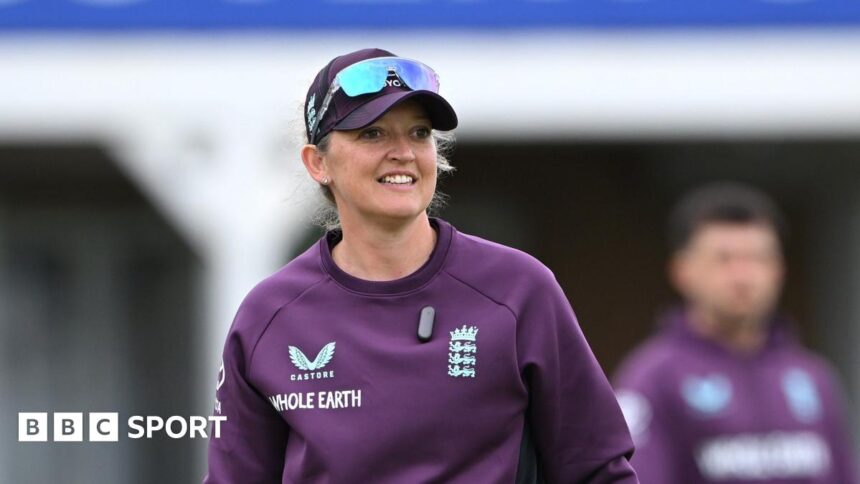
Taylor named England fielding coach in landmark move: A new era for English cricket
In a move that shatters glass ceilings and redefines the coaching landscape of English sport, former wicketkeeper Sarah Taylor has been appointed as England’s fielding coach for the upcoming Test series against New Zealand. The announcement, made by the England and Wales Cricket Board (ECB) on Monday, marks the first time a woman has been named to a coaching role for an England men’s senior side in a major sport. It is a decision that has been met with near-universal acclaim, and for good reason: Taylor is not a symbolic hire. She is, by any objective measure, one of the finest fielding minds the game has ever produced.
Taylor, 36, will join the men’s Test squad for the three-match series against the Black Caps, starting in Christchurch on November 28. Her appointment follows a winter of successful work with the England Lions, where she already made a significant impact on the next generation of male cricketers. This is not an experiment; it is a logical progression for a player who redefined wicketkeeping standards in women’s cricket and who has proven her coaching acumen in the men’s game.
From World Cup hero to coaching pioneer
To understand the magnitude of this appointment, one must first appreciate the sheer weight of Taylor’s playing career. Between 2006 and 2019, she played 226 times for England, amassing a reputation as one of the best wicketkeepers to have ever played the game, regardless of gender. Her statistics are glittering: she won the 50-over World Cup in 2009 and 2017, and the T20 World Cup in 2009. But numbers alone fail to capture her genius. Taylor possessed a rare combination of lightning-fast reflexes, unerring glovework, and an almost telepathic understanding of batting angles and spin.
Her ability to stand up to the stumps to fast bowlers—a skill few male keepers master—was legendary. She turned wicketkeeping into an art form, making the difficult look routine and the impossible look inevitable. This technical mastery is precisely what makes her such a compelling choice for the men’s side. The modern Test match demands that fielders, especially the wicketkeeper, be both a defensive wall and an attacking weapon. Taylor embodies that philosophy.
“She’s one of the best in the business at what she does,” said Rob Key, England’s managing director of men’s cricket. “Her credentials speak for themselves. She has worked with our players in the Lions set-up and the feedback has been outstanding. We are thrilled to have her on board for the Test series.” Key’s endorsement is crucial. It signals that this is a merit-based appointment, not a diversity checkbox. Taylor earned this role through performance, reputation, and a clear ability to communicate her craft to male athletes.
Why Taylor is the perfect fit for England’s Test squad
The timing of this appointment is not accidental. England’s Test side, under the leadership of captain Ben Stokes and head coach Brendon McCullum, has embraced an aggressive, high-risk brand of cricket known as ‘Bazball’. A cornerstone of this philosophy is exceptional fielding. In modern Test cricket, a single dropped catch or a misfield can cost a team 30 runs and shift momentum irrevocably. England have been searching for a dedicated fielding coach who can instil a culture of relentless, athletic excellence.
Taylor’s role will be multifaceted. She will work directly with wicketkeeper Ben Foakes, arguably the best gloveman in the English county system, and with the squad’s designated keeper for the series, Jordan Cox. But her influence will extend to every player in the slips, the gully, the outfield, and the boundary. She will drill them on the specific techniques required for English and New Zealand conditions: the low, fast catch in the slips, the flat throw from the deep, and the art of anticipation.
Her previous coaching stints in men’s cricket have already demonstrated her effectiveness. At Sussex, she worked with the county’s wicketkeepers and fielders, earning praise for her ability to break down complex techniques into simple, repeatable actions. With the Manchester Originals in The Hundred, she operated in the high-pressure environment of franchise cricket, where margins are razor-thin. Most recently, she spent the winter with the England Lions, where she mentored players like James Rew and Ollie Robinson (the wicketkeeper), helping them refine their glovework against spin and pace.
Expert analysis: What this means for English cricket
From a tactical perspective, Taylor’s appointment is a masterstroke. The New Zealand series will be played on pitches that traditionally offer bounce and lateral movement, demanding impeccable catching behind the stumps. Taylor’s expertise in reading the ball off the pitch—a skill honed over years of keeping to spinners like Anya Shrubsole and fast bowlers like Katherine Brunt—will be invaluable. She can provide real-time feedback on footwork, hand position, and balance, adjustments that can turn a half-chance into a wicket.
But the broader implications are even more significant. This move normalises the idea that coaching is about skill, not gender. For decades, women’s cricket was viewed as a separate, lesser sphere. Taylor’s appointment shatters that outdated perception. She is not a “female coach” coaching men; she is a world-class coach who happens to be a woman. This distinction is critical for the next generation of female players and coaches who aspire to work at the highest level of the sport.
“It’s a landmark moment, but it shouldn’t be a surprise,” said former England captain Michael Vaughan in a recent podcast. “Sarah Taylor was a freak of nature with the gloves. If she can pass on half of that knowledge to our keepers, England will be a better side. Full stop.” Vaughan’s sentiment is echoed across the cricketing world. The appointment has been praised by former players, current internationals, and analysts alike, who see it as a progressive step that prioritises competence over convention.
Predictions for the New Zealand series and beyond
Looking ahead to the Test series against New Zealand, I predict that Taylor’s influence will be most visible in the second and third Tests. The first Test will likely see some teething issues as she builds rapport with the squad, but by the time the team moves to Wellington and Hamilton, expect to see a noticeable improvement in England’s catching efficiency. The slip cordon, which has occasionally been leaky under pressure, will become more secure. The wicketkeeper’s footwork will be sharper, especially against New Zealand’s spinners, Ajaz Patel and Mitchell Santner.
Beyond this series, Taylor’s role could expand. If she delivers results—and all evidence suggests she will—she could become a permanent fixture in the men’s coaching setup, potentially for the 2025-26 Ashes tour. The ECB has already signalled its willingness to break traditional moulds, and Taylor’s success could open the door for other female coaches in men’s professional sport, not just in cricket but in football, rugby, and beyond.
However, there will be challenges. The dressing room dynamic in men’s international cricket is notoriously intense. Taylor will need to command respect through her knowledge and presence, not her reputation. But those who have worked with her describe her as demanding, articulate, and fiercely competitive. She does not suffer fools gladly, and she expects the same standards she set for herself as a player. That attitude, combined with her technical brilliance, makes her an ideal fit for a team that prides itself on high standards.
Conclusion: A new standard for coaching
Sarah Taylor’s appointment as England’s fielding coach is more than a headline. It is a statement that English cricket is willing to look beyond traditional boundaries to find the best people for the job. In a sport that has often been slow to change, this move is a refreshing, forward-thinking decision. Taylor brings world-class expertise, a proven track record in the men’s game, and a relentless pursuit of excellence. She is not a symbol; she is a solution.
As the Test series against New Zealand approaches, all eyes will be on the England fielders. Will they be sharper? Will they create more chances? If history is any guide, the answer is a resounding yes. Sarah Taylor has spent her entire career making the impossible look possible. Now, she has the chance to do the same for an entire team. For English cricket, this is not just a landmark moment—it is the beginning of a new, more inclusive, and more excellent era.
Source: Based on news from BBC Sport.