Team USA’s Golden Triumph: A Legacy Celebrated With the Gaudreau Children
In the crisp, thin air of Milano Cortina, history was made not just with a score, but with a sacred promise kept. The final buzzer of the 2026 Winter Olympics men’s hockey final signaled more than Team USA’s thrilling 2-1 victory over arch-rival Canada. It unleashed a torrent of emotion, culminating in a scene so profoundly human it transcended sport. As the Stars and Stripes were prepared for raising, the team’s focus shifted from the vanquished foe in red and white to four young children, clad in USA gear, being carefully guided onto the glistening ice. They were the children of the late Johnny and Matthew Gaudreau. In that instant, a gold medal celebration transformed into a powerful, tear-streaked tribute to legacy, family, and the unbreakable bonds forged in locker rooms and living rooms alike.
A Victory Forged in Memory
The path to this golden moment was paved with a collective weight and a unifying purpose. The tragic loss of Johnny “Johnny Hockey” Gaudreau and his brother Matthew in the summer of 2024 sent shockwaves through the hockey world, leaving a void felt most acutely by their families, friends, and teammates. For the architects of the 2026 U.S. Olympic team, the mission became twofold: assemble a squad capable of reclaiming gold for the first time in over two decades, and do it in a way that honored the indelible spirit of the Gaudreau brothers.
The tournament itself was a masterclass in resilience. Team USA battled through a gauntlet, their play defined by a gritty determination that seemed to burn brighter than mere national pride. In the final against Canada, every blocked shot, every frantic save, and every punishing check felt amplified. The 2-1 victory over Team Canada was a classic, a tight-checking affair won on a third-period deflection and preserved by heroic goaltending. But as the players mobbed each other at center ice, their eyes quickly turned to the stands.
An Unforgettable On-Ice Tribute
What followed was a sequence of gestures that will be etched into Olympic lore. First, veteran defenseman Zach Werenski—a former Columbus Blue Jackets teammate and close friend of Johnny’s—retrieved a familiar jersey. As Queen’s “We Are the Champions” echoed through the arena, the team gathered for a victory lap with Johnny’s No. 13 jersey, waving it high for the world to see. It was a symbolic carry, a declaration that while his dazzling skill wasn’t physically on the ice, his essence was in every player who wore the crest that day.
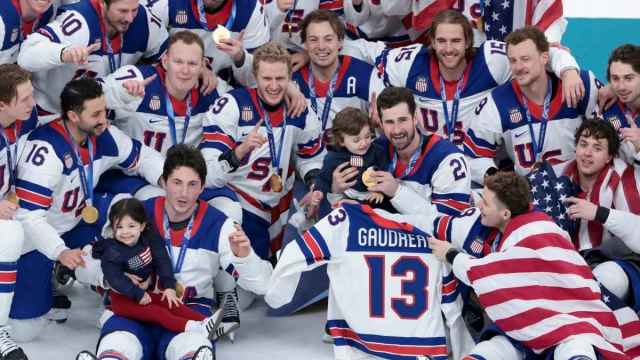
Yet, the most heart-melting moment was still to come. With the formalities underway, Werenski and several other players skated to the boards near where the Gaudreau family sat. In a spontaneous and beautifully chaotic act, they began helping Johnny and Matthew’s young children—the nephews and niece of the team—step over the dasher and onto the Olympic ice.
- Gaudreau brothers’ kids celebrate Team USA’s gold medal, their small hands clutching player’s gloves.
- They were hoisted onto shoulders, their smiles wide with a mix of confusion and delight.
- One child wore a miniature No. 13 jersey, a poignant echo of the sweater leading the lap moments before.
“We wanted to get the whole family on, but it was kind of hard with the gate, so we figured we’d grab the kids,” Werenski later told the New York Times. “But it was a special moment seeing (their parents) Guy and Jane.” In the stands, Jane and Guy Gaudreau, the brothers’ parents, watched through tears, their grief and pride intersecting in a powerful, silent understanding. The emotional moment for parents Guy and Jane Gaudreau was a universal portrait of loss and love, witnessed by millions.
Expert Analysis: The Deeper Impact of a Gesture
From a sports journalism perspective, this moment operates on multiple levels. Firstly, it showcases the evolution of team culture in modern sports. This was not a pre-scripted, PR-driven event; it was an organic, player-led initiative born from genuine relationship and loss. It signals a maturity and emotional intelligence within the team’s leadership, understanding that some victories are bigger than the game.
Secondly, the immense love on social media that followed was immediate and visceral. Clips of the children on the ice went viral, not for the athletic feat, but for the raw humanity. In an era of hot takes and negativity, this moment cut through the noise. It reminded global audiences of sport’s core purpose: to inspire, to unite, and to tell human stories. The International Olympic Committee often speaks of “building a better world through sport.” For two minutes on that ice, with those children, that ideal felt palpably real.
Finally, it redefines legacy. Johnny Gaudreau’s legacy is secure as one of the most gifted American players of his generation. But now, intertwined with that athletic legacy is a story of enduring brotherhood and tribute. Future mentions of the 2026 gold medal will forever include this act. It cemented the Gaudreau family as an eternal part of Team USA’s story, ensuring that their sons are remembered not just for how they died, but for how their spirit fueled a nation’s greatest hockey triumph in a generation.
Predictions: How This Moment Reshapes the Future
The ripple effects from this golden, tear-stained night will be felt for years to come. We can anticipate several key developments:
- Cultural Shift in Team Building: Future Olympic and professional teams will look to this as a benchmark for authentic team chemistry. GMs and coaches may place even greater emphasis on recruiting players with strong character and emotional connectivity, recognizing that the deepest bonds can fuel the highest performance.
- A New Chapter for the Gaudreau Family: While nothing can replace their loss, this public embrace by the hockey world provides a profound point of connection. The children, now forever part of Olympic history, will have this tangible memory of their fathers’ impact. It creates a bridge between their private grief and the public adoration for their fathers.
- Elevated Storytelling in Sports Media: Networks and publications will lean into more nuanced, human-interest narratives surrounding major events. The overwhelming positive response proves that audiences crave stories of resilience, family, and legacy as much as they crave highlight-reel goals.
- Inspiration for the Next Generation: The image of those children on the ice is a powerful recruiting tool for youth hockey in America. It communicates that hockey is a family, a community that supports its own through unimaginable tragedy and celebrates its highest joys together.
A Golden Legacy, Forever Linked
The 2026 Olympic gold medal will sit in a case, a hard, cold symbol of athletic supremacy. But its true meaning is warm, living, and emotional. It is inextricably linked to the smiles of four children skating where their fathers dreamed of skating, and to the tearful gaze of grandparents witnessing a team’s love for their sons. Team USA did not just win a hockey game. They performed an act of collective memory, weaving the Gaudreau family into the very fabric of their achievement.
In the end, the most enduring snapshot from Milano Cortina won’t be the game-winning goal. It will be the sight of a child, perched on the shoulders of an Olympic champion, holding a gold medal that also belongs to his dad. It was a victory for a nation, but a tribute to a family. And in that beautiful, heartbreaking, and ultimately uplifting convergence, sport revealed its highest purpose: to heal, to honor, and to hold us together, long after the final buzzer has sounded.
Source: Based on news from Yahoo Sports.