Team USA’s Golden Moment: Tkachuk Brothers Lead Victory with Heroes in Their Hearts
The roar that echoed from Milan’s ice sheet to living rooms across the United States wasn’t just one of triumph; it was one of catharsis. For the first time since the “Miracle on Ice” in 1980, the United States men’s hockey team stood atop the Olympic podium, gold medals around their necks after a heart-stopping overtime victory over arch-rival Canada. Yet, in the immediate, breathless aftermath of hockey’s ultimate glory, stars Matthew and Brady Tkachuk delivered a powerful message that transcended sport. Draped in the Stars and Stripes, they dedicated their historic win to a broader idea of American excellence: the nation’s heroes.
A Legacy Fulfilled: Ending the 46-Year Gold Medal Drought
The weight of history was palpable as Team USA faced Canada in the gold medal game at the 2026 Winter Olympics. For 46 years, the ghost of Lake Placid loomed—a legendary moment that inspired generations but remained a peak unconquered by subsequent American squads. This team, a blend of youthful speed and veteran grit, carried that burden. The game itself was a classic: a back-and-forth chess match of North American hockey at its most intense, culminating in an overtime period that saw chances at both ends before the decisive goal.
Fox News contributor and veteran sportscaster Jim Gray, analyzing the win, emphasized its significance. “This wasn’t just a hockey game; it was a cultural moment,” Gray stated. “To finally break through against Canada, on the world’s biggest stage, after nearly five decades of near-misses, validates the growth of USA Hockey. But what struck me was the immediate perspective these young men showed.” That perspective was crystalized by the Tkachuk brothers in their raw, emotional post-game interview.
More Than a Flag: The Tkachuks’ Patriotic Pledge
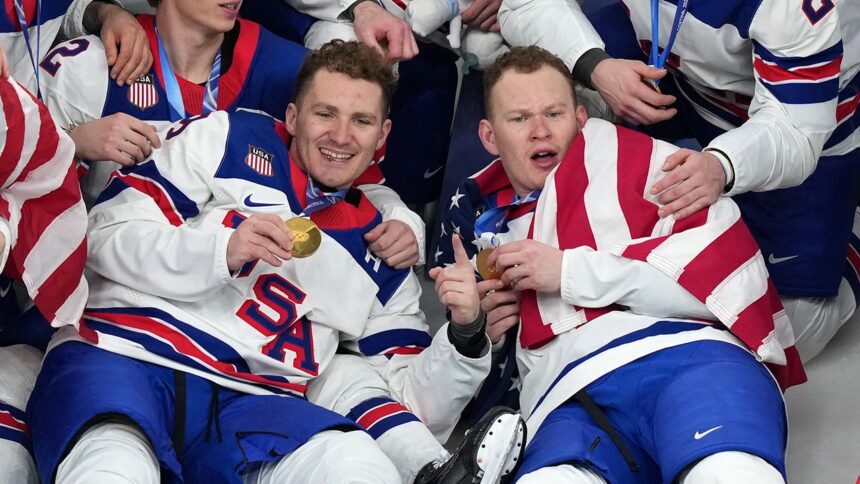
With an American flag draped over each of their shoulders, still sweating from the battle, Matthew and Brady Tkachuk spoke to KSDK-TV. Their words quickly shifted from the on-ice strategy to the off-ice inspiration. “This medal, this flag,” Brady began, gripping the fabric, “it represents so much more than us. We get to play a game. We’re thinking about the real heroes—the military, first responders, everyone who serves this country every day. This is for them.”
Matthew echoed the sentiment, adding a layer of family legacy. “Our grandfathers served. We grew up understanding that sacrifice and teamwork aren’t just hockey concepts. Celebrating with this flag is our way of keeping them top of mind, of saying thank you.” This conscious decision to anchor their athletic achievement in national gratitude resonated powerfully. In an era where celebrations can often be self-focused, their gesture was a poignant reminder of the platform athletes hold.
Fox News correspondent Madison Scarpino, reporting from the scene, noted the impact. “The image of the Tkachuk brothers wrapped in the flag, speaking so earnestly about service, instantly became the defining portrait of this victory. It connected the dots between the sacrifice required to win an Olympic gold and the sacrifices made for the nation itself.”
Analysis: The Anatomy of a Golden Team
How did this U.S. team finally scale the mountain? Expert analysis points to a perfect storm of factors that coalesced in Milan:
- Blended Leadership: The roster masterfully mixed Olympic veterans with dynamic, younger NHL stars. This provided calm under pressure and explosive skill.
- Elite Goaltending: The tournament’s MVP likely resided in the American crease, providing the steady backbone necessary for a gold-medal run.
- The “Tkachuk Factor”: Beyond their patriotic post-game comments, Matthew and Brady brought a unique blend of skill, physicality, and relentless will that typified the team’s identity. They were a nightmare to play against in every zone.
- Clutch Performance: Winning tight games against Canada, Sweden, and the Russian team required a next-play mentality and an unshakable belief system, which the coaching staff instilled.
This victory was not a fluke but the culmination of a systemic rise in American hockey development. The gold medal is a testament to decades of investment in grassroots programs, national team development, and the increasing depth of talent produced in the U.S.
The Ripple Effect: Predictions for USA Hockey’s Future
This gold medal victory is not an endpoint, but a potential launching pad. The implications for the future of USA Hockey are profound:
A New Standard Set: The “Miracle” is now joined by the “Milano Mission.” The psychological barrier is broken. Future American teams will no longer carry the burden of the long drought, but rather the expectation of contending for gold every Olympics.
Inspiration for a Generation: Just as the 1980 team inspired the Tkachuks’ father’s generation, the 2026 team will ignite dreams in kids across the country. Youth registration is predicted to see a significant “gold medal bounce.”
Sustained Rivalry Dominance: Beating Canada for the ultimate prize shifts the mental edge in the sport’s greatest rivalry. While Canada will always be a powerhouse, this win proves the U.S. can win the biggest games on the most pressurized stage.
The “Patriot Athlete” Model: The Tkachuks’ deliberate nod to national heroes may inspire other athletes to use their moments of triumph for similar recognition, fostering a deeper connection between sports stars and the broader concept of service.
Conclusion: A Victory for Sport and Spirit
The United States men’s hockey team’s gold medal in Milan will be remembered for the sheer athletic achievement: ending a 46-year wait, defeating a titan in Canada, and showcasing the beautiful, brutal essence of Olympic hockey. The overtime goal will be replayed for generations. But the enduring legacy of this team may well be the perspective they displayed before the ice had even dried.
By consciously choosing to dedicate their pinnacle moment to America’s heroes, Matthew and Brady Tkachuk, and by extension their teammates, elevated their victory from the sporting realm to the national spirit. They reminded a watching nation that while the pursuit of excellence on the ice is worthy, it is a reflection of the pursuit of excellence in service to others. They didn’t just win gold; they wore the flag as a tribute, ensuring that in their moment of supreme personal achievement, the focus was on something far greater than themselves. That is the mark of true champions.
Source: Based on news from Fox Sports.