Azeez Al-Shaair’s Fined Message: Where the NFL’s Personal Expression Policy Meets a Global Crisis
In the high-stakes, meticulously controlled universe of the NFL, where uniforms are standardized and celebrations are legislated, a strip of athletic tape became a lightning rod. Houston Texans linebacker Azeez Al-Shaair, following a fine for wearing “Stop the genocide” on his eye black during a playoff game, stood before reporters and delivered a statement that resonated far beyond the locker room. “It’s bigger than me,” he said. Those four words encapsulate a growing tension point in professional sports: the collision between league policy, personal conviction, and athletes leveraging their platform for global awareness. Al-Shaair’s decision and the subsequent financial penalty from the NFL have ignited a crucial conversation about the boundaries of expression in America’s most popular sports league.
The Act and the Repercussion: A Calculated Stand
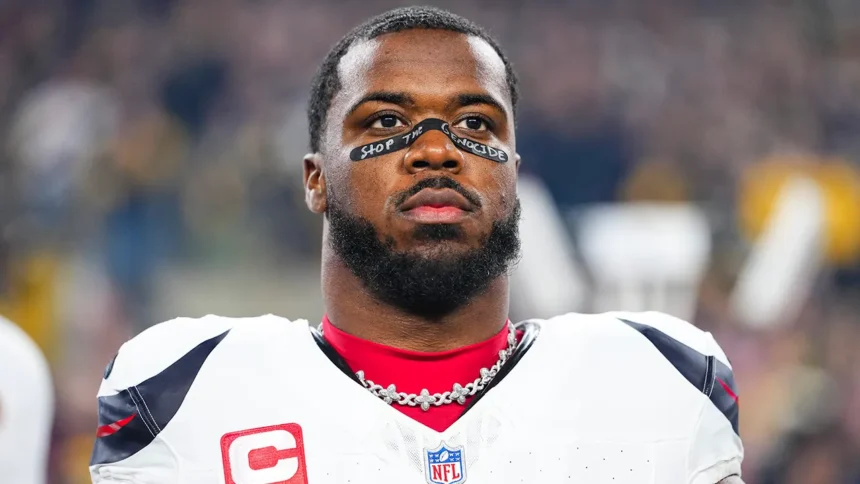
On January 12, 2026, as the Houston Texans took the field in Pittsburgh for a wild-card playoff clash, Azeez Al-Shaair made a silent, yet profoundly loud, statement. Across the adhesive tape under his eyes—a staple for reducing glare—were the words “Stop the genocide.” The message, a clear reference to the ongoing conflict in Gaza, was visible throughout the nationally televised broadcast. The Texans would go on to win the game, but Al-Shaair’s personal victory was a matter of conscience. Days later, the league office issued a fine of $11,593, citing a violation of the NFL’s uniform and equipment policy, which prohibits “personal messages” on gear unless pre-approved under the league’s “My Cause, My Cleats” initiative or similar programs.
Al-Shaair addressed the fine head-on after a subsequent loss to the New England Patriots. His demeanor was calm but resolute. He did not rail against the league or claim victimhood. Instead, he framed his action as a necessary moral imperative. “I understood what could happen,” Al-Shaair stated. “But some things are just more important than a fine. It’s about humanity. It’s about speaking up for those who feel like they don’t have a voice.” This perspective transforms the fine from a simple disciplinary action into a cost of advocacy, a price Al-Shaair was evidently willing to pay to amplify a message he deemed critical.
Expert Analysis: The NFL’s Tightrope Walk on Social Issues
The NFL’s position is rooted in a long-standing desire to maintain the game as a neutral, unifying spectacle. League executives have historically feared the “politicization” of the product, a concern famously highlighted by the controversy surrounding national anthem protests. The uniform policy is their primary tool for maintaining this control.
- The Precedent: The league has a consistent history of fining players for uniform violations with messages, whether social, political, or personal. This creates a seemingly neutral, if rigid, framework.
- The Selective Perception: Critics argue the league promotes certain “approved” social justice initiatives (like breast cancer awareness or Salute to Service) while penalizing unsanctioned ones, creating a hierarchy of acceptable causes.
- The Platform Paradox: The NFL encourages players to be community leaders and use their influence, yet strictly limits how that influence can be manifested during the game itself—the moment of their greatest visibility.
Sports sociologist Dr. Elena Rodriguez notes, “Al-Shaair’s case is the latest in a decade-long struggle. The NFL wants the cultural credibility that comes with socially conscious stars but not the divisive debates. They want controlled, branded activism. What players like Al-Shaair demonstrate is that genuine conviction cannot always be scheduled for Week 7’s ‘My Cause, My Cleats.'” The fine, therefore, is less about the message’s content and more about the league’s insistence on controlling the narrative and timing of any social or political expression.
The Ripple Effect: Teammates, the League, and the Public
Within the Texans’ locker room, Al-Shaair’s stand has been met with quiet respect. While no teammates have yet replicated the message, veterans have acknowledged his right to speak on issues he cares deeply about. Head coach DeMeco Ryans, a former linebacker himself, offered measured support, saying, “Azeez is a man of strong conviction. We respect that. Our focus is football, but we also respect our players as individuals.” This reflects a modern coaching approach: managing the potential distraction while avoiding the alienation of a valued leader.
Public reaction has been predictably polarized, mirroring the broader societal split on the Israeli-Palestinian conflict. However, a significant segment of the discussion has focused on the principle of expression itself. Al-Shaair’s Muslim faith and his philanthropic work, including building schools in Africa, provide context for his global perspective. By accepting the fine without appeal, he has positioned himself not as a rebel against the NFL, but as a conscientious participant willing to bear a personal cost. This tactic may prove more influential and sympathetic to fellow players than a protracted legal battle, potentially inspiring similar acts of quiet defiance for other causes in the future.
Predictions: The Future of On-Field Advocacy
Al-Shaair’s fined message is not an endpoint, but a signpost. Looking ahead, several developments are likely:
- More Calculated Infractions: Other players with strong convictions will see the Al-Shaair model—accept the known fine for maximum game-day impact—as a viable form of protest. The eye tape, due to its visibility on camera, will remain a prime vehicle.
- Pressure on the Policy: The NFL Players Association (NFLPA) may increasingly challenge the uniformity of the uniform policy, arguing for designated, flexible ways for players to express support for non-league-sanctioned causes without penalty.
- Sponsor Influence: The league’s corporate partners, sensitive to consumer sentiment, will watch these developments closely. Their comfort level could ultimately pressure the league to either tighten restrictions or create new, sanctioned avenues for expression.
- The “Bigger Than Me” Legacy: Al-Shaair’s phrase will enter the lexicon of athlete activism. It frames the action as selfless and cause-oriented, making the league’s financial penalty seem petty in comparison—a public relations tightrope the NFL must carefully navigate.
Conclusion: A Price Paid, A Conversation Started
Azeez Al-Shaair did not change Middle East policy with a message on eye tape. But that was likely never his goal. His objective was awareness, a breaking of the sports bubble to remind millions of viewers of a world in crisis. By stating “It’s bigger than me,” he elevated his action above the standard sports controversy. It became a case study in moral calculus: is a principle worth nearly twelve thousand dollars? For Al-Shaair, the answer was clear.
The NFL, in enforcing its long-standing rule, upheld order but may have inadvertently highlighted the limitations of its own system for a generation of athletes who see their platform in global terms. The fine was transactionally correct but contextually complex. In the end, this episode underscores a new reality in professional sports. The modern athlete is increasingly a global citizen, and their conscience does not switch off at the stadium gate. The league can continue to fine them, but as Azeez Al-Shaair demonstrated, it cannot fine away the conviction that drives them. The message, both on the tape and in his words, was delivered, and its echo will be felt in locker rooms and league offices for seasons to come.
Source: Based on news from Fox Sports.