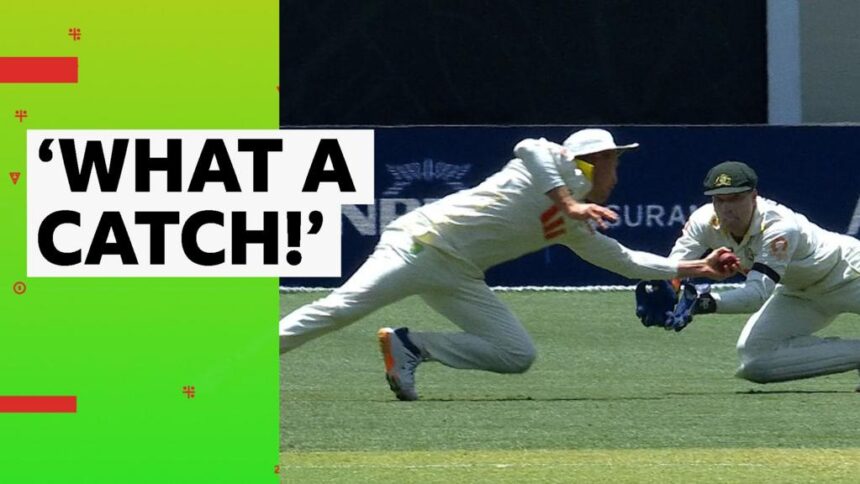
That’s the Wicket: Labuschagne’s Slip Catching Masterclass Dismisses Dangerous Jacks
The art of slip fielding is a silent, pressurized discipline, often the difference between a session of toil and a match-winning cascade. In the crucible of the third Ashes Test in Adelaide, with England’s lower order threatening to shift the game’s delicate balance, Marnus Labuschagne produced a moment of pure, instinctive brilliance. His catch to dismiss a fluent Will Jacks for 47 was more than just a wicket; it was a statement of Australian ruthlessness, a snapshot of technical perfection, and a pivotal blow that left England reeling at 337-8 on a tense final day.
The Moment of Magic: Anatomy of a Perfect Slip Catch
The dismissal unfolded with the narrative tension the Ashes demands. Will Jacks, playing with refreshing aggression, had moved to 47 and was partnering with the tail to build a potentially game-saving lead. Australian captain Pat Cummins, searching for a breakthrough, delivered a full, tempting line. Jacks, eyes lighting up, threw his hands at a wide drive. The thick outside edge flew fast and low to the right of first slip.
What happened next was a masterclass in reaction and technique. Marnus Labuschagne, stationed at first slip, had mere fractions of a second to process the trajectory. His body became a coiled spring of athleticism. He propelled himself to his right, his hands, soft yet sure, meeting the ball just inches from the turf. The catch was taken cleanly, the celebration understated but fierce—a pointed finger to the sky, a roar absorbed by his teammates. It was the culmination of countless hours of dedicated practice, a brilliant catch that underscored why Australia’s slip cordon is among the most feared in world cricket.
- Lightning Reactions: The edge was fierce and dying. Labuschagne’s start was instantaneous.
- Soft Hands, Strong Base: A critical technique to absorb the pace and prevent the ball from rebounding.
- Full-Stretch Commitment: Maximum athletic effort for a chance many would have considered a half-opportunity.
Labuschagne: The Unassuming Maestro in the Cordón
While his batting idiosyncrasies are globally famous, Marnus Labuschagne’s value as a premier slip fielder is sometimes under-sung. This catch against Jacks was not an anomaly; it is part of a growing highlight reel. His positioning is consistently impeccable, his concentration monastic. He embodies the modern slip fielder: not just a safe pair of hands, but an agile, dynamic athlete capable of converting half-chances into wickets.
This skill set is invaluable to the Australian attack. Bowlers like Pat Cummins, Mitchell Starc, and Nathan Lyon feed on the confidence that edges will be gobbled up. Labuschagne, alongside stalwarts like Steve Smith and David Warner, forms a catches at slip consortium that applies psychological pressure from the moment a batter walks in. Every play-and-miss is amplified, every tentative prod scrutinized. The dismissal of Jacks was a direct result of this pressure—a batter forced to play at a wide one, knowing the window for error was microscopically small.
The Context: A Pivotal Blow in the Adelaide Narrative
To understand the weight of this dismissal, one must view the broader Ashes Test in Adelaide context. England, facing a daunting first-innings deficit, were fighting for survival and a semblance of momentum. Will Jacks represented a genuine threat; his ability to score quickly could have shifted the pressure back onto Australia and set up a more complicated final-day run chase.
At 337-8, with Jacks removed, England’s resistance was effectively broken. The tail was exposed, and Australia could wrap up the innings swiftly, controlling the terms of the declaration and the final run chase. Labuschagne’s catch, therefore, wasn’t just a wicket; it was the key that unlocked the innings. It transformed the narrative from “England building a partnership” to “Australia closing in for the kill,” a crucial shift in momentum on a day five pitch that was still playing relatively true.
Expert Analysis: What Makes a World-Class Slip Catcher?
Speaking from a technical standpoint, the Labuschagne grab is a textbook example for aspiring cricketers. The fundamentals are non-negotiable: a low, balanced stance with weight on the balls of the feet; eyes laser-locked on the batter’s edge or the tip of the bowler’s fingers; hands held in a relaxed, ready position.
But the elite separator, as seen here, is the preternatural ability to judge the catch post-deflection. The ball can deviate off the bat, swing, or seam late, changing its line dramatically. Labuschagne’s brain processed this data in real-time, allowing his body to adjust mid-lunge. Furthermore, his work ethic is legendary. It is reported he takes hundreds of slip catches after every training session, honing a skill that, while often reactive, is deeply rooted in proactive preparation.
Predictions for the remainder of the series must now account for this Australian fielding strength. England’s top order will be acutely aware that faint edges are unlikely to go to ground. This mental hurdle, this need to be perfect in their strokeplay, could lead to further tentative dismissals. Australia’s bowling attack, already potent, is magnified by this predatory fielding unit.
Conclusion: A Catch That Captured the Ashes Ethos
In the grand ledger of the 2023 Ashes, “c Labuschagne b Cummins” against Will Jacks may not be the most celebrated entry. But for purists and tacticians, it was a moment that distilled the contest’s essence. It was a fusion of individual excellence (Marnus Labuschagne’s sublime skill), tactical pressure (Cummins’ persistent line), and collective fortitude (the Australian team’s unwavering standard).
As the series progresses, this brilliant catch will stand as a reminder. It reminded England that Australian advantages are not just with bat and ball, but in the critical, game-changing spaces in between. It reminded fans that Test match turning points can be as quiet as a snick and as explosive as a full-stretch dive. And it reminded everyone that in the high-stakes theatre of the Ashes, moments of fielding genius like Labuschagne’s are not mere highlights—they are the very wickets upon which matches, and perhaps trophies, are won and lost.
Source: Based on news from BBC Sport.