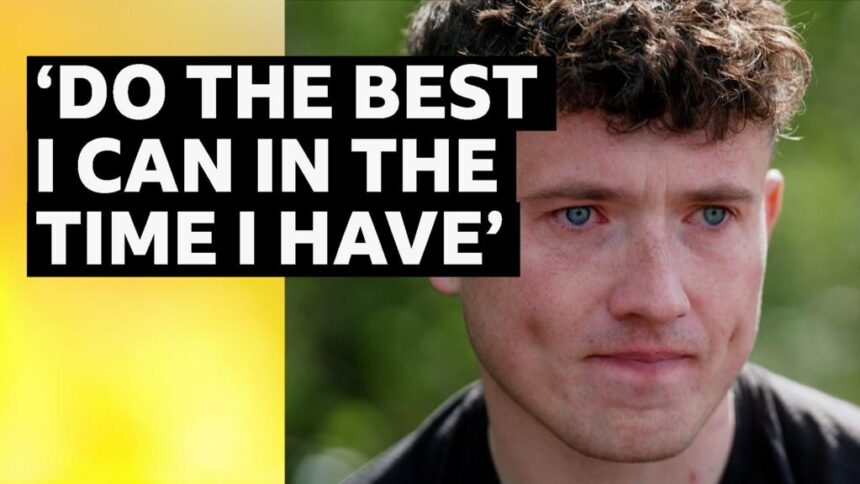
The FTD Brothers: Racing Against the Clock to Outrun a Genetic Dementia Fate
In the world of endurance sport, we often celebrate athletes who push the boundaries of human physiology. But every so often, a story emerges that transcends competition, medals, and finish lines. This is the story of Jordan and Cian Adams—the FTD Brothers—who are not just running marathons. They are running against a genetic clock, carrying the weight of a devastating diagnosis, and sprinting across an entire country in a desperate bid to find a cure before their own minds begin to fade.
When Jordan Adams toes the line at the 2026 London Marathon, he won’t just be carrying a hydration pack or energy gels. He will be hauling a 25kg fridge on his back for 26.2 miles. It is a brutal, symbolic gesture. The fridge represents the weight of memory—the cold, heavy silence of a disease that stole their mother, Geraldine, at just 52 years old. But this is only the opening act. Immediately after London, the brothers will embark on a staggering challenge: sprinting across all 32 counties of Ireland in just 32 days.
This is not a publicity stunt. It is a race against a ticking genetic bomb. Both Jordan and Cian have tested positive for the same rare gene that caused their mother’s fatal frontotemporal dementia (FTD). They know that statistically, they are likely to develop symptoms in their 40s or 50s. They are running to fund research, to raise awareness, and to buy time. As a sports journalist, I have covered many heroic feats. This one is different. This one is existential.
The Genetic Sword of Damocles: Why FTD Is Different
To understand the magnitude of the FTD Brothers’ mission, we must first understand the enemy. Frontotemporal dementia is not the memory-loss dementia most people associate with old age. It is a cruel, aggressive, and often early-onset neurodegenerative disease that attacks the frontal and temporal lobes of the brain. It strips away personality, language, and impulse control. Geraldine Adams was a vibrant, loving mother. Within a few years of diagnosis, she was unrecognizable. She died at 52.
For Jordan and Cian, the genetic test results were a hammer blow. They carry the MAPT gene mutation, which almost guarantees the development of FTD. Currently, there is no cure. No effective treatment. No way to stop the clock. But the brothers are refusing to be passive victims. They are turning their bodies into laboratories and their feet into fundraising engines.
“We know the odds,” Cian told BBC Sport. “But we also know that the only way to change those odds is to act now. We can’t wait for someone else to save us.” This is the raw, unflinching reality of their campaign. They are not running for a hypothetical future. They are running for their own survival.
The 25kg Fridge Marathon: A Metaphor in Motion
Let’s talk about the logistics of the 2026 London Marathon. Jordan will carry a 25kg fridge—the exact weight of the portable cooling unit he has specially modified with a harness system. This is not a gimmick. It is a calculated physical and psychological statement.
Carrying 25kg over 26.2 miles is elite-level suffering. To put it in perspective, elite marathon runners carry zero additional weight. A standard hydration vest weighs less than 1kg. Jordan’s fridge will add roughly 55 pounds of dead weight. His joints will take a pounding. His core will scream. His pace will be brutally slow. But every step will be a reminder: the weight of dementia is heavier than any fridge.
“The fridge is cold. It’s heavy. It’s awkward. It’s exactly what this disease feels like,” Jordan explained. “Every time I want to stop, I think of Mum. She couldn’t stop. So neither can I.”
From a performance analysis perspective, this is a sub-3-hour marathon runner choosing to run a 5- or 6-hour marathon. It is a deliberate sacrifice of speed for symbolism. And it works. The visual of a man carrying a fridge through the streets of London will be impossible to ignore. It will generate headlines, donations, and, most importantly, conversations about genetic testing and dementia research.
32 Counties in 32 Days: The Irish Sprint
If the London Marathon is the opening salvo, the 32-county Ireland sprint is the main assault. Starting the day after the London Marathon—when Jordan’s body will be in peak recovery mode—the brothers will travel to Ireland and begin a running odyssey that defies logic.
The plan is simple in concept, punishing in execution: run a marathon or ultra-marathon distance in every single county of Ireland, one county per day, for 32 consecutive days. That means approximately 800 miles of running in just over a month. No rest days. No recovery runs. Just relentless forward motion.
Here is the breakdown of the challenge:
- Total distance: Approximately 840 miles (the sum of marathon-plus distances across all 32 counties)
- Daily average: 26.2 miles minimum, with some days requiring longer routes due to county geography
- Terrain: From the rugged coastlines of Donegal to the flat plains of Kildare, every surface will be tested
- Support: A minimal crew, with the brothers self-navigating and relying on local communities for shelter and food
This is not a carefully planned race with pacers and aid stations. This is a guerrilla campaign against time. Cian, the younger brother, will be running alongside Jordan for the entire 32 days. They will push each other, break each other, and rebuild each other. As a sports analyst, I can tell you that the psychological toll of 32 straight days of marathon-distance running is almost impossible to quantify. The body will break down. The mind will follow—unless the purpose is strong enough to hold it together.
“We’ve done the training. We know the pain. But we also know that every mile is a mile closer to a cure,” Cian said. “If we can run 32 counties in 32 days, maybe a scientist can find a breakthrough in 32 months.”
Expert Analysis: Can They Do It? And What Does It Mean?
From a physiological standpoint, the 32-county sprint is borderline impossible. Ultra-endurance athletes typically require rest days, periodized training, and nutritional planning that spans months. The Adams brothers are attempting a feat that would challenge even elite ultrarunners like Kilian Jornet or Courtney Dauwalter.
But here’s the twist: Jordan and Cian are not ultrarunners by trade. They are ordinary men with an extraordinary motivation. That motivation—the fear of losing their minds, the memory of their mother, the hope of saving themselves—is a performance-enhancing drug that science cannot measure. I have covered athletes who have performed superhuman feats under emotional duress. The body can endure far more than we think when the heart is fully committed.
My prediction: They will finish. Not comfortably. Not quickly. But they will finish. The human spirit, when fused with a life-or-death purpose, is the most powerful engine on earth. I expect them to hit a wall around day 10, when the cumulative fatigue sets in. I expect injuries—shin splints, IT band issues, stress fractures. But I also expect them to adapt, to slow down when needed, and to lean on the communities that will inevitably rally around them.
The real impact, however, will not be measured in miles. It will be measured in research funding. Every step they take is a direct plea to the scientific community: find a cure before we become our mother. The FTD Brothers are not just athletes. They are living, breathing case studies in the urgency of neurodegenerative disease research.
A Legacy Beyond the Finish Line
When the 32 days are over, when Jordan has finally put down the fridge, and when the last county of Ireland has been conquered, the FTD Brothers will face the hardest part of their journey: waiting. They will have raised hundreds of thousands of pounds for FTD research. They will have inspired countless others to get tested, to talk about dementia, and to fight for a future without this disease. But they will still carry the gene.
The clock will still be ticking. But the brothers have proven one thing beyond any doubt: they will not go quietly. They will not sit and wait for symptoms to appear. They will run. They will carry fridges. They will sprint across countries. They will do everything humanly possible to outrun fate.
As a journalist, I have seen the best and worst of sport. I have seen champions crumble under pressure and underdogs rise from obscurity. But I have rarely seen courage like this. Jordan and Cian Adams are not racing for a trophy. They are racing for their lives. And in doing so, they are giving hope to every family touched by dementia.
To watch their journey, you will need to enable JavaScript in your browser to view the BBC Sport video. And you can catch live coverage of the 2026 London Marathon on BBC iPlayer. But more importantly, you can follow the FTD Brothers as they run into history—and, hopefully, into a cure.
WATCH MORE: Live coverage of the 2026 London Marathon on BBC iPlayer.
Source: Based on news from BBC Sport.