The Great Injustice of the 2026 Super Bowl: Why the Wrong Seahawk Won MVP
In the afterglow of Super Bowl LX, a narrative of poetic justice seemed to unfold. The Seattle Seahawks, led by a punishing ground game, defeated the New England Patriots 29-13. The crown jewel of their victory was running back Kenneth Walker III, who rumbled for 135 yards, becoming the first back to eclipse 130 yards in the big game since Terrell Davis in 1998. In an era defined by the systemic devaluation of his position—a decade of depressed contracts, late-round draft capital, and public disdain—Walker’s Super Bowl MVP award felt like a triumphant correction. A running back mattered again. But in our rush to anoint this feel-good story, we committed a profound injustice. We missed the real masterpiece of Super Bowl LX, a performance of such sublime, game-warping dominance that it should have forced us to rethink the award itself. The true MVP never touched the ball on offense.
The Allure of the Narrative vs. The Reality of the Game
Let’s be clear: Kenneth Walker III was excellent. His performance was a testament to grit and vision, a throwback to a grittier NFL aesthetic. As a pending free agent, his MVP honors will be a powerful bargaining chip in a league that has forgotten how to pay players at his position. The symbolism was rich, and the sportswriters and fans who voted for him were undoubtedly swayed by this powerful, decade-long context. It was a great story.
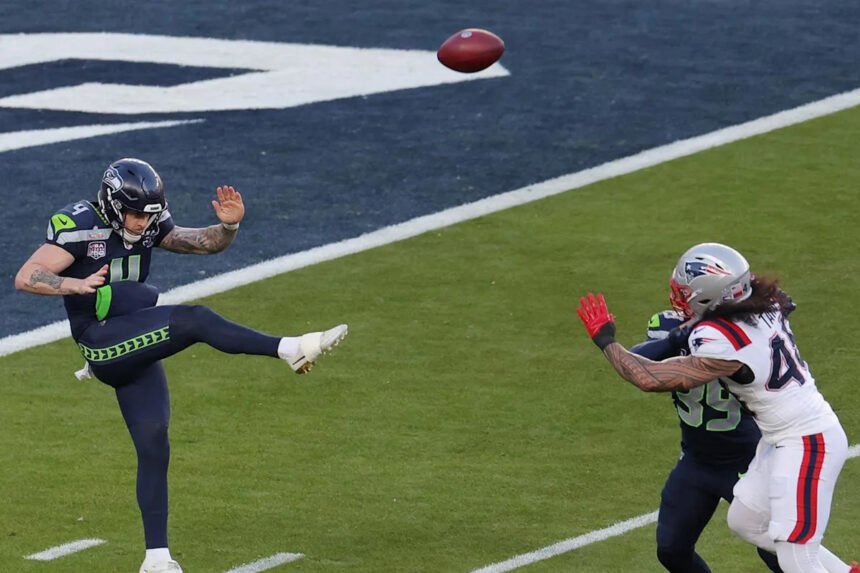
But the Super Bowl MVP award is not meant to be a lifetime achievement correction or a socio-economic statement for a position group. It is designed, in theory, to honor the player most instrumental to his team’s victory on that specific day. And when you dissect the machinations of Seattle’s win, a different, more compelling picture emerges. The Patriots’ offense, led by young quarterback Drake Maye, was not simply stopped by the Seahawks’ defense; it was suffocated from its very inception. The man who applied the pillow, snap after snap, was not a linebacker or a safety. It was punter Michael Dickson.
The Case for Michael Dickson: A Historic Field Position Clinic
Forget the highlight-reel runs for a moment. Consider the battlefield. In a game where points were at a premium for New England, field position wasn’t just a factor; it was the entire narrative. Michael Dickson authored that narrative with one of the greatest punting performances in football history.
- Net Punting Dominance: The average NFL punt nets about 41 yards of field position. Dickson, on football’s biggest stage, averaged a staggering net of 47.3 yards on seven punts. This isn’t just good; it’s a season-leading figure posted in a single, high-pressure game.
- The Coffin Corner Symphony: Dickson didn’t just kick it far; he placed it with surgical precision. Three of his punts were downed or went out of bounds inside the New England 7-yard line. Each one was a psychological and strategic dagger, forcing a rookie quarterback to embark on a 93-plus-yard march against a ferocious, well-rested defense.
- The Drive-Killing Results: Those three drives starting in the shadow of their own end zone ended as follows: a punt, an interception, and the game clock expiring. Dickson didn’t just make tackles; he orchestrated turnovers and killed hope.
- The Complete Specialist: He even recorded a tackle on the Patriots’ only semi-successful return, a play nullified by penalty. He also saved a field goal by handling a low snap on a hold, contributing directly to three of Jason Myers’ record-setting five field goals.
This was not a punter having a good day. This was a weapon of mass destruction, systematically burying an opponent and gifting his defense and offense short fields. Walker’s runs often started near midfield; Dickson is the reason why.
Why We Refuse to See the Obvious: The NFL’s MVP Bias
The reluctance to award Dickson is symptomatic of a deeper, more stubborn bias. The NFL has a hierarchy of visibility, and it is brutally rigid.
Quarterbacks and skill-position players operate in the spotlight. Their value is immediate, visceral, and easily quantified. A running back breaking tackles is a universally understood spectacle. Conversely, the value of a dominant special teams performance is subtle, cumulative, and strategic. It is the art of the possible. Dickson didn’t score points, but he made scoring for Seattle exponentially easier and scoring for New England a near impossibility.
We pay lip service to the importance of “the third phase,” but our awards reveal our true priorities. The last non-offensive player to win Super Bowl MVP was Dexter Jackson in 2003. Before that, you must go back to 1990 (Ottis Anderson, a running back, was the last non-QB before Walker). The system is engineered to ignore performances like Dickson’s, no matter how historically significant. Kicker Jason Myers, with his record 17 points, had a more traditional stat line and thus garnered more “hipster MVP” buzz than Dickson. But even Myers’ brilliance was facilitated by the field position Dickson provided.
The Legacy and the Lesson for Future Super Bowls
So, what does this mean for the future? Kenneth Walker III will have his MVP trophy, his trip to Disney World, and a brighter financial future. History will record his name in the ledger. Michael Dickson will have a ring and the quiet respect of true students of the game. It feels like an unsatisfying equilibrium.
Prediction: The 2026 Super Bowl will be remembered not for Walker’s MVP, but as the ultimate case study for why the award’s selection process is flawed. It will fuel arguments in bars and on podcasts for years. It should also force a reckoning within the voting body—a mix of sportswriters and fans—to expand their definition of “most valuable.” Value is not always measured in yards and touchdowns. Sometimes, it’s measured in inches of field position, in the slow, crushing erosion of an opponent’s will, and in the absolute command of the game’s hidden geometry.
In a just world, a panel would have watched Dickson’s seventh punt sail out of bounds at the New England 4-yard line with two minutes left and seen the masterpiece for what it was: the defining performance of Super Bowl LX. He didn’t just help win the game; he dictated its terms from the first time he stepped onto the field. That is the very definition of value. The great injustice of Super Bowl LX is that we were given a chance to finally honor the subtle, game-altering genius of special teams, and we chose the comforting, familiar story instead. The wrong Seahawk is going to Disney World.
Source: Based on news from Yahoo Sports.