The Moves We Loved for Fantasy in the 2026 Offseason
Every team enters the offseason intending to improve its lot. The thing about that, though: That doesn’t necessarily mean trying to get better for the year to come, and it doesn’t necessarily mean trying to get better for fantasy football. And also, of course, sometimes teams just do it poorly. Some moves really make our fantasy lives easier, but some make them way harder. So now, with most of the biggest offseason moves behind us, let’s take a look at some of the best offseason moves for fantasy. These moves make our fantasy lives that much easier, or at the least that much more exciting. Wednesday, I looked at the worst offseason moves for fantasy (and for these purposes, we’re assuming A.J. Brown will be a Patriot this season).
In a league where backfields are increasingly muddied by committees and veteran presence, the 2026 offseason delivered a handful of transactions that fantasy managers should be celebrating. These are the moves that clear the deck, unleash elite talent, and create the kind of volume that wins championships. Let’s break down the best of the best.
All Systems Go for Bijan Robinson, Jahmyr Gibbs
If you have been playing fantasy football for the last three years, you know the pain of owning Bijan Robinson or Jahmyr Gibbs. Both are generational talents, drafted in the first round of the NFL Draft, and both have been elite producers when given the rock. But there has always been a ceiling—a glass ceiling installed by the presence of a thunder-and-lightning partner who vultured touchdowns and capped weekly upside.
That ceiling has been obliterated in 2026.
The Detroit Lions shipped David Montgomery to the Houston Texans in a trade that shook the NFC North. In three seasons with Detroit, Montgomery ran for 33 touchdowns. That is not a typo. He was the ultimate goal-line eraser, turning Gibbs’ explosive runs into field goals while Montgomery punched it in from the one-yard line. For Gibbs, who is arguably the most explosive running back in the league, that touchdown share was a constant source of frustration. Now, with Montgomery gone, the Lions brought in Isiah Pacheco as a replacement. Pacheco is a tough runner, but he is not Montgomery. He is not a 250-pound bulldozer who commands 15 carries inside the 10-yard line. Gibbs is now the undisputed alpha in one of the NFL’s best offenses.
Meanwhile, down in Atlanta, the Falcons let Tyler Allgeier walk in free agency to the Arizona Cardinals. Allgeier was the definition of a fantasy buzzkill. Last year, he scored 8 rushing touchdowns compared to Bijan’s 7. Think about that. The supposed “lead back” in Atlanta was out-touched in the red zone by a backup. That is now over. The Falcons brought in Brian Robinson Jr. from Washington, and while he is a capable runner, he is a clear downgrade from Allgeier in terms of short-yardage efficiency and nose for the end zone.
What this means for fantasy: Both Gibbs and Robinson are now the only two candidates to be the 1.01 overall pick in 2026 drafts. They are no longer “elite RBs with a slight headache.” They are elite RBs with a green light. Expect Gibbs to push for 2,000 total yards and double-digit touchdowns. Expect Bijan to finally get the 300-plus carries we have been waiting for. If you land either of these guys in the first round, you are building a championship core.
Kenneth Walker III Gets His Shot
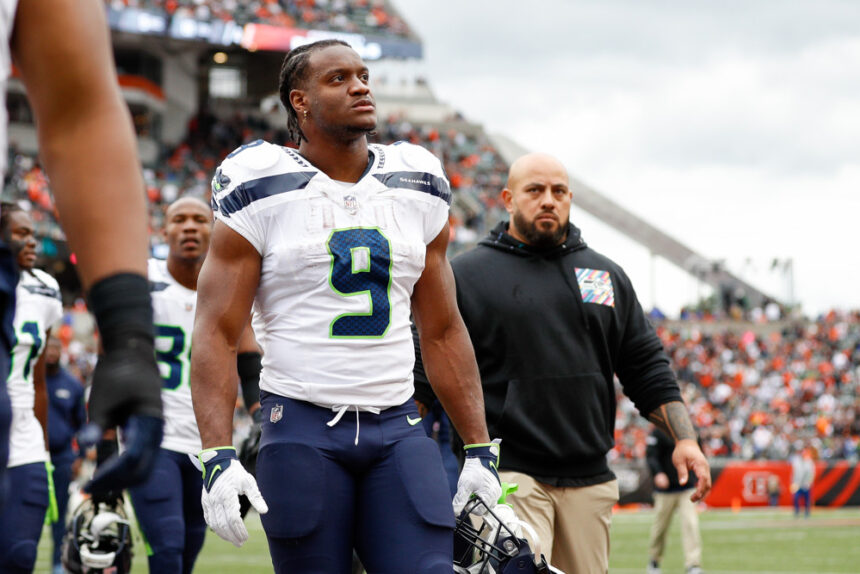
For years, Kenneth Walker III has been a frustratingly talented enigma. He has the vision, the burst, and the home-run ability to be a top-five fantasy back. But he has been trapped in a timeshare that made him a volatile weekly start. In Seattle, he shared the backfield with Zach Charbonnet, who consistently siphoned passing-down work and short-yardage carries. Then, in a surprising move this offseason, the Seahawks traded Charbonnet to the Chicago Bears, clearing the path for Walker to be the undisputed workhorse.
The Seahawks did not bring in a high-profile replacement. They signed a veteran minimum back and drafted a Day 3 rookie. That is a vote of confidence. Walker is now the clear RB1 in a offense that, under offensive coordinator Ryan Grubb, has shown a commitment to running the ball effectively. The Seahawks’ offensive line has also been upgraded in free agency, which only boosts Walker’s outlook.
Key reasons to love this move:
- Volume spike: Walker is projected to see 18-22 touches per game, up from the 14-16 he averaged with Charbonnet around.
- Pass-catching role: With Charbonnet gone, Walker will inherit the majority of third-down work. He caught 40 passes last year; that number could jump to 55-60.
- Goal-line monopoly: Walker has the power to convert near the goal line, and now he won’t be pulled for a “bigger back.”
Fantasy managers should view Walker as a solid RB1 with top-five upside. He is a steal in the second round of drafts, and if you pair him with a safe first-round pick, your roster will be dangerous.
The Quarterback Carousel That Actually Helps
While running backs dominated the headlines, a few quarterback moves deserve a spotlight for their fantasy implications. The most impactful? Justin Fields signing with the New Orleans Saints. Fields is a fantasy darling because of his rushing ability. In New Orleans, he joins an offense with a strong offensive line and a creative play-caller in Klint Kubiak. The Saints have Chris Olave and Rashid Shaheed as deep threats, and Fields’ ability to extend plays will unlock explosive plays that were missing with Derek Carr under center.
Fields is a top-five fantasy quarterback if he stays healthy. His rushing floor alone makes him a QB1, and the improved supporting cast gives him legitimate passing upside. This is a classic “system upgrade” that fantasy managers should target in the middle rounds.
Another move to love: Bryce Young being traded to the Los Angeles Rams. Young’s career in Carolina was a disaster, but the Rams have a track record of reviving careers (see: Baker Mayfield, Matthew Stafford). Sean McVay’s offense is quarterback-friendly, and Young will have Cooper Kupp and Puka Nacua as targets. He is a deep sleeper in superflex leagues and a cheap QB2 in standard formats.
Wide Receiver Reshuffles That Create Opportunity
The wide receiver market was surprisingly quiet, but one move stands out: Kyle Pitts being traded to the Kansas City Chiefs. Yes, Pitts is a tight end, but his move to Kansas City is a fantasy earthquake. Patrick Mahomes has never had a tight end with Pitts’ athletic profile. Travis Kelce is still good, but he is 36 years old and slowing down. Pitts will be used as a hybrid receiver, lining up in the slot and out wide. In Andy Reid’s offense, with Mahomes throwing the ball, Pitts could easily post 1,000 yards and 8-10 touchdowns. He is a top-three tight end this season.
Additionally, the New England Patriots signing Amari Cooper is a sneaky win for fantasy. Cooper is a veteran route-runner who can still create separation. In New England, he will be the clear WR1 for a young quarterback (likely Drake Maye). Cooper is not a league-winner, but he is a reliable WR2 with weekly spike potential.
Final Verdict: The 2026 Offseason Was a Fantasy Goldmine
Every year, we see teams make moves that look good on paper but fall flat in practice. This offseason, the stars aligned for fantasy managers. The Bijan Robinson and Jahmyr Gibbs breakouts are no longer a matter of “if” but “how dominant.” Kenneth Walker III finally gets the workload he deserves. Justin Fields has a new lease on life in New Orleans. And Kyle Pitts is about to become the next great Chiefs tight end.
As you prepare for your 2026 fantasy drafts, remember this: The teams that win championships are the ones that identify the players whose roles have expanded. This offseason, the roles expanded for the right players. Target them aggressively. Trust the volume. And enjoy watching these stars shine without the shackles of a committee.
The 2026 season is shaping up to be one of the most exciting in recent memory—and these moves are the reason why.
Source: Based on news from Yahoo Sports.