Thierry Henry’s Touching Tribute: Lifetime Achievement Award Dedicated to His Children
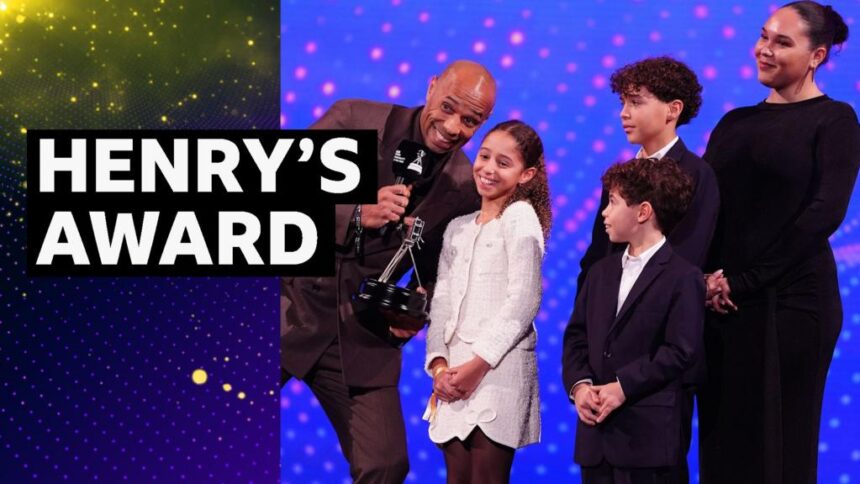
In a moment that transcended sport, the BBC Sports Personality of the Year 2025 ceremony was punctuated by raw, unfiltered emotion. Thierry Henry, the former Arsenal and France icon, a man synonymous with cold-blooded finishing and regal arrogance on the pitch, stood humbled before the world. Accepting the prestigious Lifetime Achievement award, the legendary striker did not look to the past, to his medals or his records. Instead, he gazed into the eyes of his future, dedicating the honour to his children with the simple, powerful declaration: “This is your award, not mine.” In an instant, the ultimate individual accolade became a profound family testament.
A Legacy Forged in North London and Beyond
To understand the weight of Henry’s gesture, one must first appreciate the colossal legacy he was acknowledging. Thierry Henry wasn’t just a great footballer; he was a revolution. Arriving at Arsenal as a winger, he was transformed under Arsène Wenger into the most devastating striker the Premier League has ever seen. His career is a highlight reel of impossible angles, blistering pace, and nonchalant brilliance. He lifted two Premier League titles, including the immortal ‘Invincibles’ season of 2003/04, and three FA Cups in England. He conquered Europe with Barcelona and the world with France, a 1998 World Cup and Euro 2000 champion. Yet, the Lifetime Achievement award encompasses more than silverware.
It recognises his enduring impact: the shift in mentality he brought to English football, the elegance he married with efficiency, and his status as a cultural icon. After hanging up his boots, he transitioned into punditry and coaching, maintaining a revered voice in the game. This award was the formal crowning of a footballing life lived at the zenith. And yet, for Henry, the summit had a new, more meaningful view.
“This Is Your Award, Not Mine”: The Power of a Parent’s Pivot
The dedication was not a throwaway line. It was the core of his acceptance speech, a deliberate pivot from self-congratulation to paternal devotion. In that phrase, Henry reframed a lifetime of sacrifice, travel, obsession, and public scrutiny. The early morning training sessions, the nights away in hotel rooms before colossal matches, the unbearable pressure of penalty shootouts—all of it was now presented to his children not as an absence, but as a journey undertaken for them.
This resonates deeply because it humanises the superhero. Fans see the 228 goals for Arsenal, the chest-thumbing celebration against Tottenham. His children, however, lived with the man behind the icon. They saw the recovery from defeat, the grind of rehabilitation, the weight of expectation. By handing them the award, Henry was saying: “You bore the cost of this legacy. This glory is yours as much as mine.” It was an act of profound gratitude and recognition that the most important team he ever played for was his family.
- Redefining Success: The moment moved the conversation from professional accolades to personal legacy.
- A Modern Sporting Parent: It highlighted the complex balance elite athletes must strike between vocation and family.
- Emotional Intelligence: Henry displayed a vulnerability rarely associated with his on-pitch persona, setting a powerful example.
Analysis: Why This Moment Struck a Universal Chord
As an expert observer, the power of Henry’s dedication lies in its universal truth and its timing. In an era where sports discourse is often dominated by transfer fees, social media spats, and statistical analysis, this was a pure, human narrative. It connected with anyone who has ever strived for professional excellence while wrestling with the guilt or compromise of family time.
Furthermore, it recontextualises the entire arc of a sporting life. The Lifetime Achievement award typically serves as a bookend, a final look in the rearview mirror. Henry, however, used it as a bridge. He connected his past struggles and triumphs directly to his children’s future, implying that the discipline, resilience, and passion he honed on the pitch are the very values he hopes to pass on. The trophy becomes less a relic and more a teaching tool—a tangible symbol of what dedication can build.
It also subtly addresses the often-unseen sacrifices of sporting families. While the athlete is celebrated, their children grow up with a parent whose physical and emotional presence is often dictated by a fixture list. Henry’s act acknowledged that imbalance and offered a public, heartfelt thank you.
The Henry Blueprint: Predicting the Impact on Future Icons
Moments like these have a ripple effect. Thierry Henry has set a new standard for how modern legends can accept the ultimate honours. We can predict several impacts:
A New Acceptance Speech Paradigm: Future recipients of lifetime awards, across all sports, may feel inspired to look beyond the thank you to coaches and fans, and to centre the family narrative. The template is no longer just recounting glory days; it’s about attributing meaning to the journey.
Humanising the Brand: In an age of personal branding, Henry’s genuine emotion cut through the noise. It showed that the most powerful brand move is authenticity. This strengthens his connection with fans on a deeper, more empathetic level, ensuring his legacy is loved, not just respected.
Influencing the Next Generation: For young athletes watching, especially those starting families, it presented a powerful model for integrating personal and professional life. It champions the idea that legacy is not just what you leave on the field, but what you instill in your home.
Conclusion: A Legacy Recalibrated
Thierry Henry arrived at the BBC Sports Personality of the Year ceremony as a footballing god, a figure etched in bronze and highlight reels. He left as something more relatable and, therefore, more monumental: a father. His Lifetime Achievement award will forever be remembered not for the career it summarised, but for the heartfelt direction he gave it. “This is your award, not mine” was more than a sweet sentiment; it was a recalibration of legacy.
It declared that the true value of a lifetime’s work is not measured in trophies alone, but in the foundation it provides for the next generation. The pace that terrorised defences, the vision that unlocked teams, the coolness that decided finals—all of it was, in his eyes, for them. In that act, Thierry Henry scored perhaps his most memorable goal: a decisive strike for humility, love, and the enduring truth that our greatest achievements are never truly our own.
Source: Based on news from BBC Sport.