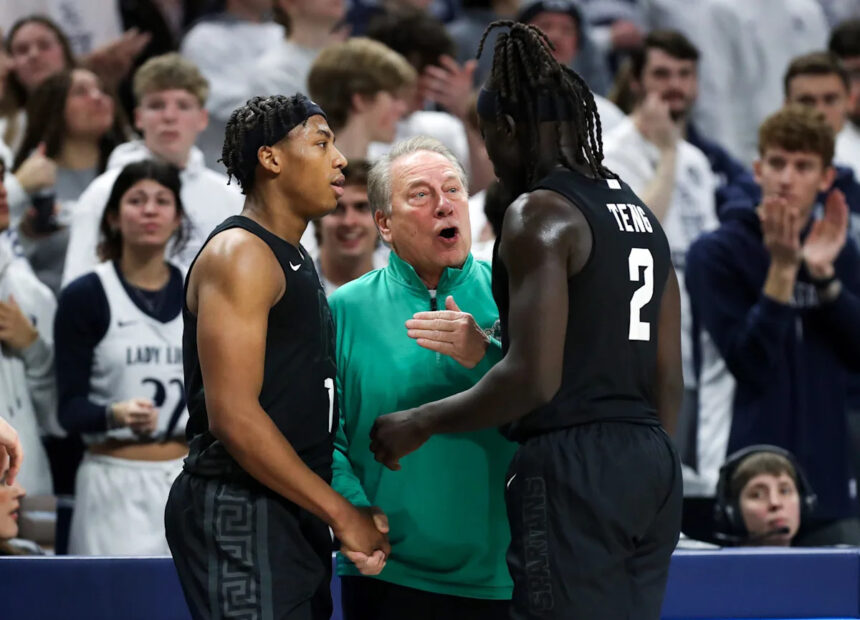
Tom Izzo’s Fiery Rant: A Coach’s Fury Over NCAA Chaos and Viral Video Missteps
EAST LANSING — The familiar, gruff cadence filled the practice facility, a sound as much a part of Michigan State basketball as the Spartan logo itself. Tom Izzo was holding court, and the air was thick with a potent mix of exhaustion and exasperation. Just back from a grueling road stretch, the Hall of Fame coach unloaded on Thursday, Jan. 22, targeting two modern-day irritants: the crumbling authority of the NCAA and the relentless, often decontextualized, nature of digital media. At the heart of it all was a viral FS1 clip featuring freshman guard Kur Teng, a snippet that ignited Izzo’s protective instincts and became a symbol of a larger battle he feels he’s losing.
The Spark: More Than Just a Viral Clip
To the casual scroll, the clip was simple: Kur Teng, the promising freshman, missing a defensive assignment during a game. FS1 aired it, part of a larger segment analyzing rookie mistakes. But to Izzo, it was a personal affront and a pedagogical failure. “They show a clip of Kur Teng, who’s played maybe 80 minutes total, making a mistake that 90% of the freshmen in America make,” Izzo fumed. His issue wasn’t with criticism, but with the execution. “Did they call? Did they ask for context? Do they know what we were trying to do on that play, or what we told him just two timeouts prior?”
For Izzo, this represents a fundamental shift in how players are developed—and judged—in public. It’s no longer just about the 40 minutes of game action, but about the 24/7 news cycle hungry for content, often at the expense of a young player’s confidence and learning process. Viral clip culture, in his view, shortcuts the journey, turning nuanced teaching moments into public mockery without the crucial context of instruction and growth.
The Real Target: The “Wild, Wild West” of College Basketball
Yet, the viral video was merely the fuse. The true explosion was reserved for what Izzo sees as the existential crisis crippling his sport: the total collapse of coherent governance. Asked about the latest eligibility controversy—Charles Bediako’s return to Alabama via court order after three professional seasons—Izzo’s frustration boiled over into a landmark rant.
“I just get mad,” Izzo stated, his voice rising. “It’s pretty evident that I have no say, the coaches have no say. And coaches are doing what they want to do… Utterly ridiculous. And yet, we have judges now doing it. We have Congress not jumping in. We have the NCAA with no say. So it’s the wild, wild west, so be prepared for anything.”
His comments, while not naming names, were pointed indirect shots across the bow of coaches like Alabama’s Nate Oats and Baylor’s Scott Drew, who have leveraged legal loopholes to add former professionals to their rosters mid-season. Izzo’s core argument hinges on competitive integrity and the erosion of a common rulebook.
- Judicial Intervention: Courts, not athletic governing bodies, are now deciding roster eligibility.
- NCAA Impotence: The association has been rendered a bystander in its own sport, afraid of litigation.
- Coach Autonomy: With no enforceable standard, ethics become subjective, creating a chaotic free-for-all.
“We’re all for player freedom,” Izzo clarified. “But there has to be a structure. When you have professionals playing in college games because a judge says so, what are we even doing? What are we teaching?”
Izzo’s Broader Battle: Principle in a “Do-What-You-Want” Era
This outburst is not an isolated incident. It is the latest chapter in Izzo’s long-standing crusade for what he perceives as the right way to build a program. While others chase immediate talent via the transfer portal or legal gray areas, Izzo’s Michigan State model remains rooted in development, continuity, and a specific brand of accountability. The viral Teng clip offended him because it undermined the private teaching process. The Bediako ruling offends him because it undermines the public competitive framework.
He is, in essence, railing against a system that has made principles feel like penalties. His rant connects two seemingly disparate issues:
1. The Micro-Issue (The Clip): A lack of respect for the private, developmental journey of a student-athlete.
2. The Macro-Issue (The Ruling): A lack of respect for the shared rules that define a fair competition.
Both, to Izzo, are symptoms of a sport losing its way, prioritizing instant gratification—whether for TV clicks or for wins—over sustainable structure and earned success.
What Comes Next: Predictions for a Sport at a Crossroads
Tom Izzo’s venting session is a canary in the coal mine for college basketball. His voice carries the weight of decades of experience, and his warnings should not be dismissed as mere curmudgeonly complaining. They are a diagnosis of a profound illness. So, what happens now?
Prediction 1: The Legal Floodgates Are Open. The Bediako case will not be an outlier. We will see more agents and lawyers using the court system to gain eligibility for players, further marginalizing the NCAA and creating a patchwork of eligibility standards state-by-state.
Prediction 2: A “Super League” Acceleration. This chaos accelerates the push for a breakaway group of powerful football and basketball schools to form their own compact, with a new, legally-armored governance structure. Izzo’s plea for Congress to act may be futile, but it highlights the desperation for a centralized authority.
Prediction 3: Izzo’s Model Will Be Tested. Michigan State’s commitment to high school recruitment and multi-year development will face unprecedented pressure. The question becomes: can this philosophy survive in a world where rivals can inject professional talent via lawsuit in January?
Conclusion: The Last Stand of a Principle-Driven Coach
Tom Izzo’s blast was about more than a TV clip or a single player’s eligibility. It was the roar of a dinosaur who refuses to go extinct, a principled coach surveying a landscape that increasingly rewards opportunism over tradition. He is fighting a two-front war: one for the soul of how players are taught and treated, and another for the basic rules of the sport itself.
In the end, the Kur Teng clip symbolized everything he feels is wrong. It was a snapshot without a story, a moment of failure isolated from the process of growth. Similarly, the NCAA’s current state is a snapshot of failure, isolated from its original purpose of governance. Izzo, famously “never happy,” has found his unhappiness rooted in a profound sense of dislocation. He is coaching in a sport whose very definition is changing daily, and his Thursday tirade was the sound of a man trying to shout some sense back into it—before the final whistle blows on the game he loves.
Source: Based on news from Yahoo Sports.