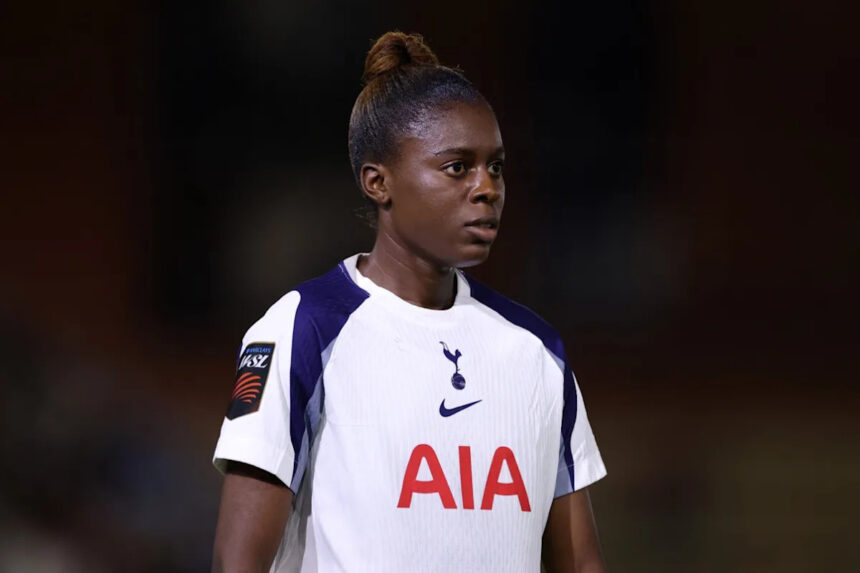
Tottenham and England’s Jessica Naz Struck by Devastating Second ACL Injury
The cruel, unwelcome specter that haunts women’s football has returned, this time casting its long shadow over one of the Women’s Super League’s most dynamic talents. Tottenham Hotspur winger Jessica Naz, a pivotal figure for club and a burgeoning England international, has been ruled out for an estimated six to nine months after suffering a rupture of the anterior cruciate ligament (ACL) in her right knee. The injury, sustained in Sunday’s match against Aston Villa, marks a heartbreaking recurrence for the 23-year-old, who lost an entire season to the same injury in 2019. This is more than a squad setback; it’s a profound personal and professional blow that underscores a persistent crisis within the sport.
A Cruel Twist of Fate: The Moment and The Aftermath
The incident occurred with just 20 minutes remaining in a tightly contested WSL fixture at Brisbane Road. Naz, who had started every league game for Spurs this season, fell awkwardly after a challenge, her right knee bearing the brunt of the landing. The immediate distress was visible. Play was halted as medical staff attended to the stricken winger, who was eventually carried from the pitch on a stretcher, the concerned silence of the crowd speaking volumes. Scans later confirmed the worst fears: a ruptured ACL, requiring surgical intervention and a long, arduous road to recovery.
For manager Martin Ho, the loss is tactical and emotional. Naz had been an integral component of Tottenham’s attacking structure, her pace, direct dribbling, and improved final ball making her a constant threat. Her absence leaves a void not easily filled. “She’s been a key player for us, and to see her go down like that is devastating for everyone connected with the club,” Ho stated in the aftermath. The club has pledged its full support, but the path ahead is dauntingly familiar for the player herself.
History Repeats: The Psychological Mountain of a Second ACL
This diagnosis carries a uniquely heavy weight for Jessica Naz. In 2019, during a pre-season session, she suffered her first ACL injury, which sidelined her for the entirety of the 2019/20 campaign. The mental and physical toll of that rehabilitation—a grueling process of rebuilding strength, mobility, and, most challengingly, confidence—is a journey no athlete wishes to make once, let alone twice.
The psychological battle of a second ACL injury is often cited by sports psychologists as significantly more complex. Athletes must confront:
- Re-traumatization: The immediate fear and frustration of repeating a catastrophic injury.
- Trust in the Reconstructed Knee: Overcoming the subconscious hesitation to push the joint to its limits, a hesitation that can inhibit performance.
- Extended Career Uncertainty: Questions about long-term durability and potential for future setbacks become louder.
Naz’s resilience was proven after her first comeback; she returned to become a WSL regular and earned her first senior England caps in 2023. That same fortitude will be called upon again, but the support system around her—from medical staff to sports psychologists—will be more critical than ever.
An Alarming Epidemic: The ACL Crisis in Women’s Football
Naz’s injury, while a personal tragedy, is not an isolated incident. It is a data point in a disturbing and persistent trend. The past 18 months have seen a staggering list of top female footballers across the globe succumb to ACL injuries, including:
- England stars Beth Mead, Leah Williamson, and Fran Kirby.
- Netherlands’ Vivianne Miedema and Lieke Martens.
- Spain’s Alexia Putellas and Caroline Graham Hansen.
- A host of WSL talents from various clubs.
This epidemic has forced the sport to confront uncomfortable questions. Why is the ACL injury rate in female athletes significantly higher—sometimes reported as 2-8 times higher—than in their male counterparts? The consensus points to a multifaceted web of factors:
- Anatomical and Hormonal Differences: Wider pelvises altering knee alignment, ligament size, and the potential influence of the menstrual cycle on ligament laxity.
- Sport-Specific Biomechanics: Differences in landing, cutting, and deceleration patterns observed in some female athletes.
- Historical Underinvestment: A legacy of less access to the same level of year-round, specialized strength and conditioning coaching during formative years compared to men’s football.
- The Fixture Congestion: An increasingly packed calendar with minimal off-season, offering less time for foundational physical preparation.
Researchers, clubs, and governing bodies are now scrambling for solutions, from tailored neuromuscular training programs to deeper research into hormonal cycle monitoring. The injury to Jessica Naz is another urgent call to action.
Looking Ahead: Implications for Tottenham and England
In the immediate term, Martin Ho must find a new formula. The loss of Jessica Naz’s direct attacking threat forces a tactical reshuffle. Does he promote from within, giving opportunities to emerging talents, or does he look to the transfer market? Spurs’ ambitions for a top-four finish have undoubtedly been complicated, testing the squad’s depth and resilience.
For England, the picture is equally concerning. Sarina Wiegman’s Lionesses, already navigating the returns of Mead and Williamson from their own ACL recoveries, now see another potential weapon for Euro 2025 qualifying and beyond sidelined. Naz was part of the recent squad and represented the exciting, next-generation depth Wiegman has been cultivating. Her race against time to be fit for major tournaments is now a secondary concern to her overall health and long-term career prospects.
Predictions for the road ahead are fraught with caution. A best-case scenario would see Naz return for the tail end of the 2024/25 WSL season. However, the primary focus must be on a recovery that is not rushed, but comprehensive—addressing both the physical reconstruction and the mental readiness to compete at the elite level once more.
Conclusion: A Test of Resilience and a Call for Change
The image of Jessica Naz leaving the Brisbane Road pitch is a somber one, symbolizing both individual heartbreak and a collective challenge for the sport. Her journey back will be followed with empathy and hope by fans, teammates, and rivals alike. Her proven character suggests she will meet this challenge with fierce determination.
Yet, her story must become more than an inspirational comeback narrative. It must serve as another catalyst for meaningful, accelerated change. The ACL injury crisis in women’s football demands greater investment in preventive research, specialized medical and conditioning support tailored to female athletes, and a thoughtful examination of the demands placed upon them. The talent and popularity of the women’s game are soaring; the infrastructure and scientific understanding must rise to meet it, to protect its brightest stars like Jessica Naz from this all-too-common fate.
Source: Based on news from Yahoo Sports.