Troublesome Toe Forces McIlroy to Halt US PGA Practice: Will a DIY Surgery Derail His Major Momentum?
PHILADELPHIA — The pursuit of back-to-back major championships is a grueling endeavor, testing every fiber of a golfer’s physical and mental resilience. But for Rory McIlroy, the challenge at the 105th US PGA Championship has taken an unexpected, and frankly, bizarre detour. The world number three was forced to abandon a practice round at Aronimink Golf Club after only three holes on Tuesday, his preparation for the season’s second major thrown into disarray by a troublesome right little toe.
The Masters champion, who arrived at the Donald Ross-designed layout in Pennsylvania hoping to build on his stunning victory at Augusta National, walked off the course visibly uncomfortable. The culprit? A self-administered surgery that would make even the most hardened medical professional wince. Just hours after revealing he had removed his own toenail in a hotel bathroom, McIlroy’s foot rebelled, threatening to overshadow his bid for a fifth major title.
This is not the script anyone wrote for McIlroy’s attempt to join the elite ranks of golfers who have won consecutive majors. The US PGA Championship starts on Thursday, and the Northern Irishman’s camp is now in damage control, scrambling to ensure a minor podiatric issue doesn’t become a major headline.
The DIY Surgery: How a Shower Became an Operating Room
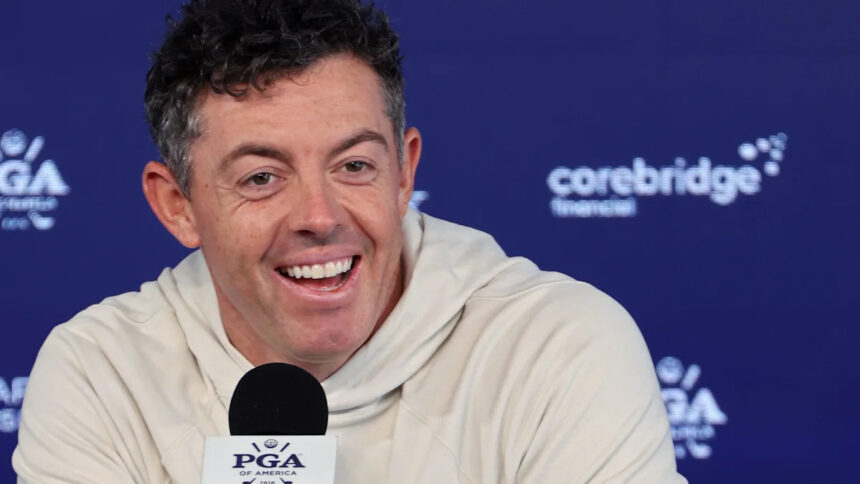
The saga began with a mundane annoyance. During his pre-tournament press conference, McIlroy, 34, was in high spirits, discussing the nuances of Aronimink’s tricky greens and the weight of expectation following his Masters triumph. But the conversation took a sharp turn when he was asked about his health.
“I had a little issue with my right foot,” McIlroy confessed, a wry smile spreading across his face. “My little toe has been bothering me for a while. The nail was getting ingrown.” What followed was a tale of DIY determination that has since gone viral. “I softened it up in the shower and just ripped it off,” he said, laughing. To prove the point, he removed his sock and shoe, displaying the raw, nail-less digit to a handful of stunned reporters.
While McIlroy treated the moment as a lighthearted anecdote, the consequences were immediate and physical. The Masters champion had planned to play nine holes of practice on Tuesday afternoon, having already completed an earlier scouting trip. But the exposed nail bed—highly sensitive and vulnerable—could not withstand the pressure of a modern golf swing.
“It’s just raw,” McIlroy admitted later. “I thought I’d be fine, but as soon as I started walking and putting weight on it, the friction was too much.” The decision to halt the practice round was not taken lightly. For a player of McIlroy’s caliber, every moment of preparation on a new course is precious. Aronimink, hosting its first major since 1962, demands precision. Walking off after three holes was a significant red flag.
Expert Analysis: The Mechanics of a Toe-Induced Breakdown
To the casual observer, a missing toenail might seem trivial. But in the high-stakes world of professional golf, the feet are the foundation of every swing. Golf biomechanics relies heavily on ground reaction forces. The right foot, in particular, plays a critical role in a right-handed player like McIlroy.
“The right foot is the anchor in the backswing and the driver of rotation in the downswing,” explains Dr. Mark Phillips, a sports podiatrist who has worked with multiple Tour players. “If the little toe is compromised, the body instinctively alters its weight distribution to avoid pain. This can lead to a cascade of compensations—a sway, a slide, or a loss of balance at impact.”
McIlroy was seen limping on the third hole of his practice round. According to a report from Golf Digest, at one point he stopped and removed his shoe entirely, shaking his head in frustration. The visual was jarring: the world’s most dynamic ball-striker, reduced to hobbling on a practice tee.
- Weight Shift Disruption: McIlroy generates enormous power through lateral movement. Any foot pain can shorten his shift, leading to a loss of speed.
- Balance at Impact: The little toe provides fine motor control for stability. Without it, the body may “grab” the ground with the larger toes, altering spine angle.
- Walking Fatigue: Aronimink is a demanding walk. Over 72 holes, a sore toe can cause a limp that tires the entire kinetic chain.
The immediate solution? McIlroy admitted he would need to go up half a size on his golf shoes for the tournament. This is a tactical adjustment, but not without its own risks. A shoe that is too loose can cause blisters or heel slippage, while a shoe that is too tight will aggravate the exposed nail bed. It is a delicate balancing act that his equipment team will be working on until the first tee shot on Thursday.
Predictions: Can McIlroy Overcome the Toe Turmoil?
The question now is not whether McIlroy has the game to win—his Masters performance was a masterclass in resilience and shot-making—but whether he can manage the physical distraction. History offers mixed signals.
We have seen golfers play through extraordinary pain. Tiger Woods won the 2008 US Open on a broken leg. Ben Hogan survived a near-fatal car crash. But a raw, exposed nail bed on the little toe presents a unique challenge: it is a constant, low-level irritation that never stops, even when standing still. It is the golf equivalent of a pebble in your shoe that you cannot remove.
“The mental toll is the biggest factor,” says former European Tour pro and analyst James Kingston. “Rory is a rhythm player. He needs to feel ‘flow.’ If every swing is accompanied by a twinge of pain, it breaks that rhythm. He’ll be thinking about his foot, not the shot.”
However, McIlroy has a history of thriving under adversity. His victory at the 2023 Genesis Scottish Open came after he battled a neck issue. His Masters win followed a year of near-misses and public scrutiny. The Northern Irishman is at his best when his back is against the wall.
Prediction for the US PGA Championship:
McIlroy will not withdraw. He is too competitive, and the chance to win back-to-back majors is too historic. Expect him to manage the pain with a combination of larger shoes, extra padding, and painkillers. However, the practice disruption is a real blow. He lost valuable time learning the subtleties of Aronimink’s Donald Ross greens, which are notoriously difficult to read.
I predict a slow start. McIlroy may struggle to find his rhythm on Thursday, perhaps shooting an even-par 70. But if he can get through the first 18 holes without the toe becoming a catastrophic issue, his class will likely shine through. A top-5 finish is still a strong possibility, but a victory might require a miracle of willpower over biology.
Strong Conclusion: A Test of Grit in the City of Brotherly Love
Philadelphia is known for its tough, blue-collar ethos. The fans at Aronimink will respect a fighter. Rory McIlroy is exactly that. He did not win the Masters by accident; he won it by grinding out pars when his swing was shaky and by trusting his process. The “troublesome toe” is now the latest obstacle in a career defined by overcoming them.
Will the DIY surgery become a legendary footnote in a fifth major victory? Or will it be the reason a promising campaign unravels before our eyes? The answer lies in how McIlroy manages the next 48 hours. The US PGA Championship is a test of the complete golfer—and right now, that test starts from the ground up.
For the golf world, the story has shifted. We are no longer just analyzing his swing path or his putting stroke. We are watching how a man walks, how he winces, and how he adapts. Rory McIlroy has silenced critics before. Now, he must silence a screaming nerve ending in his right foot. If he can do that, Aronimink might just become the stage for his most improbable triumph yet.
Source: Based on news from Yahoo Sports.