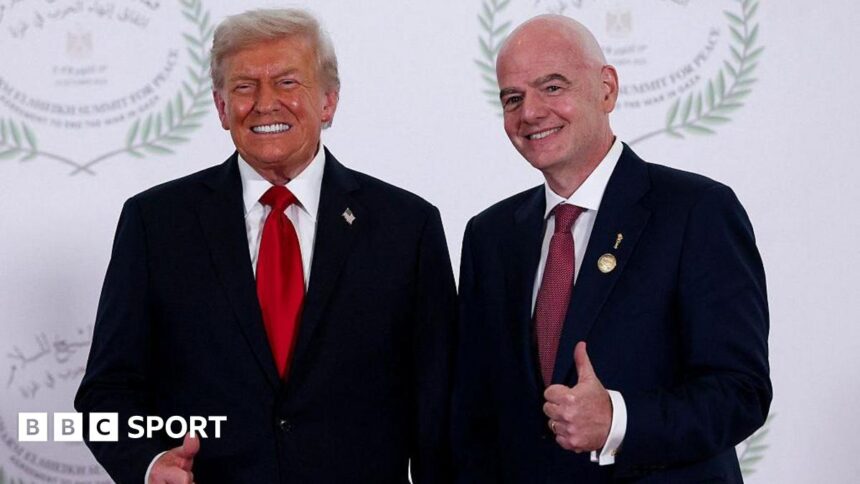
Trump and Infantino: A World Cup Draw Steeped in Political Theater
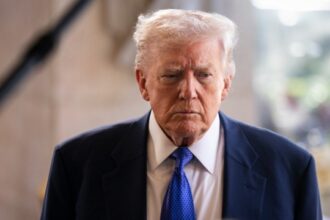
The World Cup draw is traditionally a night of pure footballing anticipation. A global audience tunes in to see which nations will clash in the group stages, a ceremony of shiny balls and sporting fate. But when the 2026 FIFA World Cup draw unfolds this Friday at Washington D.C.’s Kennedy Center, the most compelling narrative won’t be about Portugal’s path or Argentina’s group. It will center on the two men seated in the front row: former U.S. President Donald Trump and FIFA President Gianni Infantino. Their proximity, both physical and philosophical, raises urgent questions about the uncomfortable, and perhaps dangerous, merging of geopolitics, personal ambition, and the world’s most popular sport.
A Stage Set for More Than Football
The venue itself is the first clue that this is no ordinary football event. The Kennedy Center, a hallowed American cultural institution, sits just a mile from the White House. In a move that drew significant controversy, President Trump overhauled its board of trustees earlier this year, installing loyalists and effectively bringing the venue under his political influence. That the most consequential draw in football history is being held here, under his symbolic chairmanship, is a masterstroke of political stagecraft.
This is not a coincidence. The ceremony has been meticulously planned with its most famous attendee in mind. The presence of co-host leaders—Mexico’s President Claudia Sheinbaum and Canada’s Prime Minister Mark Carney—adds a veneer of diplomatic normality. But the spotlight will be unshakably fixed on Trump and Infantino. Their alliance represents a potent fusion of interests:
- For Trump, it is a commanding return to the global stage during an election cycle, associating his brand with a celebration of American grandeur and organizational prowess.
- For Infantino, it is the ultimate validation of his North American project and a powerful alliance with a figure who embodies the “commercial partner” model Infantino has long sought for FIFA.
The message is clear: the 2026 World Cup is as much a political and commercial enterprise as it is a sporting one.
The Unlikely Alliance: Pragmatism Over Principle
To understand the depth of this relationship, one must look past traditional sports governance. Gianni Infantino’s presidency has been defined by expansion and commercial aggression—more teams, more tournaments, more revenue. He operates in the realm of realpolitik, seeking partnerships with nations and leaders who can deliver infrastructure, stability, and financial growth, often sidelining concerns over human rights or democratic norms.
Donald Trump, a former sports property owner himself, operates on a similar wavelength: deal-making, spectacle, and the projection of power. Their bond was solidified in 2022 when Trump attended the World Cup final in Qatar, a tournament mired in controversy over migrant worker rights and LGBTQ+ freedoms. His presence there was a tacit endorsement of Infantino’s “don’t focus on the politics” mantra. In return, Trump receives the legitimacy and global audience that only an event like the World Cup can provide.
This symbiosis is fraught with ethical peril. FIFA, still recovering from the corruption scandals of the 2010s, has pledged transparency and reform. Aligning so visibly with a deeply polarizing political figure engaged in a fierce domestic battle risks:
- Politicizing the tournament itself, alienating a significant portion of the American and global public.
- Undermining FIFA’s stated commitments to inclusivity and non-discrimination.
- Creating a perception that the 2026 World Cup is a “Trump project,” which could complicate logistics and public support should the political landscape shift.
The 2026 Tournament: Predictions for a Politicized Spectacle
The draw is merely the opening act. The real test will come in 2026. Based on the current trajectory, we can anticipate several key developments that will extend far beyond the pitch.
First, the narrative will be relentlessly commercial and nationalistic. Expect framing around “the biggest World Cup ever” to be intertwined with “American greatness.” Trump, if involved in any capacity, will leverage the event’s success as proof of his executive prowess. The line between tournament organizer and political campaign will be dangerously thin.
Second, security and protest will be defining themes. The event will be a magnet for demonstrations on a range of issues, from immigration policy to global conflicts. The security apparatus will be immense, potentially creating a fortress-like atmosphere around stadiums. How host cities manage dissent will be a major story.
Third, the “sportswashing” critique will reach a fever pitch. Critics will argue that both men are using the beautiful game to launder their images: Trump, his political standing; Infantino, his controversial governance model. The world’s media will scrutinize every handshake and shared laugh for its symbolic weight.
Ultimately, the football will be spectacular. The first 48-team World Cup, across three nations, promises incredible matches. But the shadow over the tournament is now unmistakable and self-inflicted.
A Dangerous Game for the Soul of Football
The fundamental question posed by Friday’s draw is this: who does the World Cup belong to? Is it a global festival for fans of all creeds and colors, governed with at least a nod to ethical stewardship? Or is it merely a lucrative platform, a geopolitical tool to be co-opted by the highest bidder or the most powerful ally?
The Trump-Infantino alliance suggests FIFA’s leadership has chosen the latter path. This is a gamble with the soul of the sport. By embracing a figure of profound division, Infantino is not just navigating politics—he is actively choosing a side. He is betting that the commercial and logistical benefits of this alliance outweigh the costs to FIFA’s reputation and the alienation of millions of fans who see football as an escape from, not an amplifier of, partisan strife.
As the balls are drawn and the groups are formed this Friday, watch the audience more than the stage. The proximity of Trump and Infantino is not just a photo opportunity; it is a symbol of a new, uncomfortable era for world football. The 2026 World Cup may be hosted by three nations, but its story is being written by two men in Washington, and their partnership threatens to redefine what the World Cup means for a generation. The beautiful game has always existed in the real world, but it has rarely felt so much like a political pawn.
Source: Based on news from BBC Sport.
Image: Source – Original Article