Trump’s World Cup Indifference: A Political Statement That Overshadows FIFA’s ‘Peace Prize’
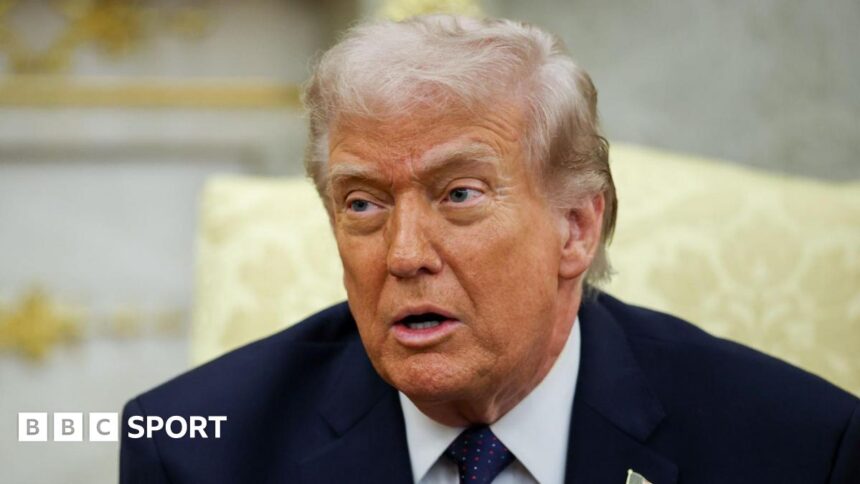
In a stunning collision of global sports diplomacy and high-stakes geopolitics, former U.S. President Donald Trump has declared he “does not care” if Iran participates in the 2026 FIFA World Cup, a tournament the United States is co-hosting. This blunt dismissal, delivered to Politico, arrives against a backdrop of escalating military strikes between the U.S., its allies, and Iran, casting a long, dark shadow over what was meant to be a celebratory moment for FIFA. The organization had just weeks earlier presented Trump with its inaugural ‘FIFA Peace Prize’ at the 2026 draw ceremony, a decision already mired in controversy. Now, Trump’s comments have ripped open the delicate veneer of sports unity, exposing the raw political nerves that the beautiful game is often forced to navigate.
The Jarring Juxtaposition: A Peace Prize and a Provocation
The sequence of events reads like a geopolitical satire. In December, at a glittering ceremony for the 2026 World Cup draw, FIFA took the unprecedented step of awarding its first-ever ‘Peace Prize’ to Donald Trump. The honor, reportedly for “historic diplomatic achievements” in the Middle East through the Abraham Accords, was met with immediate and fierce criticism from human rights groups and football purists who argued it politicized the sport’s highest governing body. Fast forward to a tense spring marked by open conflict, and the recipient of that peace award is openly expressing indifference toward a nation’s participation in the very tournament he helped secure.
This creates a profound contradiction. FIFA’s core statutes vehemently advocate for neutrality and the use of football as a tool for bridging political divides. By awarding Trump, FIFA aligned itself, however symbolically, with a specific political legacy. Trump’s subsequent comments on Iran, a nation with a passionate football culture and a team ranked among Asia’s best, demonstrate how easily that legacy can be invoked in a manner diametrically opposed to FIFA’s stated ideals. The ‘Peace Prize’ now looks less like an endorsement of unity and more like a political trophy, its meaning instantly diluted by the laureate’s own words.
Beyond the Headline: The Tangible Implications for 2026
Trump’s statement “I really don’t care” is not merely a throwaway line. It is a political signal with potential operational, security, and sporting repercussions for the 2026 World Cup, the largest ever with 48 teams.
- Visa and Entry Logistical Nightmare: Iranian players, staff, and thousands of passionate fans would require entry into the United States. A sitting or future administration influenced by this rhetoric could enact stringent vetting processes, creating delays, denials, and a climate of intimidation. The fundamental principle of guaranteed team participation could be threatened.
- Unprecedented Security Challenges: Hosting Iran during a period of overt hostility would require a security apparatus of monumental scale and cost. Protests, both for and against the Iranian regime, would be inevitable at match venues and team hotels, straining local law enforcement and potentially creating flashpoints.
- Player and Fan Safety Concerns: The well-being of Iranian athletes and supporters would be paramount. They could become targets for harassment or worse, turning what should be a career-defining sporting event into a stressful, potentially dangerous ordeal.
- The Specter of Boycott: Iran’s football federation, or even the Iranian government itself, could pre-emptively boycott the tournament if they deem the environment hostile or unsafe, depriving the competition of a top Asian side and its fans.
This moves the conversation from abstract political posturing into the realm of practical tournament execution. FIFA, U.S. Soccer, and local organizing committees are likely already running crisis scenarios on this exact issue.
Expert Analysis: Football as the Unwitting Political Arena
“This is the ultimate test of FIFA’s often-repeated mantra that football and politics do not mix,” says Dr. Anya Petrova, a professor of sport and geopolitics. “In reality, they are inseparable. A World Cup is the single largest global event outside of war. It is inherently political. Trump’s comments are not a gaffe; they are a calculated reminder that for powerful states, sport is an extension of foreign policy.”
Petrova points to the historical precedent of sports being used as a battleground. “We saw it with the U.S.-led boycott of the 1980 Moscow Olympics and the Soviet retaliation in 1984. What’s different here is the overt indifference. It’s not an active boycott, but a statement of apathy that questions Iran’s very place on the global stage. For the Iranian players, who are citizens with immense national pride, this is a profound insult that transcends politics.”
The analysis underscores that the 2026 World Cup integrity is at stake. The tournament’s success is predicated on the smooth participation of all qualified nations. When a co-hosting nation’s most prominent political figure expresses dismissiveness toward one of those competitors, it undermines the entire spirit of the event FIFA is contractually obligated to protect.
Predictions: Navigating the Storm to 2026
The path to the 2026 kick-off is now fraught with diplomatic landmines. Several likely scenarios could unfold:
- FIFA’s Quiet Diplomacy: Behind the scenes, FIFA will exert immense pressure on the U.S. government, regardless of administration, to guarantee full cooperation for all qualified nations. They will cite binding host country agreements and the immense financial and reputational risk of a politicized tournament.
- The “Bubble” Solution: Iran’s team may be forced to operate in a heightened security “bubble,” with restricted movement and heavily policed fan zones, creating a segregated and tense experience that contradicts the festival atmosphere of a World Cup.
- A Litmus Test for U.S. Foreign Policy: The treatment of the Iranian national team will become a global barometer for the state of U.S.-Iran relations in 2026. It will be a live, televised diplomacy that no speech or UN resolution could match in public perception.
- Legacy Damage for FIFA: The decision to award Trump the Peace Prize will be revisited incessantly in the lead-up to the tournament. It may be seen as a catastrophic misstep that compromised FIFA’s neutrality and helped enable the current crisis.
The most probable outcome is a tense, heavily managed participation for Iran, filled with symbolic protests and a media frenzy that often overshadows the football itself.
Conclusion: When Indifference Speaks Louder Than Words
Donald Trump’s stated indifference to Iran’s World Cup participation is a masterclass in political power play. It uses the platform of the world’s most-watched sporting event to send a message of marginalization without the diplomatic cost of an official ban. It forces FIFA, an organization with a notoriously fragile moral compass, into an impossible position: defend the sporting rights of a nation in conflict with its prize-winning host, or risk becoming seen as a pawn in a wider geopolitical game.
The 2026 World Cup was envisioned as a celebration of football’s growth in North America. Instead, a shadow has been cast. The tournament now faces the grim prospect of having its narrative dominated not by the magic of the pitch, but by the tensions off it. The beautiful game promises a temporary escape from the world’s problems, but as Trump’s comments have proven, the world’s problems have a relentless habit of invading the game. The true test for 2026 will not be who lifts the trophy, but whether the fundamental principle of peaceful sporting competition can survive the weight of a peace prize gone wrong.
Source: Based on news from BBC Sport.